
June 12, 2023
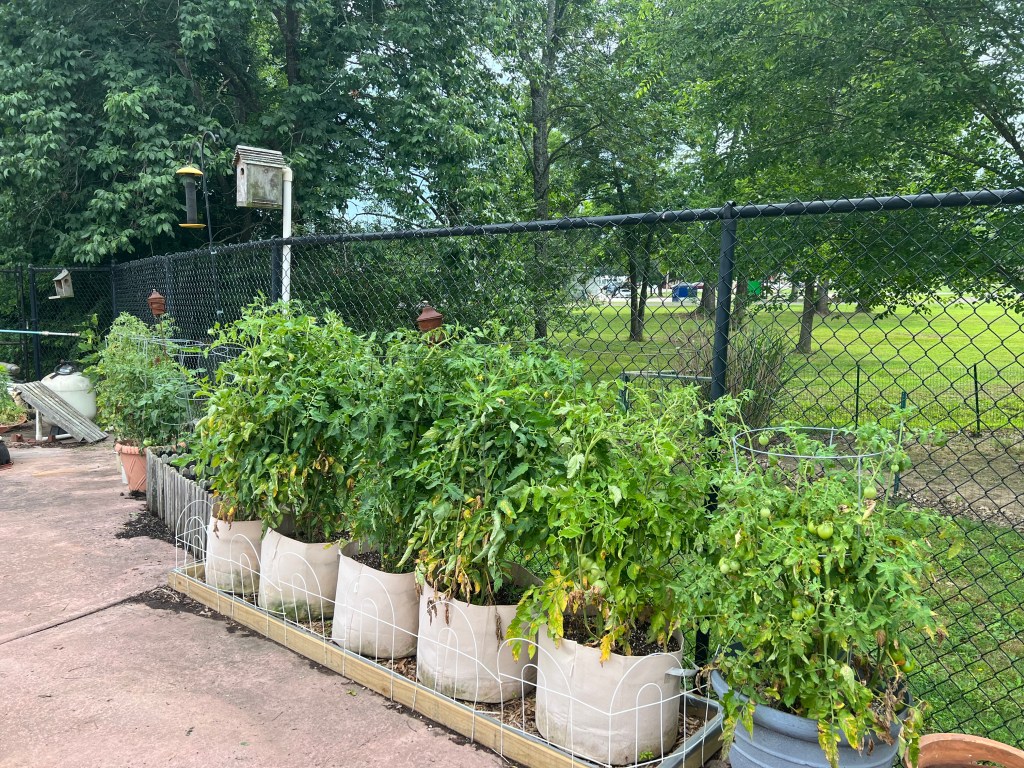
Last summer I blogged on the sparse fruit produced by the tomatoes and peppers in my container garden. My only comfort was everyone in my Arkansas Gardeners group had the same complaint. It was a bad year for gardens in Arkansas. I ended up with several handfuls of garden fruits. This year I added grow bags to my containers. Despite getting the plants into the ground late and ignoring them for two weeks while I was in Kansas, the tomato plants have taken off and now I am having the opposite problem. The foliage and green tomatoes are combining with the wind and rain (wet soil) to cause the plants to tip over in their cages. I battled one of the cages earlier this week but this morning all nine of the cages were either tipping or toppled. I attached the top of each cage to the chain link fence they sit in front of to give them more stability. While I was at it, I harvested two jalapenos and a dozen super sweets. The season is just starting, and I already have nearly as much fruit as last year.
When I went online, I found the wild ancestor (Solanum pimpinellifolium) of the modern tomato is native to Mexico and western South America. Modern tomatoes are all varieties of the cultivated plant (Solanum lycopersicum). The name comes from the Nahuatl (Aztec) word “tomatl”, which gave rise to the Spanish word “tomate”, and in English became “tomato”. Tomato plants typically grow anywhere from 3 to 10 feet (1 to 3 m) in height. The plants are vines and typically have a weak stem that sprawls unless it is supported (like mine). There are two types of tomatoes. The indeterminate tomato plants are perennials in their native habitat and produce fruit throughout the growing season. In cultivation they are treated as annuals and are replanted every year. The other type of tomatoes are determinate (bush) plants that are true annuals. They stop growing at a certain height and produce their crop all at once. I have indeterminates and am hoping to have a lot of fruit throughout the summer.
The oldest surviving depiction of tomato fruit and leaves (Solanum lycopersicum var. lycopersicum) comes from a page from the En Tibi Herbarium (1558). En Tibi herbarium is short for En tibi perpetuis ridentem floribus hortum (Here for you a smiling garden of everlasting flowers) which is a 16th century herbarium. This book contains 473 dried plant specimens, belonging to 455 species and subspecies and 97 families, and is one of the largest and oldest known of its kind. An herbarium is a collection of preserved plant specimens and associated data used for scientific study. The specimens may be whole plants or plant parts which are usually dried and mounted on a sheet of paper but may also be stored in boxes or kept in alcohol or other preservatives. The specimens are often used as reference material in describing plant taxa. The 16 3/4 by 11 1/2 inch (42 by 29 cm) En Tibi Herbarium features a fine leather binding, blind and gold embossed ornamentation, along with gilt and gauffered page edges and was owned by the Emperor of Habsburg, Rudolph II in the 1500’s. The book is currently held in the treasure room of the Naturalis Biodiversity Center in Leiden.
Thoughts: The Spanish saw the tomato used in cooking by the Aztecs and brought the plant to Europe. Botanists in France, Italy, and northern Europe saw the tomato as a relative of the deadly belladonna nightshade (Atropa belladonna). The tomato’s reputation got worse as its acidic juice interacted with the pewter plates. The tomato was later deemed safe and during the 16th century went along with European colonization to other parts of the world. The tomato met with suspicion for its looks and association, but when people got to know it, the fruit became a staple. Humans often mistrust new or different things (and people) and make assumptions without taking the time to know them. We need to treat people by their fruit rather than our impression. Like the tomato, everyone deserves a chance. Act for all. Change is coming and it starts with you.
 A travelers odyssey