
June 16, 2023
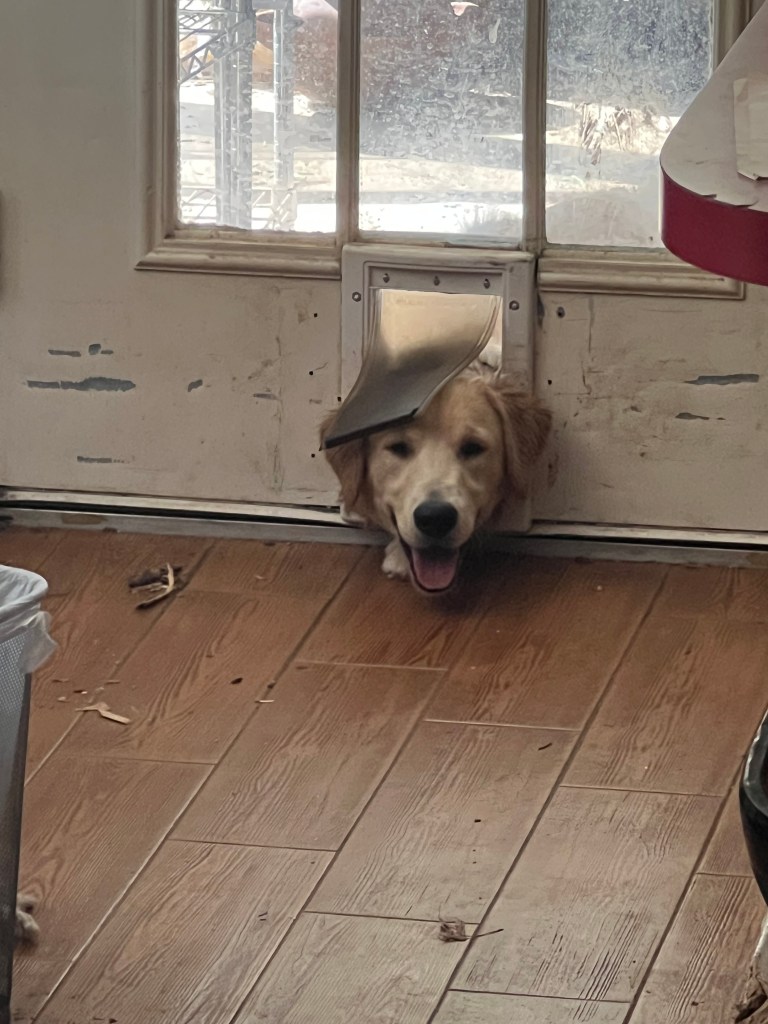
Melissa called me over last week to see the new habit Loki has learned when he wants to get back inside the house. When Melissa originally lived in the house, she shared it with four cats and a small dog (and parents). The door leading outside from the kitchen had a small door with a vinal flap that allowed the cats to come in or go outside whenever they wanted. The cats did not make the move with Melissa to Kansas and were gone by the time we returned 10 years later. Our sheltie was too big for the door and Bella never tried to squeeze through the small hole. When we acquired Zena, she was too large for the hole as a small puppy, and now at 80 pounds has never attempted to squeeze through. Although Loki is also too big to use this as an access, that does not keep him from sticking his head and front paws through the door to make sure we know he wants inside.
When I went online, I found a pet door or pet flap (also referred to specifically as cat/kitty door/flap, dog/doggy door/flap) is a small opening to allow pets access in and out of a building without needing a human to open the door. These entrances were originally simple holes, but the modern form is a hinged and often spring-loaded panel or flexible flap, and some are even electronically controlled. The modern versions offer a degree of protection against wind, rain, and larger-bodied intruders from getting access to the dwelling. A pet door is a convenience for owners of companion animals because it allows the pets to come and go as they please and reduces the need for pet-owners to manually let the pet in or take them outside. This also curtails unwanted behavior like barking to be let in/out, scratching on doors or walls, and excreting in the house. The door also helps ensure a pet left outdoors can safely get back into the house in case of bad weather. Our access door is on the screened porch that leads to the kitchen, so Loki is already safe, he merely wants inside.
The Oxford English Dictionary records the first use of the phrase “cat flap” in 1957 and “cat door” in 1959, but the idea is much older. In rural areas, cat doors (often simple holes) in the walls, doors, or even roofs of grain and flour storage spaces have long been used to allow feral cats to hunt rodents that feed on the grain. Semi-domestication of wildcats by human’s dates to at least 7,500 BCE in Cyprus, and the domestic cat was a part of everyday life in ancient Egypt from 6,000 BCE on. In modern times, the pest reduction function is mostly lost, but farm cat doors and holes are still common in rural areas like Valencia, Spain (called gateras), and Vaunage, France (called chatières). In an example of early urban legend, the invention of the pet access door was attributed to Isaac Newton (1642–1727) in a story saying Newton made a large hole for his adult cat and a small one for her kittens, not realizing the kittens could use the large hole. Newton biographers cite passages saying Newton never kept a dog or cat in his chambers, but over 60 years earlier this story was related by J. M. F. Wright in his 1827 memoir. Wright adds “Whether this account be true or false . . . there are in the door to this day two plugged holes of the proper dimensions for the respective egresses of cat and kitten.”
Thoughts: I have considered replacing our back door with one that has larger access and have found doors online that allow for dogs as big as Loki and Zena. This would save Melissa from opening and closing the door dozens of times a day as she works in her kitchen office and the dogs want/need access in and out. What stops me is knowing the large access would allow everything else (including a human) into our house. Newton’s example suggests intelligence is not the same as common sense. If Newton did make the access holes, I am sure teasing by his friends caused them to be plugged. Having access to something does not mean it is ours to use without regard for others. Act for all. Change is coming and it starts with you.
 A travelers odyssey