
June 17, 2023
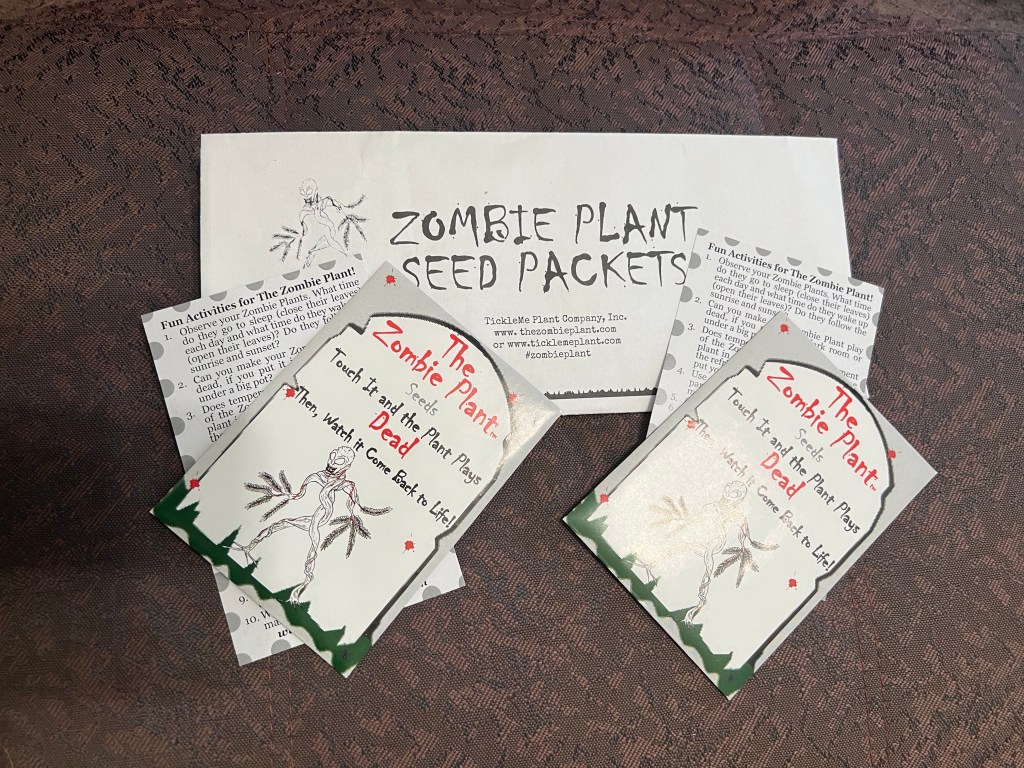
I received an email from the delivery service that the Father’s Day gift sent from my son and his family had been delivered. During the pandemic the delivery people stopped ringing your doorbell and now just place the package in some (hopefully) unobvious place on your porch. An e-mail is sent when the item is placed and hopefully you will be able to retrieve it before the porch pirates know it is there. When I went out to retrieve my package, I noticed there were two deliveries rather than just one. I decided to open the smaller package first. It was the three pair of socks I had asked Melissa to order for me. The second package was flat and about 2 1/2 feet (0.76 m) square. I carefully slit the tape and emptied the contents onto the counter. It turned out there were several different items in the box. There was a low sling chair to sit on while I work my garden, a gardening bag along with several tools to help with the work, and an envelope containing two packets identified as zombie plant seeds.
When I went online, I found a zombie plant (Mimosa pudica), also called sensitive plant, sleepy plant, action plant, touch-me-not, or shameplant, is a creeping annual or perennial flowering plant of the pea/legume family Fabaceae. The name is derived from the Latin pudica, meaning ‘shy, bashful, or shrinking’. The species is native to the Caribbean and South and Central America but is now distributed as a weed throughout the tropics in the Southern US, South Asia, East Asia, Micronesia, Australia, and South and West Africa. The Zombie is not shade-tolerant and is primarily found on soils with low nutrient concentrations. Like several other plant species, pudica undergoes changes in leaf orientation termed nyctinastic movement (sleep). The foliage closes during darkness and reopens in light. This was first studied by French scientist Jean-Jacques d’Ortous de Mairan. Because of the plants’ unique response to touch, it became an ideal plant for experiments regarding plant habituation and memory. In the UK the zombie plant has gained the Royal Horticultural Society’s Award of Garden Merit.
Zombie plants produce pale pink or purple flower heads beginning in mid-summer with more flowers as the plant gets older. A single flower survives for less than a day, and usually dies completely by the next day. The flowers are very brittle and soft. The globose to ovoid heads are 0.3 to 0.4 inches (8 to 10 mm) in diameter. The floret petals are red in their upper part and the filaments are pink to lavender. The color and shape of the flowers have led many to call them the “brains” which are quickly consumed by the zombie. The zombie is not a carnivorous plant like the Venus fly trap. Carnivorous plants derive some or most of their nutrients from trapping and consuming insects, arthropods, or protozoans, and occasionally small mammals and birds. The zombie plant is often grown by gardeners for its curiosity value. The sensitive compound leaves quickly fold inward and droop when touched or shaken (die) and like a zombie, re-open (come back to life) a few minutes later.
Thoughts: The reason two packets of zombie seeds and activity cards were sent was to encourage you to plant one and send the other to a friend. This spreads the fun, along with advertising the company that cultivates them. Humans often ask others for recommendations before making a purchase. With the internet and smart phones many of our recommendations come online. A 2019 report found 63% of consumers between 18 and 34 years said they “trust what influencers say about brands much more than what brands say about themselves.” Academic research has found “seeded” marketing campaigns that leverage “seed agents or microinfluencers to discuss brands with friends and acquaintances” can increase total sales by up to 18% throughout a campaign. We are all “microinfluencers” who pass information (good or bad) to those in your sphere of influence. Make sure what you share is worth hearing. Act for all. Change is coming and it starts with you.
 A travelers odyssey