
June 19, 2023
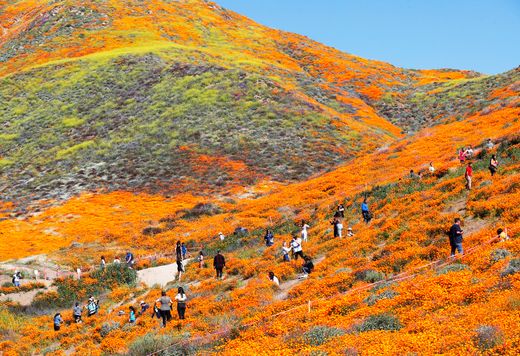
Hidden among the Father’s Day and Juneteenth information in Sunday’s newspaper was an article on the effect last winter’s rains had on the California hillsides. This resulted in an explosion of wild black mustard (Brassica nigra) which now blanket the hills surrounding Los Angeles in bright yellow flowers. As temperatures warm the mustard dies, leaving their dried stalks to act as a tinderbox for wildfires. The invasive plant also crowds out native flowers and can be nearly 4 feet (1.2 m) tall, blocking the burgeoning wildflowers from the sun. Clothing designer Max Kingery is among a growing group of artists, designers, and chefs who are harvesting the invasive plants and turning them into dyes for clothing, works of art, and even in salads and a form of pesto. To get the right hues for the dyes requires a lot of mustard, but in this context that is a good thing. Clearing the plots of the mustard restores the biodiversity while broadening the neighborhoods concept of land care and gets people into seeing themselves as environmentalists. Removing the invaders allows the native wildflowers to enjoy the superbloom that is allowing the mustard to flourish.
When I went online, I found a superbloom is a rare desert botanical phenomenon in California and Arizona where an unusually high proportion of wildflowers blossom at roughly the same time. The term seems to have appeared as a label in the 1990’s. A rare chain of events must happen for a superbloom to occur. The invasive grasses compete with native flowers for moisture so the desert must remain dry enough to keep the grasses from being established. The autumn rain needs to be sufficient to penetrate deep into the soil to reach the dormant seeds of flowering plants. Too much subsequent rain will wash away the young plants, and too little rain will kill them from lack of moisture. The ground then needs to warm slowly over several months following the first soaking rain, and there must be enough cloud cover to shield the soil from the desert heat and insulate the soil from freezing temperatures at night. When the plants reach the surface, the shoots cannot be disturbed or uprooted by strong winds. This is a rare chain of events. A California superbloom occurs about once every ten years, but the persistent drought which affected the state over the last decades has made them even rarer.
In the Mojave Desert of California, common plant species and their colors composing the superbloom are brittlebush (Encelia farinose – yellow), California poppies (Eschscholzia californica – bright orange), bluebells (Phacelia campanularia – deep purple), lupine (Lupinus albus – purple), sand verbena (Abronia villosa – yellow), desert sunflowers (Geraea canescens – bright yellow), evening primrose (Camissonia brevipes – mostly white but occasionally yellow), popcorn flowers (Plagiobothrys rufescens – white or yellow), and desert lily (Hesperocallis undulata – white). Invasive plants also include the wild mustard, and particularly the black mustard that has invaded the hills around Los Angeles. After a unique series of winter storms, outdoor enthusiasts are expecting an unprecedented abundance of flowers this year. Daniel Winkler, a research ecologist with the US Geological Survey said there is no scientific definition for what constitutes a superbloom. “The superbloom is really a cultural phenomenon, where people decide that there are enough flowers here, right now, that we’ll call it a superbloom.” Winkler said.
Thoughts: The black mustard that is flourishing amid the current superbloom originated in North Africa, spread to Europe, and was introduced to the Pacific coast of North America in the 1700’s where it has been found in adobe bricks of the missions. It is now classified as an invasive weed. Invasive plants and animals can predominate as they have no natural predators or deterrents. While the vast fields of yellow look pretty, they exist at the expense of the natural variety of colors they dominate. Act for all. Change is coming and it starts with you.
 A travelers odyssey