
June 20, 2023
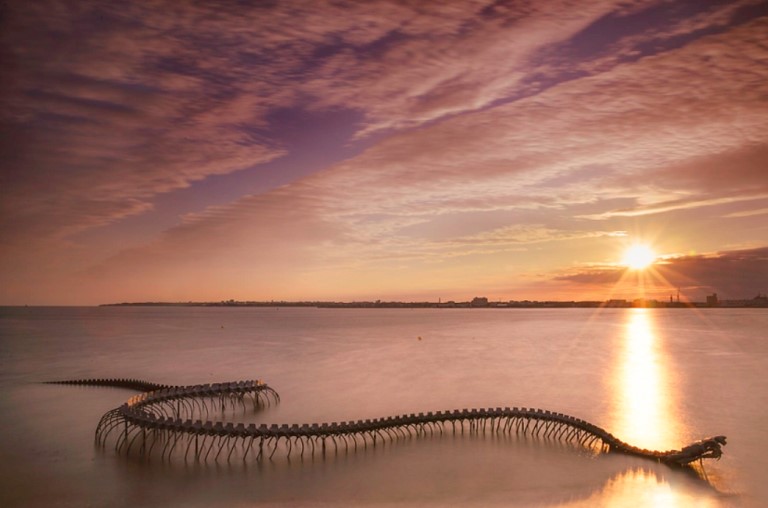
Last Saturday I found a link on Tiffy Taffy to the giant ‘serpent’ that emerges from the sea off the coast of France. This is a 425-foot (129.5 m) sculpture that is repeatedly hidden and revealed by the tides every day in the Loire Estuary. The serpent is located along the Loire estuary and is part of a permanent public art collection that spans the 37-mile-long shore. Made of aluminum, the giant serpent emerges from the water when the tide rolls out as if the ocean is revealing an ancient fossil. The piece was created in 2012 by the French-Chinese contemporary artist Huang Yong Ping and is called Serpent d’océan. Huang created the giant serpent to mimic the nearby Saint Nazaire bridge to blend the piece with the rest of the landscape.
When I went online, I found that sea serpents have a prominent role in myths and legends of most seafaring cultures on Earth and with the reality of the oceans’ biodiversity and the dangers of the sea itself it is not difficult to see why. A sea serpent or sea dragon is a type of sea monster described in various mythologies, including Mesopotamian (Tiamat), Judaeo-Christian (Leviathan), Greek (Cetus, Echidna, Hydra, Scylla), and Norse (Jörmungandr). An apparent eye-witness account is given by Aristotle in his work Historia Animalium on natural history. The Greek historian Strabo makes reference to an eyewitness account of a dead sea creature sighted by Poseidonius on the coast of the northern Levant, reporting, “As for the plains, the first, beginning at the sea, is called Macras, or Macra-Plain. Here, as reported by Poseidonius, was seen the fallen dragon, the corpse of which was about a plethrum [100 feet or 30 m) in length, and so bulky that horsemen standing by it on either side could not see one another, and its jaws were large enough to admit a man on horseback, and each flake of its horny scales exceeded an oblong shield in length.” The creature was reported to have been seen sometime between 130 and 51 BCE. Huang’s serpent mixes myth and reality as more sea giants (past and present) are discovered.
Huang is known for his various art installations that challenged tradition, brought various cultures together, and most prominently commented on humanity itself. Huang created an even bigger serpent in 2016 for his Empires exhibition in the Grand Palais in Paris. This even larger serpent was 787 feet (239.8 m) long and surrounded by 305 shipping containers. Huang intended the piece to start a conversation around world trade. Huang was one of the most well-known artists in China during their avant-garde movement in the 1980’s, and many of his pieces were banned by the Chinese government. He moved to France in 1989 to have more freedom of expression. Much of his work was based on politics and attempting to push them to higher moral ground. He often used animals and insects to depict his views on aspects of human nature. Huang liked to use art to address the topic of identity and cultural mixing and he did this using various animals and Chinese mythological creatures and adding them to the European art scene and landscape. Huang died from a brain hemorrhage on October 19, 2019, at the age of 65. As the giant serpent in the Loire estuary shows, the tide rolls in and out, long after your life is over.
Thoughts: While I did not see the Serpent, when I visited the Musee d’Orsay in Paris with my sister and brother-in-law they were commenting on the beautiful paintings housed on the upper floor that were well known to them. Frankly, I was not impressed. However, the lower floors contained sculptures and paintings I did find impressive. As Huang stressed, art not only imitates life, but it can also cause us to reflect on the past and strive for a better future. Act for all. Change is coming and it starts with you.
 A travelers odyssey