
June 21, 2023
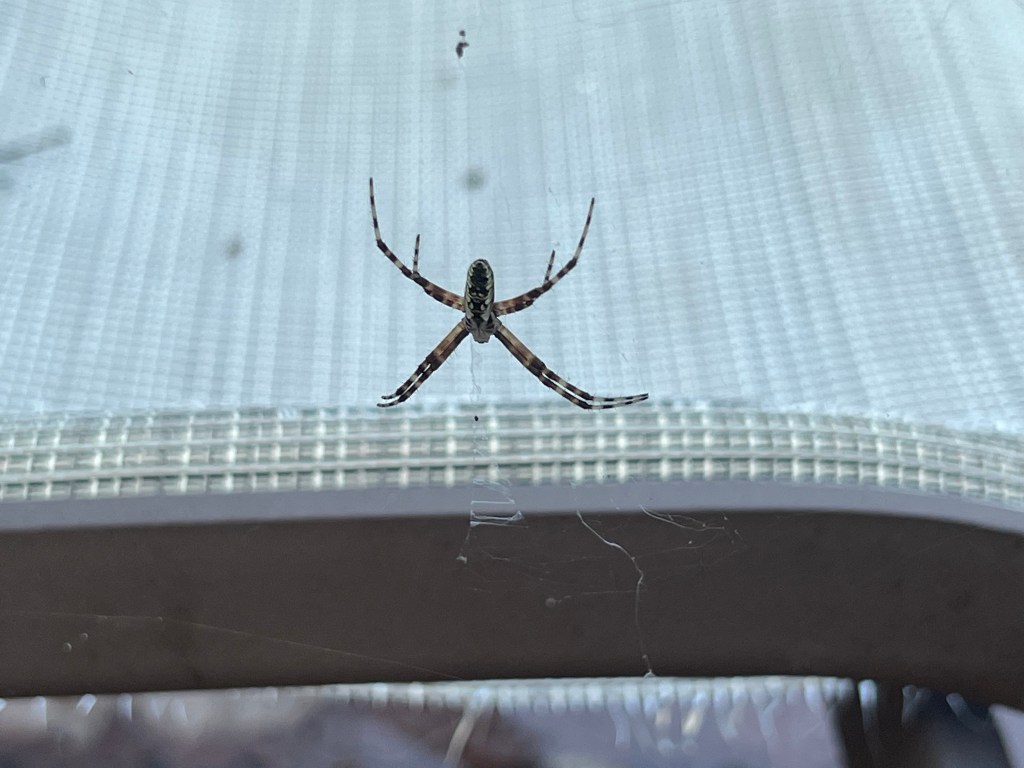
The kids (my dogs) like to go out with me when I water my garden. Zena likes to grab a quick drink from the hose when she can get her mouth close enough and Loki goes crazy when I bring out the hose, hopping and spinning around. Now he pushes Zena out of the way as he franticly tries to bite and lick the constant stream of water. After I watered last night, I sat in one of our pool chairs for a moment to watch the dogs chase each other around the deck. I looked at the other chair and noticed a 1 inch (2.5 cm) spider had built a web across the arm of the chair. I am always intrigued by the spiders who thrive around my garden and decided to take a closer look. It hung motionless in the center of its web and held its legs in four pairs of two. The circular web had a thicker zig-zag thread that ran through the middle. What really caught my eye was the striated markings on the spider’s leges, alternating black and yellow. This appeared to be the yellow garden spider I had blogged about after my sister sent me a picture of one on its huge web at mom’s two years ago.
When I went online, I found the yellow garden spider (Argiope aurantia), also known as the black and yellow garden spider, is common to the contiguous US, Hawaii, southern Canada, Mexico, and Central America. It has distinctive yellow and black markings (hence the name) on the abdomen and a mostly white cephalothorax. Its scientific name translates to “gilded silver-face” (Argiope means “silver-face”, aurantia means “gilded”). The body length of the male ranges from 0.20 to 0.35 inches (5 to 9 mm), while the larger females range from 0.75 to 1.10 inches (19–28 mm). The spiders may bite if disturbed or harassed, but the venom is harmless to non-allergic humans, roughly equivalent to a bumblebee sting in intensity. Yellow garden spiders are orb-weavers and prefer to build their webs in areas adjacent to open sunny fields where they stay concealed and protected from the wind. They can also be found along the eaves of houses and outbuildings or in any tall vegetation where they can securely stretch a web. Female yellow garden spiders tend to be somewhat local, often staying in one place throughout much of their lifetime. The large size of my yellow spider indicated this must have been a female.
Females of the yellow garden spiders are the most common ones seen in gardens. Their webs are usually characterized by a zigzag shaped stabilimentum (an extra thick line of silk) in the middle extending vertically. The spiders spend most of their time in their webs, waiting for prey to become ensnared. When prey becomes caught in the web, the spider may undulate the web back and forth to further trap the insect. When the prey is secure, the spider kills it by injecting its venom and then wraps the prey in a cocoon of silk for later consumption (typically 1 to 4 hours later). Prey includes small vertebrates, such as geckos and green anoles, as well as insects. Two years ago, my sister accidentally bumped into the web and this undulating and shaking of its web was what the spider had done. Luckily my sister is bigger than a gecko and was able to get away.
Thoughts: While female yellow garden spiders grow and molt throughout the summer, the males die shortly after mating, even if they do not become the female’s tasty snack. Offspring usually hatch in late summer or autumn. In cold areas the young spiders may remain dormant in the egg sac during winter and emerge in the spring. Females usually die in the first hard frost after mating but if the temperatures permit, females may live several years. Nature has developed a delicate balance between male and female of a species, as well as between predator and prey, that ensure the best genes are passed to succeeding generations. Humans have used intellect to overcome this balance. We need to use our intellect to preserve the balance nature provides. Act for all. Change is coming and it starts with you.
 A travelers odyssey