
June 26, 2023
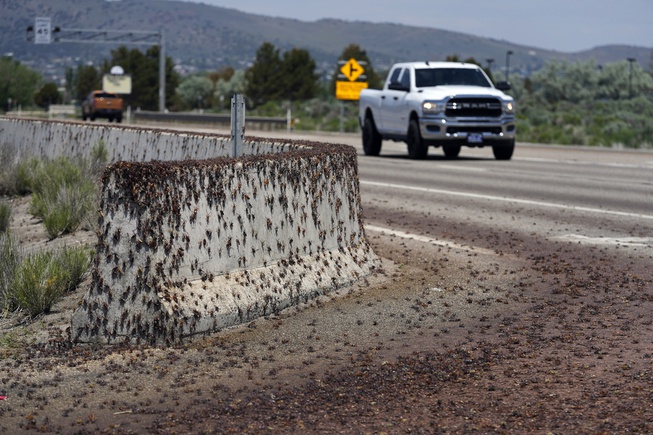
Last Thursday my local newspaper carried an AP story of the blood-red crickets that had invaded a town in north central Nevada. Tens of thousands of Mormon cricket eggs buried about an inch deep in the soil began to hatch in late May and early June. The cricket invasion has especially hit the small town of Elko along Interstate 80. The crickets stick to tires and the bottoms of shoes and their carcasses are everywhere. They blanket highways and scuttle over barriers seeking food. They are crushed under the tires of trucks creating something like a blood-red oil slick. Residents are trying several innovative ways to rid the ground of insects. A local hospital has hired four temporary part-time employees to clear the campus to allow patients to enter the building. Residents use brooms and leaf-blowers to move the live and dead crickets from their lawns and walkways. While the adult crickets only live long enough to mate (males) and lay eggs (females), they continue to hatch in waves from May to early August.
When I went online, I found Mormon crickets (Anabrus simplex) are a large insect native to western North America in rangelands dominated by sagebrush and herbaceous flowering plants like grass, sedge, or rush (forbs). Anabrus is a genus in the shield-backed katydid subfamily in the Tettigoniidae family, commonly called katydids, bush crickets, and previously “long-horned grasshoppers”. Mormon crickets can grow to almost 3 inches (8 cm) in length. Coloration can vary among individuals from black, brown, red, purple, or green. The dorsal “shield” above the prothorax (pronotum) covers vestigial wings, and in some individuals can include colored markings, while the abdomen may also have a striped appearance. Like many Tettigoniidae, females have a long tube-like organ (ovipositor) used to burrow into the earth to insert the eggs, which is sometimes mistaken for a stinger. The high population densities of swarming Mormon crickets cause them to undergo changes in morphology and coloration. Solitary crickets are typically green or purple, while swarming individuals are often black, brown, or red. Although flightless, the Mormon cricket may travel up to 1.2 miles (2 km) a day in its swarming phase. This swarm can become a serious agricultural pest and sometimes a traffic hazard.
While “Mormon cricket” is the common name for this insect, it is a misnomer. True crickets are of the family Gryllidae, while Mormon crickets are of the Tettigoniidae family. Mormon crickets take their common name from the prominent role it played in the “miracle of the gulls”. Later accounts claimed seagulls miraculously saved the crops by eating thousands of insects that were devouring their fields. Traditional accounts report legions of gulls that are native to the Great Salt Lake appeared on June 9, 1848, following fervent prayers by the pioneer farmers. The gulls ate mass quantities of crickets, drank some salt water, regurgitated, and continued eating more crickets over a two-week period. The pioneers saw the gulls’ arrival as a miracle. The traditional story is that the seagulls annihilated the insects, ensuring the survival of the 4,000 Mormon pioneers who had traveled to Utah. A Seagull Monument was erected, and the California gull (Larus californicus) is the state bird of Utah.
Thoughts: The indigenous populations around the Great Salt Lake had a different view of the crickets and often included them in their diet. A friend at the Utah Division of State History did an analysis of the crickets and found if a buffalo fell from the sky already butchered and landed on a spit over a lighted fire to cook itself, there would still be more kilocalories available and less energy expended than eating the crickets that dropped in the lake, were salted by the waters, and then dried as they washed up on the shore. There was plenty of food . . . if you knew where to look. Humans can seek divine intervention to resolve life’s problems. While that does happen, “The Lord helps those who help themselves,” is another adage. We need to do our part as well. Act for all. Change is coming and it starts with you.
 A travelers odyssey