
June 29, 2023
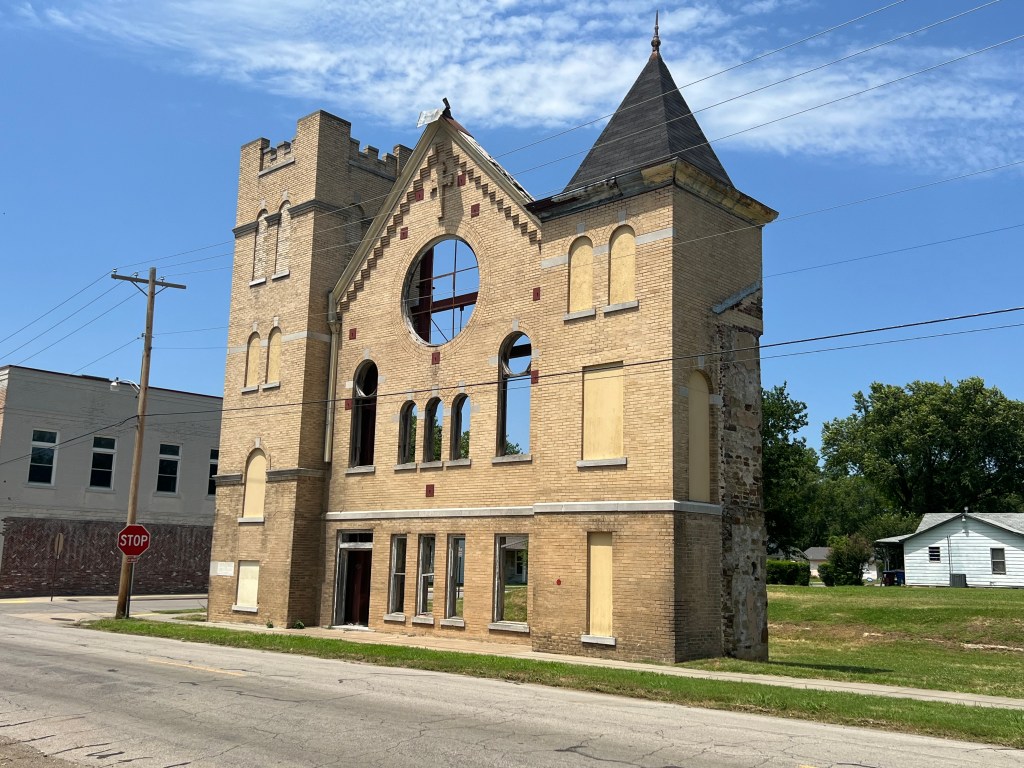
I am planning to play golf when I visit my brother next week for the 4th holiday. I was an avid golfer (although never good) but lost the drive when I moved back to Kansas. I injured my back on my last trip up North and am still recovering. I decided if I it might be good to see if I could swing a club. I knew of a driving range in the city and decided to see if I could swing a club. I was glad to see the electronic sign flash “OPEN” despite the 100F (37.7C) temperature. I saw the range was not covered but did have a tree with a chair beneath it as I walked in and asked for a bucket of balls. The owner told me the range was closed because of construction next door which forced them to remove the netting that protected neighbors from errant balls. The shop was open, just not the range. I decided to drive across town to pick up some supplies. I had never driven from this side of town but was sure I could find my way (is directions a male trait?). I drove through an unfamiliar part of town and came across an abandoned brick facade. When I got out to look, I found a cornerstone identified this as the Mallalieu M.E. Church.
When I went online, I found the Mallalieu Methodist Episcopal (M.E.) Church was established in 1885 as an African American congregation of the local Methodist Church. The brick building was built in 1921 and according to the inset cornerstone was “cleared of all indebtedness” on October 15, 1947. The building served the congregation until it relocated across the street as the Mission United Methodist Church in the late 1980’s. The Mallalieu building remained vacant and was severely damaged by the elements and the stained glass windows were sold to an out of state collector. The Howard Foundation was a non-profit started in 1988 to raise funds for the building’s rehabilitation. The long-term goal was to develop the Mallalieu building as an outreach center for the youth on the north side of Fort Smith. That did not happen, and by 2014 the rear of the building had been destroyed leaving the front facade and bracing support. There is no signage to indicate the historic past or present plans for the impressive structure that remains.
It turns out Mallalieu is a popular name among early Black M.E. churches in the South. The Rev. Willard Francis Mallalieu (1828-1911) spent 24 years in the as an M.E. beginning in 1858, including 2 years as presiding elder. Although he declined several educational positions, Mallalieu became well known and liked by his denomination through contributions to Methodist periodicals and as a platform speaker at places like Chautauqua. Mallalieu was a friend of Bishop Gilbert Haven and prepared Haven’s memorial for the General Conference of 1880. Mallalieu was a delegate to the M.E. General Conferences of 1872 and 1884, and during the 1884 M.E. General Conference Mallalieu was elected to lead the episcopacy. Mallalieu was thought of as “a practical wide-awake minister, [who] makes a good speech in a way that assures you he could preach a better sermon . . .” He was apparently also well-known and liked by the founders of Black M.E. churches of the South.
Thoughts: The national protestant denominations in the US all suffered a split during the decades prior to the American Civil War. Southern M.E. churches were no different, forming the Methodist Episcopal Church South. Following the war, many of these splits continued to maintain their own polity. The M.E. churches who returned were mostly segregated and formed separate Black and white churches, like the Mallalieu M.E. Church. Now denominations (including Methodist and Southern Baptist) are dividing over issues of sexuality and leadership roles. These divisions center on the question of who is in control. Heaven forbid we leave that call to God. Act for all. Change is coming and it starts with you.
 A travelers odyssey