
June 28, 2023
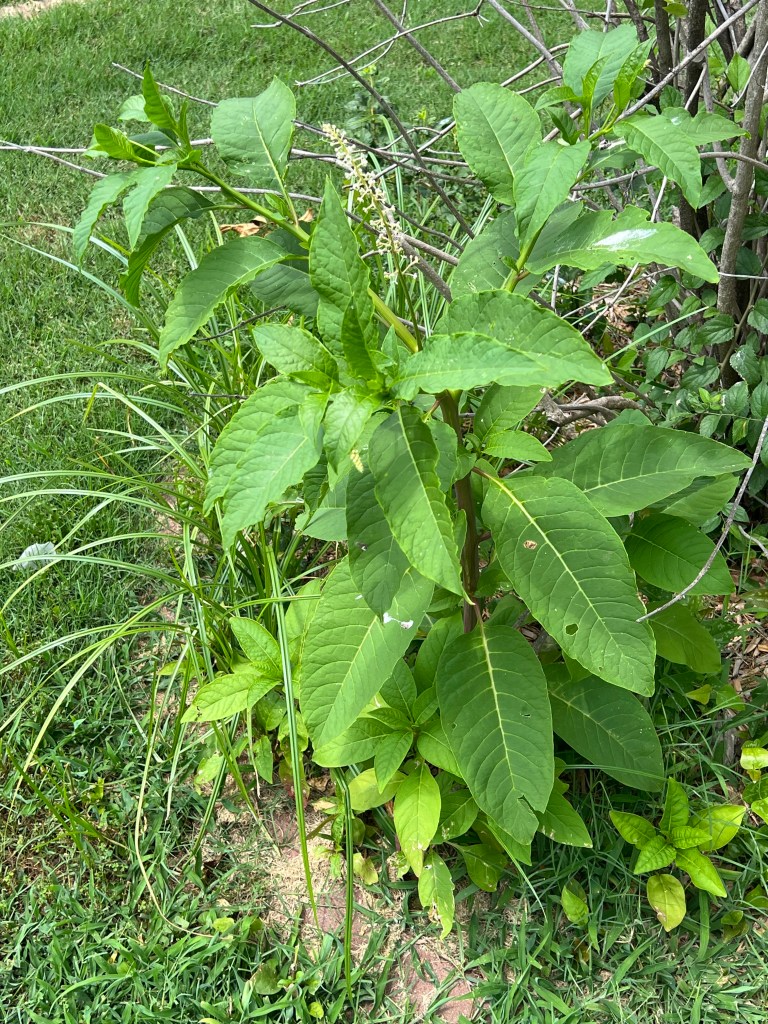
I have been lax caring for my front beds because of the extreme heat we have been under the last few weeks. Since I am reluctant to go outside, I end up staying up late and getting up later. By then the excessive heat danger alert has come up on my phone and it is too hot to do the work. That means the beds I had cleared and mulched have all overgrown. As I have gone back and forth to the car when forced outside on errands, I have noticed two weeds growing larger by the day, and one of the tall weeds has even begun to flower. I did make it outside to mow yesterday knowing it was predicted to rain (it did) and was amazed by the thickness of the stems on these two plants. I took a picture of the plants, googled it on my phone, and identified the plant as pokeweed.
When I went online, I found pokeweed (Phytolacca americana), also known as American pokeweed, poke sallet, dragonberries, and inkberry, is an herbaceous perennial plant in the family Phytolaccaceae. The first word in its scientific name comes from the Greek words phyton (plant) and lacca (crimson lake) and refers to its reddish-purple fruits. The second word indicates it is native to America. The common name “poke” is derived from an Algonquin (Native American tribe) name for the plant (puccoon) and the moniker “inkberry” comes as the berries were used to make ink. Pokeweed is native to America in the East, the Midwest, and the South. The species has been introduced as scattered populations in the far West and is naturalized in parts of Europe and Asia. Pokeweed can grow from 4 to 10 feet (1 to 3 m) tall. It has simple leaves on green to red or purplish stems and a large white taproot. The flowers are green to white, followed by berries which ripen through red to purple to almost black. The berries are a food source for songbirds such as gray catbird, northern mockingbird, northern cardinal, and brown thrasher, as well as other birds and some small mammals, but is a pest species for farmers as it is poisonous to humans, dogs, and livestock.
All parts of mature pokeweed are poisonous, but spring and early summer shoots and leaves are edible with proper cooking. By late summer the shoots and leaves become deadly, and the root and berries (late summer) are always poisonous. According to Michael Twitty, Southern food expert and author of The Cooking Gene, poke sallet was originally eaten as a potent tonic. Twitty explains that most of the pre-depression Southerners walked barefoot and were full of worms. Poke sallet acted to purge worms (vermifuge). Memorial Sloan Kettering Cancer Center cites research that raw pokeweed has medicinal properties that can help cure herpes and HIV, but there are no clinical trials to support the cooked dish as a medicine. Pokeweed is also used as a folk medicine. According to Nicole Taylor, chef and author of The Up South Cookbook, poke sallet is a “stretch food”. The plant was the first fresh vegetable to grow in early spring. People who were poor or former slaves had to be innovative with what to eat and how to cook it and we can trace a variety of wild food dishes back to them. “People who are looking for food to get by are more likely to eat poke sallet than someone who had means to eat other things.”
Thoughts: The term “poke salad” is a misnomer. The true name for the most common pokeweed dish is poke sallet or poke salat. The dish was eaten by the early English pioneers when they came to North America. The word sallet comes from an older form of English and refers to something like a cooked salad. Last year I allowed the bramble (Rubus trifidus) on my back patio to grow for the butterflies (flowers) and birds (fruit). I have planted potatoes in that spot this year and removed the aggressive plant. Now I must decide whether to allow the pokeweed to grow for the birds or cut it to protect my dogs. Most ecological decisions present a tradeoff. Act for all. Change is coming and it starts with you.
 A travelers odyssey