
August 4, 2023
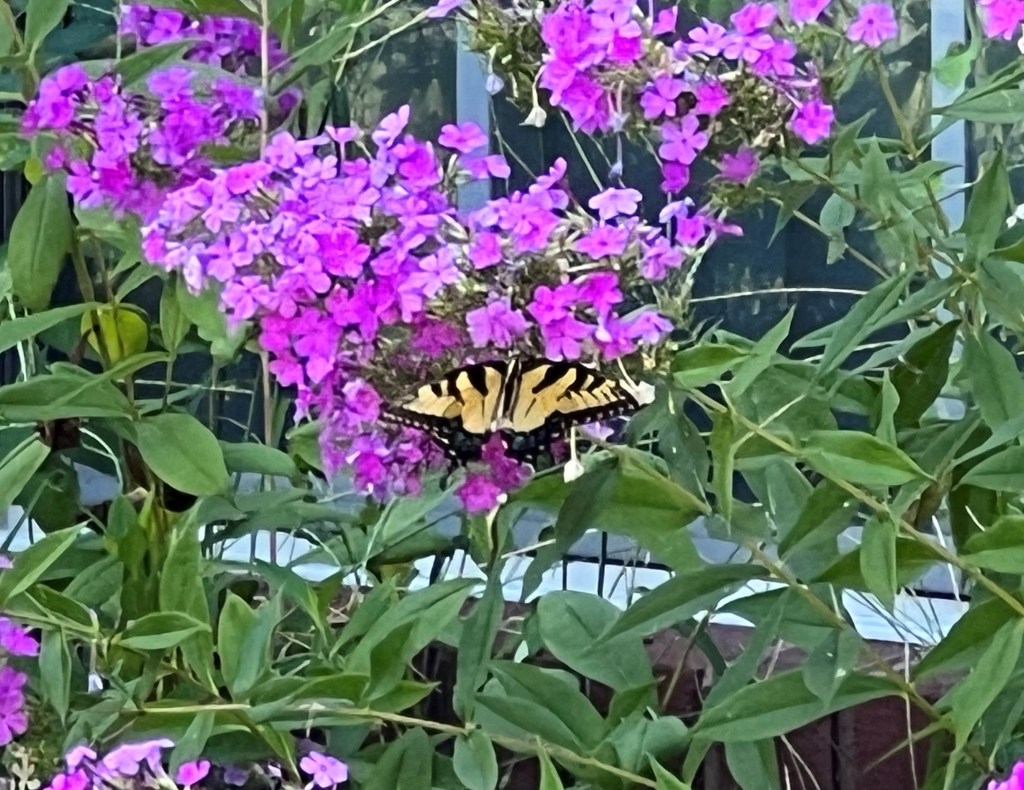
Last summer I noted the eastern black swallowtail (Papilio polyxenes) enjoying the nectar of our Garden Phlox (Phlox paniculata) that line the bed along the front of our house. While I have not seen another of that type, there have been a few monarch butterflies (Danaus plexippus), also known as the common tiger, flitting the phlox. Yesterday I went out to the car and noticed another type of butterfly. This was like the black swallowtail, but the front wings were primarily yellow with four black bands. My first impression as it flitted from flower to flower was that it looked like a small tiger pouncing on its prey.
When I looked online, I found the eastern tiger swallowtail (Papilio glaucus) is a species of butterfly native to eastern North America. It is one of the most familiar butterflies in the eastern US and ranges north to southern Ontario, Canada. The tiger is present from spring until fall and will produce two or three different broods over that time. Adults feed on the nectar of many species of flowers, mostly from those of the families Apocynaceae (oleanders), Asteraceae (daisies), and Fabaceae (beech and oak trees). The tiger has a wingspan measuring 3.1 to 5.5 inches (7.9 to 14 cm) with females being the larger sex. The male is yellow with the four black “tiger stripes” that I had seen on each forewing. Females are dimorphic and may be either yellow or black. The yellow morph is like the male but has an obvious band of blue spots along the hindwing, while the dark morph is almost completely black. The young caterpillars are brown and white, and they turn green with two black, yellow, and blue eyespots on the thorax as they age, then turn brown prior to pupating (forming a cocoon). It will reach a length of 2.2 inches (5.5 cm). The cocoon (chrysalis) varies from whitish to dark brown in color. Hibernation occurs in this stage in locations with cold winter months. The eastern tiger swallowtail is the state butterfly of Alabama (and state mascot), Delaware, Georgia, North Carolina, and South Carolina, and is the state insect of Virginia.
The tiger swallowtail presents a variety of defense mechanisms as it transitions through its life cycle. The first three stages (instars) of the caterpillar are bird dropping mimics, a coloration that helps protect it from predators. In later instars, the eyespots on the thorax serve to deter birds. Like all members of the family Papilionidae (swallowtails), the tiger caterpillar possesses an osmeterium, an orange, fleshy organ that emits foul-smelling terpenes to repel predators. The osmeterium is normally hidden and is located on the first segment of the thorax and can be turned inside out (everted) when the caterpillar feels threatened. The combination of eyespots and osmeterium makes the caterpillar resemble a snake. Dark morph females use Batesian mimicry (named after Henry Walter Bates and his work on butterflies in Brazil) where a harmless species imitates the warning signals of a harmful species as protection from predators by mimicking the poisonous pipevine swallowtail (Battus philenor). The pipevine is more common in the south, where the dark morph females are also more prevalent.
Thoughts: The male tiger does not use Batesian mimicry and are preyed upon more frequently than the females, so why are the females not all dark morphs? There are two noted hypotheses. The male avoidance hypothesis suggests the female disguises to evade male harassment, as courtship can be harmful. The pseudosexual hypothesis suggests the male will aggressively approach the male-looking female, then shift to sexual behavior when they identify them as female. One study found the Batesian females suffered less predation, but their fitness was reduced most by sexual harassment. The others faced lower sexual harassment but lost fitness from predation. Nature balances itself to achieve the best outcome for all. Humans tend to focus on what is best for me right now. Until we decide to work for the good of all (human and planet) we will fail. Act for all. Change is coming and it starts with you.
 A travelers odyssey