
August 16, 2023
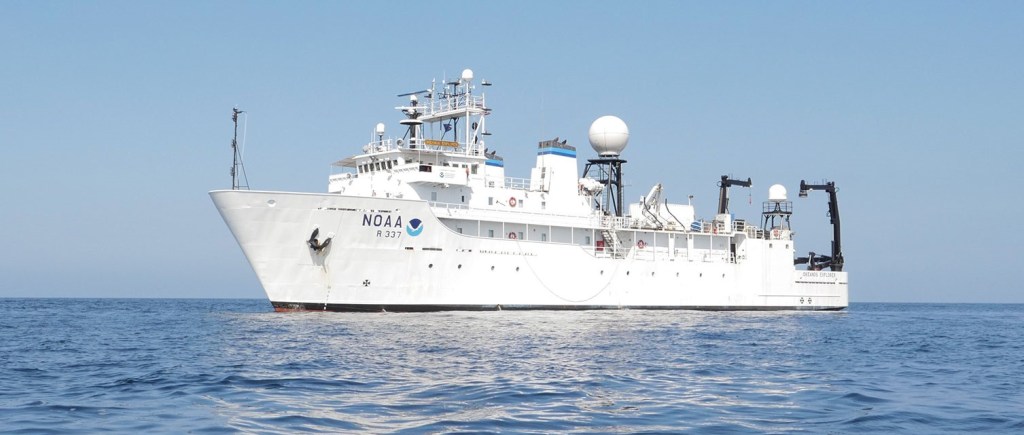
Hidden in the back section of today’s newspaper I found an article on deep sea mapping happening off the Alaskan coast. A team of 48 researchers and crew are part of the National Oceanic and Atmospheric Administration’s (NOAA) five month mission aboard the Okeanos Explorer, a reconfigured naval vessel. The ship is outfitted with the tools and technology to look deep into the ocean and collect data that can be shared in real time with onshore researchers as well as the researchers onboard. The deep ocean off Alaska’s Aleutian Islands is one of the least mapped places in the US, with only 34% of the Alaskan seafloor mapped. This is also one of the nation’s largest coastal ecosystems, and only a fraction of it has been seen. NOAA has a goal of mapping all US deep waters by 2030 and near-shore waters by 2040.
When I looked online, I found the Okeanos Explorer has traveled the globe, exploring everywhere from the Indonesian “Coral Triangle Region” and benthic environments in the Galápagos, to areas in the Gulf of Mexico, canyons and seamounts off the Northeast US Atlantic coast, and marine protected areas of the Pacific. The Okeanos collects baseline data in unexplored areas to further knowledge, while setting the stage for more in-depth exploration in the future. Prior to being acquired by NOAA in 2004 and commissioned in 2008, Okeanos operated as the US Naval Ship Capable, a T-AGOS class vessel. The NOAA ship was named by students from Illinois’ Woodstock High School in a nationwide ship-naming contest. In ancient Greek cosmology, Okeanos was the river/ocean that encircled the world. The ship is homeported in Newport, Rhode Island.
Okeanos Explorer is the only federal vessel dedicated to exploring the largely unknown ocean for the purpose of discovery and the advancement of knowledge. NOAA Ocean Exploration owns the mission equipment used during expeditions on Okeanos and coordinates the ship’s exploratory missions. The two remotely vehicles are operated via a partnership with NOAA Ocean Exploration and the Global Foundation for Ocean Exploration. Missions of the 224-foot vessel include mapping, characterization of the site, reconnaissance, advancing technology, education, and outreach. Everything done is focused on understanding, managing, and protecting the ocean. The Okeanos uses a variety of advanced technologies to explore and characterize unknown or poorly known deepwater ocean areas, features, and phenomena at depths ranging from 820 to 19,700 feet (250 to 6,000 m). The ship is equipped with four different types of mapping sonars that collect high-resolution data about the seafloor and the water column, a dual-body remotely operated vehicle (ROV) capable of diving to depths of 19,700 feet (6,000 m), and a suite of other instruments to help characterize the deep ocean. The ship not only sends data to onshore researchers but can livestream dives to the public.
Thoughts: Okeanos Explorer maps the undersea landscape, but also discovers new species in the unique environments it explores. Scientists believe only 10% of the world’s ocean species have been identified, and that there are around 2 million yet to be discovered. Of the nearly 250,000 known marine species, scientists believe all fully aquatic marine mammals emit sounds, as well as at least 100 invertebrates and 1,000 fish species. Fish and invertebrates use sound for basic life functions. Tiny oyster larvae use sound to guide them to a healthy reef. Cetaceans (whales, dolphins, and porpoises) have evolved over millions of years to use a variety of complex sounds to help navigate, communicate, and mate. When healthy, vibrant environments start to go quiet, it is a sign they are dying. When marine areas are protected, the species communication returns, and the vibrancy of the reef comes back. The deep sea areas already suffer from pollution and steps need to be taken to protect these irreplaceable sites and species. Act for all. Change is coming and it starts with you.
 A travelers odyssey