
August 18, 2023
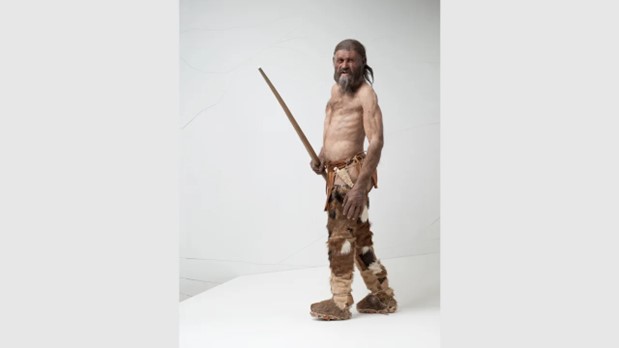
Today’s newspaper reveled new discoveries have given a different insight to the mummified remains of a man found by hikers in a glacier in the Italian Alps in 1991. The man had been killed by an arrow shot into his back and had then frozen into the ice. The mummy was found along with his clothing and gear, including a copper axe, a longbow, and a bearskin cap. The mummy is Europe’s oldest known natural human mummy, offering an unprecedented view of Copper Age (Chalcolithic) Europeans. The nature of his life and the circumstances of his death have been the subject of much investigation and speculation. An earlier draft of the mummy’s genome was published in 2012 but with the advances in genome studies a new examination was conducted in 2023. As the mummy was discovered in Ötztal Alps, it has been given the nickname “Ötzi”.
When I looked online, I found a new study of ancient DNA extracted from Ötzi’s pelvis revealed the 5,300-year-old mummy had dark skin and dark eyes and was probably bald. This contrasts with the original reconstruction of Ötzi that depicts a pale-skinned man with a full head of hair and a beard. It was originally believed the skin was discolored and the hair lost through the frozen mumification process. Albert Zink, coauthor of the research published Wednesday in the scientific journal Cell Genomics, said “the dark skin color of the mummy is quite close to the Iceman’s skin color during (his) lifetime.” Zink noted this is not surprising as many Europeans at that time likely had darker skin coloring than many present-day Europeans. Lighter skin was an adaptation to changes in climate and diet, as farmers have less vitamin D in their diet than hunter-gatherers. The iceman consumed a lot of meat, which was confirmed by the analysis of his stomach showing the presence of ibex and deer meat.
According to the study, the genome sequenced from DNA taken from Ötzi’s pelvis was more complete than a previous genome that was pieced together in 2012 when the field of ancient DNA was still in its infancy. The latest research helps clear up a puzzle in Ötzi’s ancestry. The 2012 study revealed that he had traces in his genome from the steppe people, sometimes known as Yamnaya, who only arrived in Europe centuries after his death. The new study shows that this early result was probably the result of contamination by modern human DNA. The 2023 study on Ötzi’s genome evidenced a high proportion (90%) of Anatolian-farmer-related ancestry with a lesser contribution from European hunter-gatherer-related ancestry. The genome also appeared to rule out a previously proposed genetic affinity between Ötzi and present-day Sardinians. When researchers compared Ötzi’s genome with those of other ancient humans, they found he had more in common with early Anatolian (Turkey) farmers who did not have much interaction with his European hunter-gatherer contemporaries. The iceman most likely lived in a relatively isolated area with only limited contact to other populations and low gene flow from hunter-gatherer-ancestry-related populations. When he did have contact, it may have been his last.
Thoughts: This is not the first time the story of Ötzi has been rewritten. It was originally thought that Ötzi froze to death, but a 2001 X-ray revealed an arrowhead in his shoulder, which would have been fatal. The mummy also had a head injury, possibly sustained at the same time, and his right hand shows a defense wound. “The whole story of the Iceman is intriguing, including the mystery of his violent death . . . and the question why he was up there in the high mountains when he was killed,” Zink said. Ötzi appears to represent the long standing conflict between different groups and lifeways. The farmers of the valley did not associate with the hunter-gatherers of the mountain and likely did not understand (or respect) the differences. In our globalized world we cannot afford to make the same mistake. Act for all. Change is coming and it starts with you.
 A travelers odyssey