
August 22, 2023
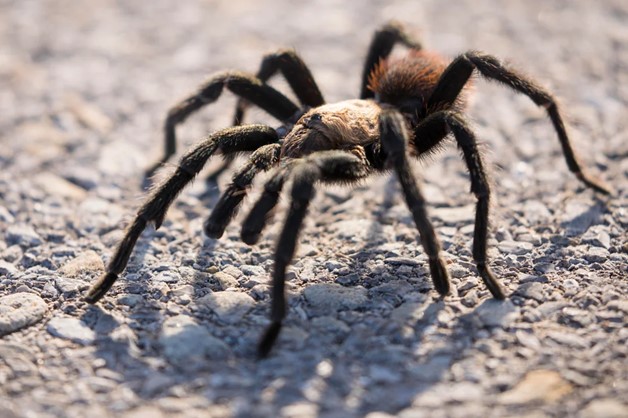
The top story in today’s Daily Briefing from my local online newspaper led with an article (jokingly) warning people scared of spiders (arachnophobia) to be on the lookout for a tarantula. As the weather cools the mating season begins for the brown tarantula. Mating season runs from late August through October, as the arachnids leave their burrows and hideouts in dry, arid areas to roam across the land in search of mates. Unlike web-spinning spiders, tarantulas often take over old burrows dug by other animals or dig their own, lining the holes with webbing to trap their prey and foil predators. The species is nocturnal and hunts at night. When the males begin their mating migration, they can often be seen close to houses or crossing roadways. The males do not have any time to waste, as their lifespan in the wild is only up to one year. Females can live up to three decades.
When I looked online, I found the Texas brown tarantula (Aphonopelma hentzi), also known as Oklahoma brown tarantula or Missouri tarantula, is one of the most common species of tarantula living in the Southern US. The large brown spider can be found in parts of Mexico, along with six US states (Texas, Missouri, Oklahoma, Kansas, Arkansas, and Louisiana). The stocky arachnids can grow to be four to five inches (10 to 12.5 cm) long and weigh between 1 to 3 ounces (28 to 85 grams). Coloration ranges from light brown to black and may vary between individuals. The generally docile tarantula is often kept as a pet. The brown tarantula has venom that is toxic to very small animals but not humans. If incited, they may stand on their back legs to show their fangs to intimidate a potential threat but will not strike unprovoked. The dense hairs on their body are also used to fling at the eyes of a predator when they are threatened. Though they look scary, the tarantula is generally shy and avoids human contact. During mating season, however, they are more on the move.
Arachnophobia is a 1990 American horror comedy film directed by Frank Marshall in his directorial debut and starring Jeff Daniels and John Goodman. The film follows a small California town that is invaded by an aggressive and dangerous spider species. The film used over 300 Avondale spiders (Delena cancerides) from New Zealand. Although not a tarantula, the spider was chosen for its large size, unusual social lifestyle, and harmlessness to humans. The spiders did not like Lemon Pledge furniture wax or hot blowing air. To make the spiders hit their “marks” during filming, a pathway was created using Lemon Pledge as the boundaries and hair blow dryers were used to get the spiders to move. The spiders avoided the Lemon Pledge and moved following the non-Pledged pathways created when the hot blow dryer air was aimed at them, hitting their marks precisely. Cast members were not afraid of the spiders and even adopted a few of them. After each “cut” was yelled, the cast would stop screaming and say “Oh, be careful, don’t step on that one” and “don’t forget that one over there”, while laughing the whole time.
Thoughts: While you may be scared or tempted to stomp on a tarantula when sighted, the old adage is true, “they are more afraid of you than you are of them”. The story goes that when the spider jumps on Becky Beechwood’s face in arachnophobia it was a “happy accident”. The spider was following the Pledge pathway and was supposed to jump onto her neck when the blow dryers were turned on, but the spider landed on her face. Actress Cori Wellins had her eyes closed relishing her hot shower and realized what had happened, thinking ” this is PERFECT!” She continued as the spider crawled down onto her upper chest before she opened her eyes and “screamed”. Now that is acting. Act for all. Change is coming and it starts with you.
 A travelers odyssey