
August 28, 2023
AP PHOTO/JACK DURA
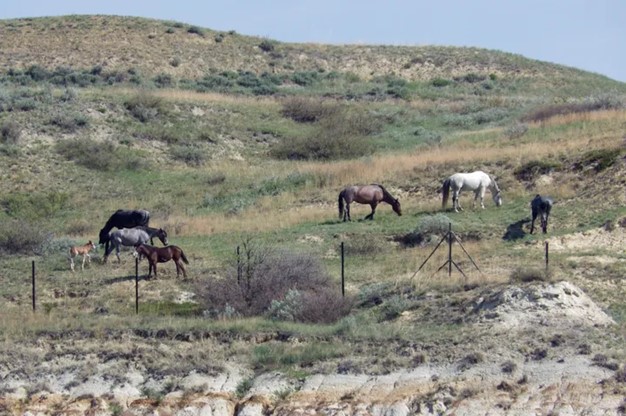
Inside the back section of my newspaper, I found an AP article on the potential removal of wild horses from the Badlands of North Dakota. The wild horses roam freely in North Dakota’s Theodore Roosevelt National Park (TRNP) but could be removed under a National Park Service (NPS) proposal. Advocates say the horses are a cultural link to the past and visitors who drive the scenic park road are often delighted to see the bands of horses, a symbol of the West. While advocates want the horses to continue to roam the Badlands, park officials brand the horses “livestock.” The NPS is revising its livestock plans and writing an environmental assessment on the impact of taking no action or removing the horses. The horses have allies in government leaders and advocacy groups. One advocate says the horses’ popularity will not stop park officials from removing them from North Dakota’s top tourist attraction. “At the end of the day, that’s our national park paid for by our tax dollars, and those are our horses. We have a right to say what happens in our park and to the animals that live there,” Chasing Horses Wild Horse Advocates President Chris Kman told The Associated Press. The breed is registered as the Nokota horse.
When I looked online, I found Nokota is a feral and semi-feral horse breed located in the badlands of southwest North Dakota. The breed developed in the 19th century from stock consisting of ranch-bred horses produced from the horses of local Native Americans and a mixture of Spanish, Thoroughbreds, harness horses, and related breeds. The Nokota was almost wiped out during the early 20th century when ranchers, along with state and federal agencies, worked to reduce competition with livestock. When TRNP was created in the 1940’s, a few bands were inadvertently trapped inside, and the breed was preserved. The Nokota has an angular frame, is commonly blue roan in color, and often exhibits an ambling gait called the “Indian shuffle”. The breed is generally separated into two sections, traditional and ranch type, which differ slightly in shape and height. The Nokota are used in many events, including endurance riding, western riding, and English disciplines.
In 1986, the park sold off many of these horses, including stallions, and released new stallions with outside bloodlines into the herds. That prompted brothers Leo and Frank Kuntz to begin buying the horses to preserve the breed. The TRNP continued thinning the herd, with roundups conducted during the 1990’s and 2000’s. The Kuntz’ founded the Nokota Horse Conservancy in 1999, and later began a breed registry through the same organization. In 2000, the last horses considered “traditional” Nokota were removed from the wild, with some purchased by supporters of the Nokota Horse Conservancy. In 2009, the North Dakota Badlands Horse Registry was created, which registers the slightly different horses now being removed from the park. The TRNP still conducts regular thinning of the herd to keep numbers between 70 and 110 individuals. Excess horses are “sold off”.
Thoughts: Republican Governor Doug Burgum (presidential candidate) has offered the state to work with the Park Service to manage the horses, and North Dakota’s Republican-controlled Legislature passed a resolution to support preserving the Nokota. North Dakota’s Republican US Senator John Hoeven included legislation in the US Interior Department’s appropriations bill that “would direct them (TRNP) to keep horses in the park in line with what was there at the time that Teddy Roosevelt was out in Medora.” Hoeven is pressing the park to keep more than 35-60 horses for genetics reasons. The final decision is unclear. The Nokota represent a link between the Spanish conquistadors, Indigenous tribes, and cowboys which shaped the badlands over the last 500 years. The Nokota are a link to our historic past, and not “livestock”. Act for all. Change is coming and it starts with you.
 A travelers odyssey