
September 01, 2023
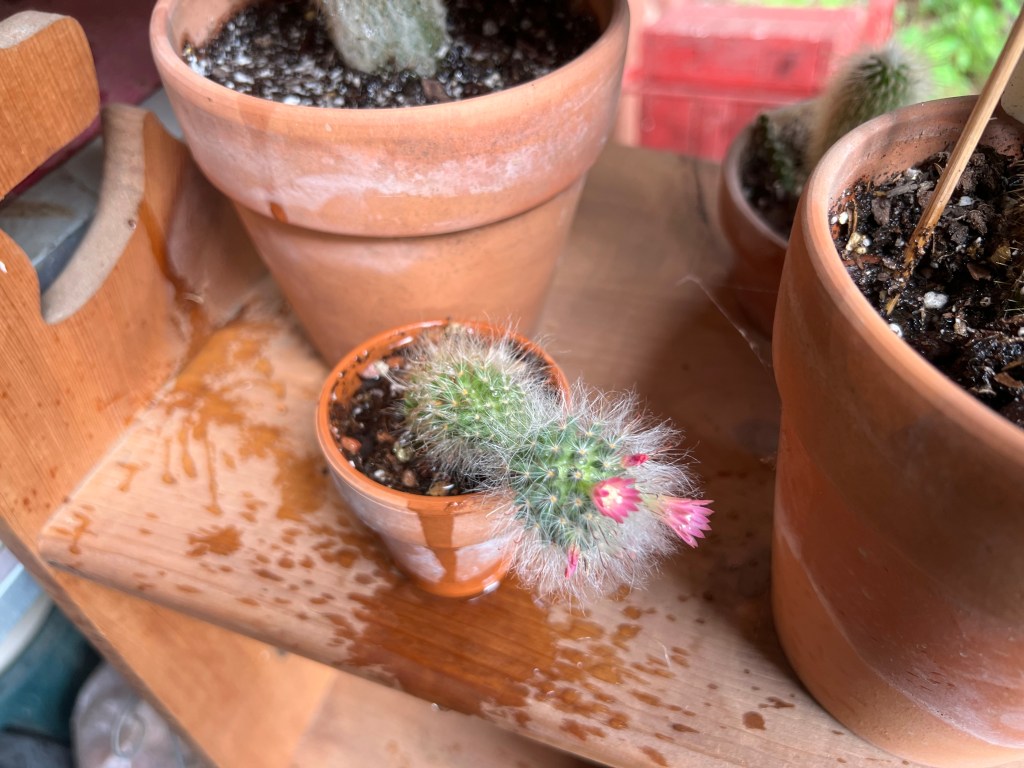
While I might not like the hot weather we have been having lately, several of the cacti Melissa has placed outside at the entrance area of our home do. These are Melissa’s summer growing cacti that she migrates from the porch greenhouse to the front walkway to allow them to get more sunshine and a fresh breeze (when available). Melissa was performing their monthly watering this last week and called me over to show me how they were doing. One of the small cacti looked like a furry little pin cushion, with its numerous white spines. The reason I had been called over was to see the beginning of a halo of flowers that had formed around the top of the plant. Melissa mentioned this was of the Mammillaria genus of cacti.
When I looked online, I found Mammillaria bocasana is a species of cactus in the subfamily Cactoideae. The cactus is often sold as a “powder puff” cactus, or as a “Powder Puff Pincushion.” In its natural habitat of Northern central Mexico, it is found between 5,413 to 7,550 feet (1650 to 2300 m) above sea level. The powder puff grows on canyon walls, in volcanic rock, and in semi-desert localities, and is often found under bushes of other native plants. Bocasana is hemispherical in shape and has white, hair-like spines that cover its radial and hooked central spines. During the spring and summer, the plant bears several cream-colored flowers, followed by a red cylindrical fruit that contains reddish-brown seeds which display partially lateral markings from where they attached to the seed pod (hilum). Its form can be variable, with many different varieties or subspecies. Although the powder puff has been listed as “Least Concern” on the IUCN Red List of Threatened Species since 2009, it is still protected from collecting in the wild in Mexico. Luckily for growers, Mammillaria can be easily propagated from seed.
The Mammilloid clade (an organism and all its descendants) is one of many that have undergone reclassification as a result of recent analysis of the genetic and hereditary molecular differences (mainly DNA sequences) to gain information on the organism’s evolutionary relationships. A 2021 study restructured the seven genera previously comprising the clade into four monophyletic groups. Monophyletic groups are typically characterized by shared derived characteristics (synapomorphies), which distinguish organisms in the clade from other organisms. The name of the genus comes from the Latin word ‘Mammilla’ which means ‘teat’ or ‘nipple’ and refers to the numerous, nipple-shaped tubercles of the stem that are the distinctive feature of the genus. In 2021, Breslin, Wojciechowski and Majure placed the following species in the genus, some already placed there, and some moved from Mammillaria, Neolloydia, Neomammillaria and Ortegocactus. As of December 2022, Plants of the World Online accepted in the genus the species moved by Breslin et al. “Looks like” is not a valid criterion.
Thoughts: The gene mapping that took place for Mammillaria had previously been done on humans. Genetic studies in the late 20th century refuted the existence of biogenetically distinct races, and scholars now argue that “races” are cultural interventions reflecting specific attitudes and beliefs that were imposed on different populations in the wake of western European conquests beginning in the 15th century. Race has been applied to linguistic groups (“Arab race” or “Latin race”), to religious groups (“Jewish race”), and even to political, national, or ethnic groups with little or no physical traits that distinguish them from their neighbors (“Irish race”, “Slavic race”, “Chinese race”, etc.). As with plants, “looks like” is not a valid criterion to separate the human species. Act for all. Change is coming and it starts with you.
 A travelers odyssey