
September 04, 2023
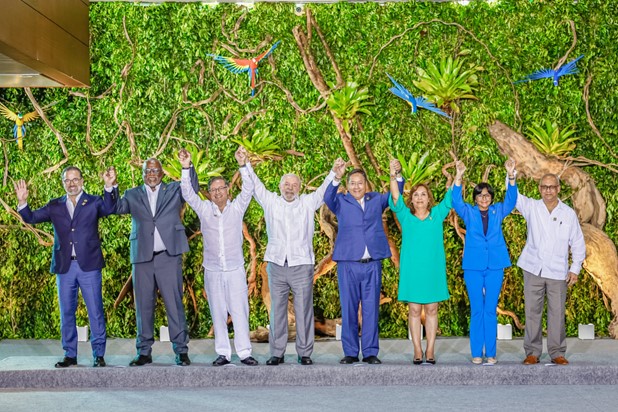
Image © Ricardo Stuckert/PR/Planalto Palace.
The front of the Business Section of Sunday’s newspaper ran an article on the growing trend in the Amazon called Bioeconomy. Bioeconomy became the new buzzword at the Amazon Summit held in Belem, Brazil in early August. The concept offers a way to protect the rainforests while providing a livelihood for tens of thousands of Amazon residents. Small to medium sized examples of this approach already exist throughout the Amazon Basin. This includes the Brazil nuts, acai harvesters, chocolate makers, freshwater fish, and rubber tappers. Para state Governor Helder Barbalho said, “the challenge is scale.” One of the problems yet to be resolved is what exactly a bioeconomy should look like. There are few success stories for sustainable enterprises on a large scale, except for the cosmetic company Nutura. Residents were cutting the ucuuba (Virola sebifera) trees to make brooms, but now selling the seeds to Nutura has tripled residents’ income while leaving the trees standing.
When I looked online, I found Bioeconomy (BE), Biobased economy (BBE), or biotechonomy is economic activity which involves the use of biotechnology and biomass in the production of goods, services, or energy. All three terms are widely used by regional development agencies, national and international organizations, and biotechnology companies. The terms are closely linked to the evolution of the biotechnology industry and the capacity to study, understand, and manipulate genetic material that has been possible due to scientific research and technological development. This includes the application of scientific and technological developments to agriculture, health, chemical, and energy industries. While the terms bioeconomy and biobased economy are sometimes used interchangeably there is value in distinguishing them. The BBE economy takes into consideration the production of non-food goods, while BE covers both bio-based economy and the production and use of food and feed. More than 60 countries and regions have bioeconomy or bioscience-related strategies, of which 20 have published dedicated bioeconomy strategies in Africa, Asia, Europe, Oceania, and the Americas.
A forest bioeconomy is based on forests and their natural resources and covers a variety of different industries and production processes. Examples of forest bioeconomy include processing of forest biomass to provide products relating to energy, chemistry, or the food industry. Forest bioeconomy covers a variety of different manufacturing processes based on wood material and the range of end products is wide. Along with the different wood-based products, recreation, nature tourism, and wild game are a crucial part of forest bioeconomy. Carbon sequestration and ecosystem services are also included in the concept. Some argue public investment would be the tool governments should use to regulate and license cellular agriculture, but private firms and venture capital tend to try and maximize investor profit rather than social welfare, and radical innovation is considered risky. The leaders and senior representatives of the strengthened Amazon Cooperation Treaty Organization who signed the Belém Declaration on August 8 took a first step.
Thoughts: When governments establish supporting infrastructure for entrepreneurial ecosystems, they can create an environment beneficial to innovative bioeconomy startups. Enabling these bioeconomy startups to act on the opportunities provided further contributes to their success. A conservative estimate put US direct subsidies to the fossil fuel industry at roughly US$20 billion for 2019. Twenty percent is allocated to coal and 80 percent to natural gas and crude oil. European Union subsidies are estimated to total 55 billion euros annually. We are subsidizing fossil fuel knowing it is destroying the planet. We should be able to subsidize bioeconomy intended to save the planet. Act for all. Change is coming and it starts with you.
 A travelers odyssey