
September 15, 2023
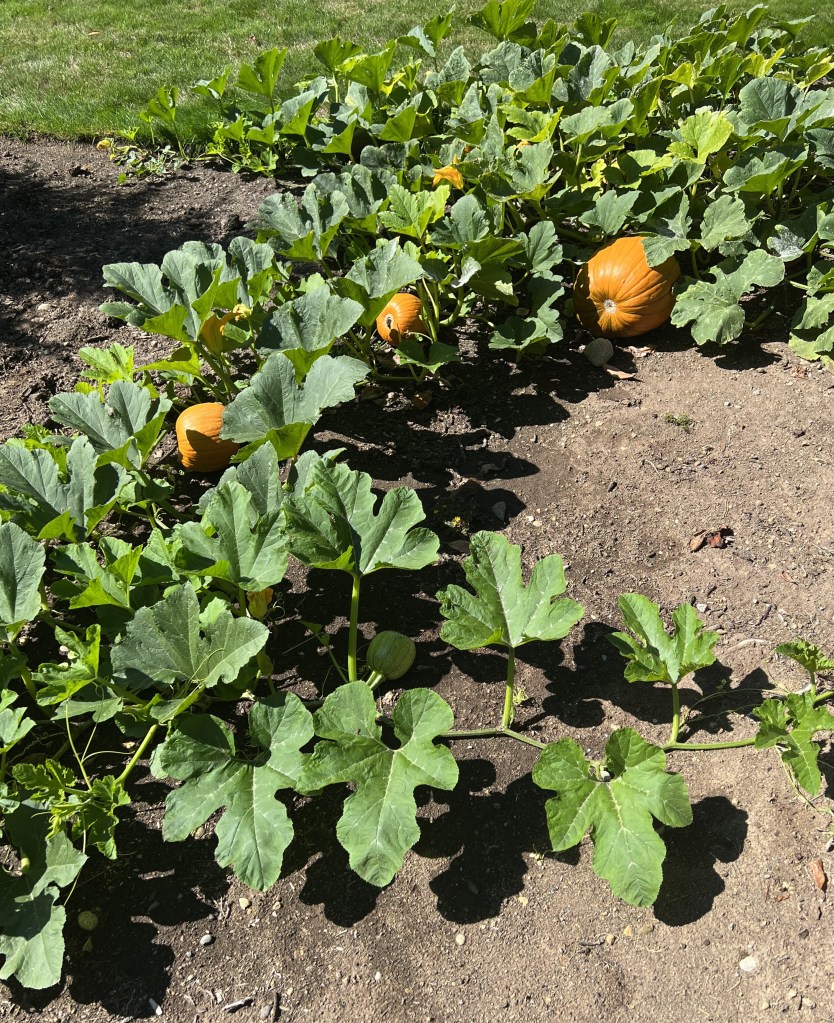
One of the first things I did when I arrived at my son’s house was to check out his garden. He had placed three 48 x 18 x 24 inch (122 x 45.5 x 61 cm) galvanized containers in a mulched area behind his house. He had holes drilled to allow the water to drain and the mulch kept the containers cool and not allowing the weeds (or grass) to grow around them. The containers had been planted with red onions (Allium cepa), carrots (Daucus carota), cucumbers (Cucumis sativus), kale (Brassica oleracea), and two types of lettuce (Lactuca sativa), butter and romaine. Most fared well, but as with any new venture, Alex found out the hard way that cucumber vines will take over everything in their path and lettuce easily wilts in the sun. In another section of his yard, Alex had planted two pumpkin vines which were doing very well. There were 6 or 7 pumpkins around 8 inches (20 cm) in diameter and one that had grown to 15 inches (38 cm). It reminded me of my one 4-inch (10 cm) watermelon on my vine at home. I think I need to give it more room next year if I want it to rival his pumpkins.
When I looked online, I found pumpkin is a vernacular term for winter squash of species and varieties in the genus Cucurbita. These pumpkins had culinary and cultural significance, but no agreed botanical or scientific meaning. The term pumpkin is used interchangeably with “squash” or “winter squash” and is commonly used for cultivars of cushaw squash and silver-seed gourd (Cucurbita argyrosperma), Asian pumpkin or black seed squash (Cucurbita ficifolia), hubbard or delicious squash (Cucurbita maxima), winter crookneck squashes (Cucurbita moschata), and summer squash (Cucurbita pepo). The pepo is native to northeastern Mexico and southern US and are one of the oldest domesticated plants in the world. Today, a variety of pumpkins are grown for food, aesthetic, and recreational use. Pumpkins have a thick shell and contain edible seeds and pulp. The pepo pumpkin is a traditional part of Thanksgiving in the US and Canada as pie and are carved as Halloween jack-o’-lanterns. Canned pumpkin purée and pie fillings are usually made of different varieties (sweet pumpkins) from those used for jack-o’-lanterns.
Cucurbita pepo is one of the oldest, if not the oldest domesticated species, with origins in southern Mexico in Oaxaca (8,000 to 10,000 BP) and Ocampo, Tamaulipas, Mexico (7,000 BP). Pumpkins of both Cucurbita pepo and Cucurbita moschata had been carried throughout North America (where they could grow) long before the arrival of Europeans. The ancient territory of C. pepo extended north into Texas and up the Greater Mississippi River Valley into Illinois and east to Florida, and possibly even to Maine. It is one of several plants cultivated in prehistoric North America as part of the Eastern Agricultural Complex (focused on corn, beans, and squash). Pepo is known to have appeared in Missouri at least 4,000 years ago (BP). Some varieties grow in arid regions and some in moist regions. Many of these Indigenous peoples, particularly in the west, still grow a diversity of hardy squashes and pumpkins not found in commercial markets. Neither C. pepo nor C. moschata had been carried into South America along with beans, although all originated in the same general region.
Thoughts: The Eastern Agricultural Complex refers to one of about 10 independent centers of plant domestication in eastern North America dating back to 5300 BCE. By 1800 BCE woodlands people were cultivating several species of plants allowing them to transition from hunter-gatherers to agriculture. Maize (Zea mays) was introduced from Mexico in 200 BCE and the eastern peoples slowly moved from indigenous plants to a maize-based agricultural. The cultivation of local plants (except pumpkins and sunflower) was abandoned, and the formerly domesticated plants returned to wild forms. This is another example saying when we leave nature alone, it will recreate itself to better serve the local ecosystem rather than humans. Act for all. Change is coming and it starts with you.
 A travelers odyssey