
September 22, 2023
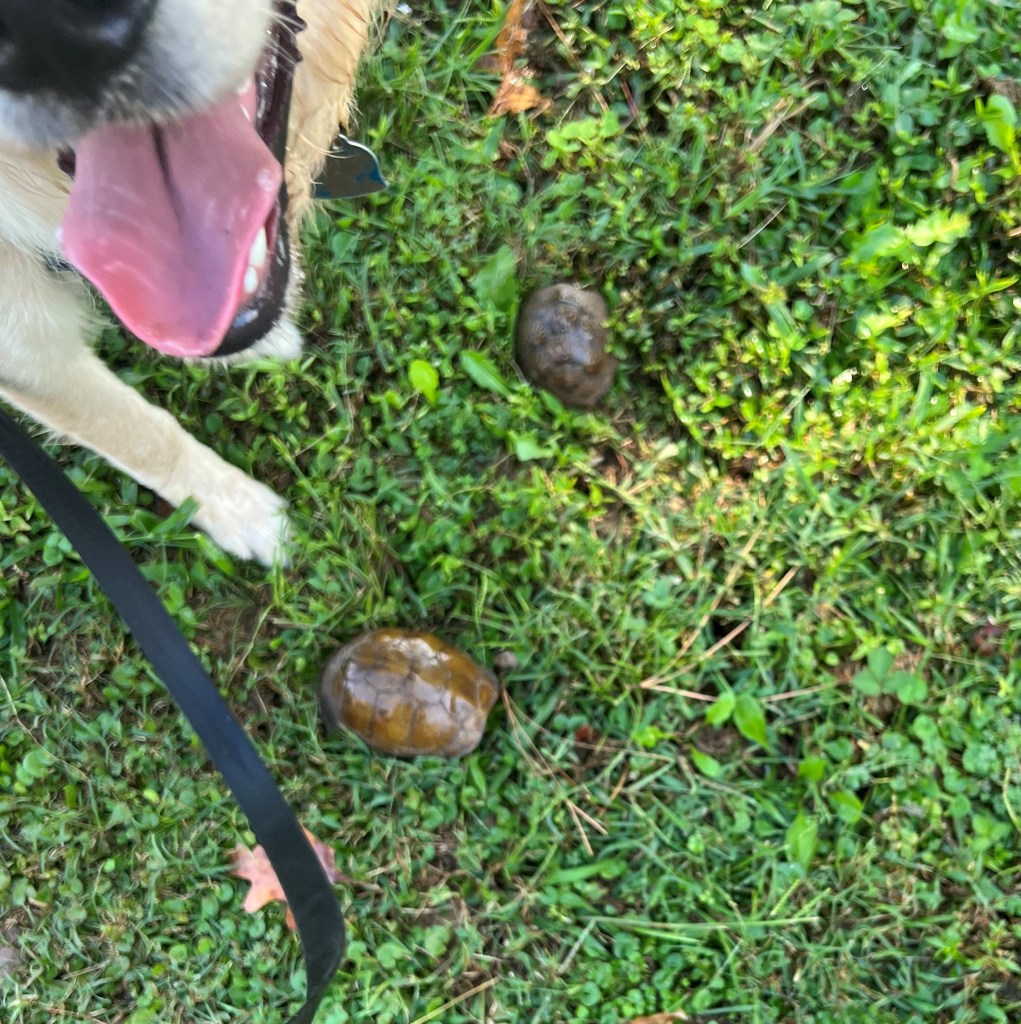
I have been trying to train Loki to take a walk. We have gotten beyond biting the leash and even to the point where he will excitedly stand and wait for me to put his harness on him. Once he gets outside however, it is jump and strain. That means I take Zena for a walk at the city park and when we return, I harness Loki and take a shorter walk through the neighborhood. Most of this loop is on streets but the last two blocks cut through a green space that comes out behind our house. While we were walking through this grassy tree-lined section we came across what looked like two rocks. Loki was interested so I took another look and realized these were two small turtles that had tightly closed their shells. The weather has been cool, and damp and I was not surprised to see the two in the grass. This is a prime time for box turtles to be on the move.
When I looked online, I found the three-toed box turtle (Terrapene triunguis) is a species within the genus of hinge-shelled turtles commonly referred to as box turtles. The species is native to the south-central part of the United States and is the official state reptile of Missouri. Three-toed box turtles got their name from the number of toes on their back feet. Some think there are four-toed examples, but others speculate the four-toed individuals are eastern box turtle (Terrapene carolina carolina)/three-toed box turtle hybrids. The three-toed have a domed shell which grows to 5 to 7inches (13 to 18 cm) in length and the highest part of its upper shell (carapace) is more posteriorly positioned than in any of the other box turtle subspecies. The dorsal and limb coloration is often completely absent, although some dark blotches are common in adults. These areas are more often a uniform olive green or tan color (like my turtles) but sometimes, faint yellow dots or lines are visible in the center of each large bony external plate (scute: Latin “shield”). In the males, the head and throat often display yellow, red, or orange spots.[6][8] Frequently, the bottom shell (plastron) is a yellow straw color and has far fewer dark markings than the plastrons of the other subspecies. The species mates in the spring as they come out of hibernation and are on the move.
Three-toed box turtles are known to move and migrate seasonally to maintain their preferred humidity level. In Arkansas, three-toed box turtles were observed in grasslands in late spring, while in early spring, summer, and late fall they were found in forested areas. During dry times, they dig shallow burrows into leaf litter to conserve moisture. When water is available, these turtles soak for longer periods of time than any of the other subspecies. Three-toed box turtles are popular in the pet trade and are commonly moved outside their home range and released but it is not known whether these released captives have an impact on the local species. The species is highly adaptive and is possibly the only box turtle who can live happily in an indoor enclosure. Three-toed are omnivores (eat plants and meat) and their diet varies with availability of food sources and the seasons. Box turtles prefer live foods to vegetation and their diet should consist of 50% plants and 50% animal protein. They can be shy about being watched while eating and may stop and stare motionless when this happens. With good care, three-toed box turtles can live at least 50 years.
Thoughts: We almost missed the turtles on our walk as they were closed and did not move. What gave them away was one had flipped over, exposing its yellow plastron. I flipped the turtle right-side-up and we watched for a bit. The turtles both remained tightly closed and did not want to play. After a few sniffs, we left them alone. Staying closed off is a good way to keep protected, but it comes at the expense of being able to eat or move. When we isolate ourselves from the surrounding culture, we miss the diversity and joy that comes with being alive. Act for all. Change is coming and it starts with you.
 A travelers odyssey