
September 25, 2023
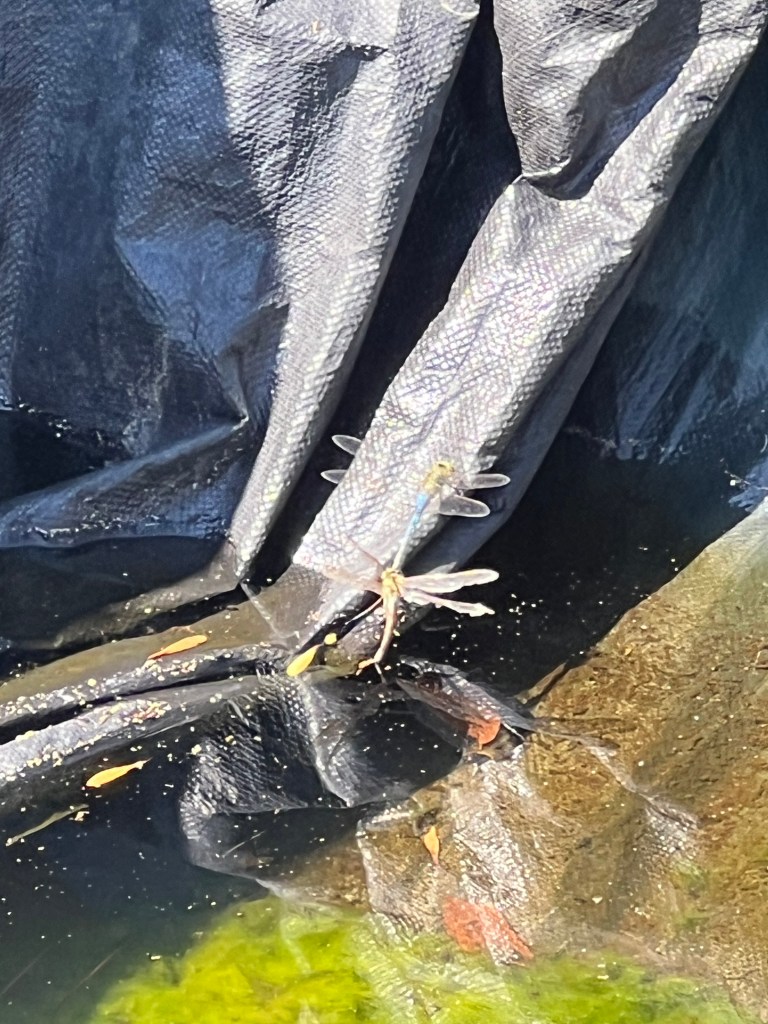
When I took the kids outside for a break over the weekend, we witnessed the mating ritual of three large dragonflies (2 males and 1 female). The pair had already coupled and were flying around our pool/pond while the other male was circling and darting around the mated pair. All three seemed disturbed by my presence (or perhaps more so Loki’s) and skittered around, diving back and forth above the water. I decided to back away from the pond to see what would happen. When I moved back, the mated pair settled on the tarp just above the water line. The female then proceeded to dip her tail into the water, apparently laying one egg after another. The two stayed together until the female completed laying her eggs. The second suiter had continued to harass the original male hoping to dislodge it from the female but when the mated pair landed near the water he flew off. He had lost his chance, and no doubt went off in search of another mate.
When I looked online, I found the common green darner (Anax junius) is a species of dragonfly in the family Aeshnidae. The dragonfly gets its common name from its resemblance to a darning needle. Both sexes have unmarked green thoraces, bull’s eye marks on their faces, and clear wings that often become amber-tinted with age. Males have bluish-purple abdomens with a black stripe down the middle while females may appear like the males or have reddish-brown abdomens (as mine did). The darner is one of the largest extant dragonflies and males grow to 3 inches (76 mm) in length with a wingspan up to 3.1 inches (80 mm). Females use a tube-like organ to lay eggs beneath the surface of the water (oviposit) in aquatic vegetation. The nymphs (naiads) are aquatic carnivores, feeding on insects, tadpoles, and small fish. Adult darners catch insects on the wing, including ant alates, moths, mosquitoes, and flies. The species is well known for its great migration distance from the northern US and south into Texas and Mexico. The species also occurs in the Caribbean, Tahiti, and Asia from Japan to mainland China. It is the official insect for the state of Washington in the US and is a common dragonfly to Arkansas.
Unlike many dragonflies, some populations of Common Green Darners migrate and during winter may fly as far south as Panama. Darner migration is complex and challenging to study. Researchers suspect a full migration takes place over at least three generations. The first generation emerges in spring in the southern part of the range and travels north in the summer to mate. The second generation emerges in the northern part of their range in summer and migrates south during the fall to mate. The third generation emerges in the southern part of the range during the winter and does not migrate but will mate. The cycle begins again with the next generation. When researchers equipped the green darners with micro radio transmitters (one tiny transmitter), they found that the dragonflies traveled about 10 miles (16 km) per hour and up to 87 miles (140 km) in a single day.
Thoughts: Not all dragonflies stay connected after they mate. In some other species another male will capture the female and scoop out the deposit by a previous male to ensure their own progeny. That is why the darners stay coupled until the eggs have been laid. Francis Bacon has one of the earliest references to the name ‘dragonfly’ in Naturall Historie: In Ten Centuries. It is widely believed Bacon picked up the name from folklore of the time where it was believed the insects were once dragons shrunk in size. This may have been aided by the voracious appetite of both nymphs and adults and their darting movement as they hunt winged prey. Folklore also associated these tiny dragons with the devil. While they are not harmful to humans, this association made many wary of their presence. What we call animals (and people) does have an impact on have we see and treat them. Act for all. Change is coming and it starts with you.
 A travelers odyssey