
September 28, 2023
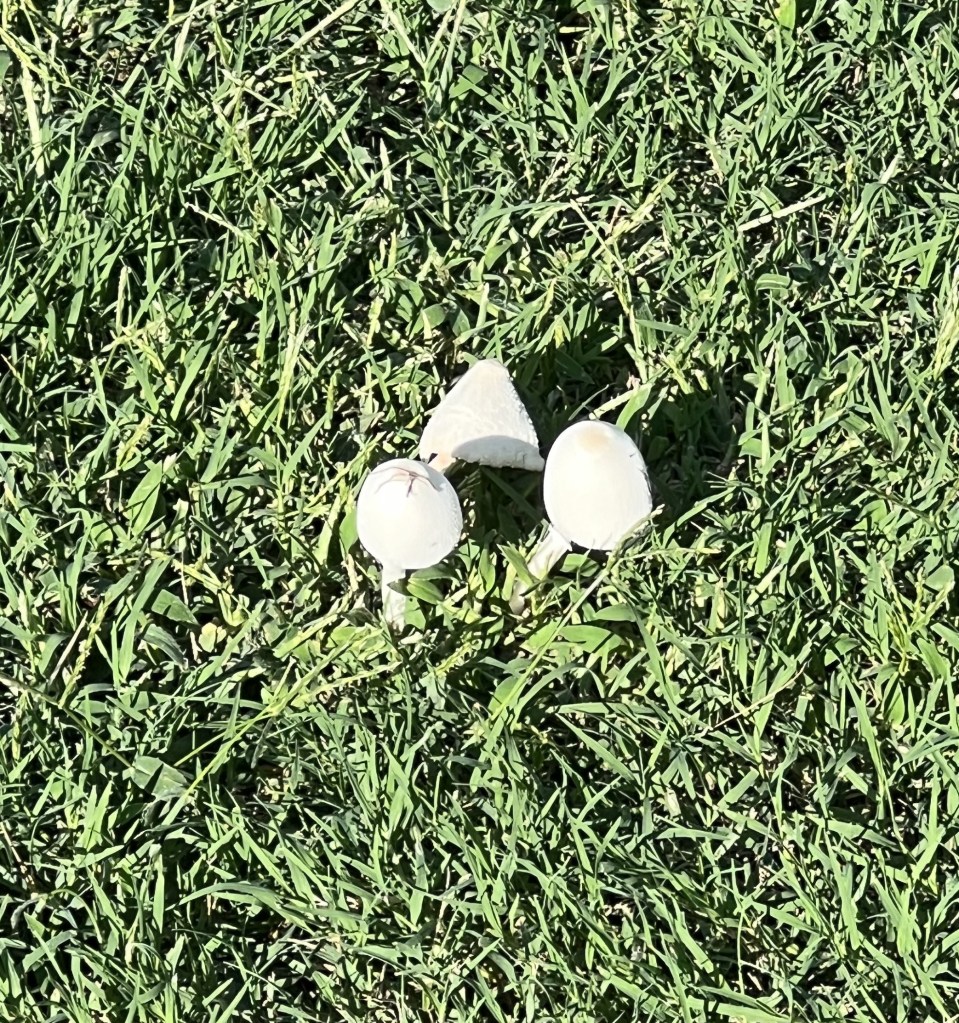
I have mentioned how when I take my dogs for a walk, I need to take each dog separately. While Loki is used to his harness and even excitedly “helps” me get it on, he has not mastered the art of walking. He strains at the leash or will stop to investigate some smell and then run full bore back to the end of the leash. I tried earlier to take both dogs, but Loki spent more time roughing with Zena than walking. This makes it a concentrated effort to train Loki to walk as we patrol the neighborhood. Zena instead likes to go to the park where she can see the sights, sniff the smells, and do her business (yes, I bring bags). After the rains and cooler temperatures last week, I noticed several sections of the park were sporting white dapperling mushrooms.
When I looked online, I found the white dapperling lawn mushroom (Leucoagaricus leucothites), is commonly known as the smooth parasol, woman on motorcycle, or white agaricus mushroom, and is a species of agaric (mushroom or toadstool) fungus. Archaically, agaric meant ‘tree-fungus’ (Latin; agaricum) but that classification changed with the Linnaean interpretation in 1753 when Linnaeus used the generic name Agaricus for gilled mushrooms. The species was originally described as Agaricus leucothites by Carlo Vittadini in 1835 and bears a similarity to species of that genus. Solomon Wasser transferred it to Leucoagaricus in 1977. The mushroom’s cap is 1 1/2 to 5 1/4 inches (4 to 15 cm) wide, granular, usually white, or grayish brown in color, but sometimes gray or pink. The flesh may bruise yellow and the gills red. The stipe (stem) is 2 to 4 1/2 inches (5 to 12 cm) long, commonly with a wide base, and bruising yellow or brown. A ring is usually present on the stem. The spores are white, smooth, and elliptical. The dapperling generally appears in human made areas such as gardens and parks but may sometimes be found in forests. The dapperling I saw were in a park.
There are many types of mushrooms that look similar to the dapperling, with white domed caps, brown or white gills, and grow in small groups in your lawn. Types of common garden mushrooms include the false parasol mushroom (Chlorophyllum molybdites), field mushrooms (Agaricus campestris), giant puffball mushroom (Calvatia gigantea), and white dunce caps (Conocybe apala). Other varieties of mushrooms that grow on lawns are orange, tan, or brown. This includes the fairy ring mushrooms, weeping widow mushrooms (Lacrymaria velutina), Agaricus placomyces, and scruffy twiglets (Tubaria furfuracea). While the dapperling is sometimes regarded as edible, the species is suspected of being poisonous due to gastric-upset-causing toxins. It may also be confused with the deadly death angel mushroom (Amanita ocreata). Correctly identifying species of mushrooms in your yard is vital as some types of mushrooms in gardens are highly poisonous and can cause severe health consequences. Never eat any type of mushroom from your garden without identifying the species with 100 percent certainty.
Thoughts: Mushrooms like the dapperling appear in your yard in late summer or early fall and usually along with plenty of rain, high humidity, warm weather, and shaded conditions. Yard mushrooms are a sign of decomposing organic matter in the soil and boost the nutrient content of your lawn. You can leave them, run over them with the mower, or throw them in the compost pile. One house I lived in in California had a leaky roof in the closet dormer. During a rainy period, I found a large mass of Chicken of the Woods Mushrooms (Laetiporus sulphureus) had taken over a damp spot on the rotting floor. This species emits a strong earthy aroma (let alone it was inside my house!), so I removed them. While mushrooms indicate the healthiness of your lawn soil, these are not good conditions inside your house. I left the mushrooms outside alone. Act for all. Change is coming and it starts with you.
 A travelers odyssey