
October 04, 2023
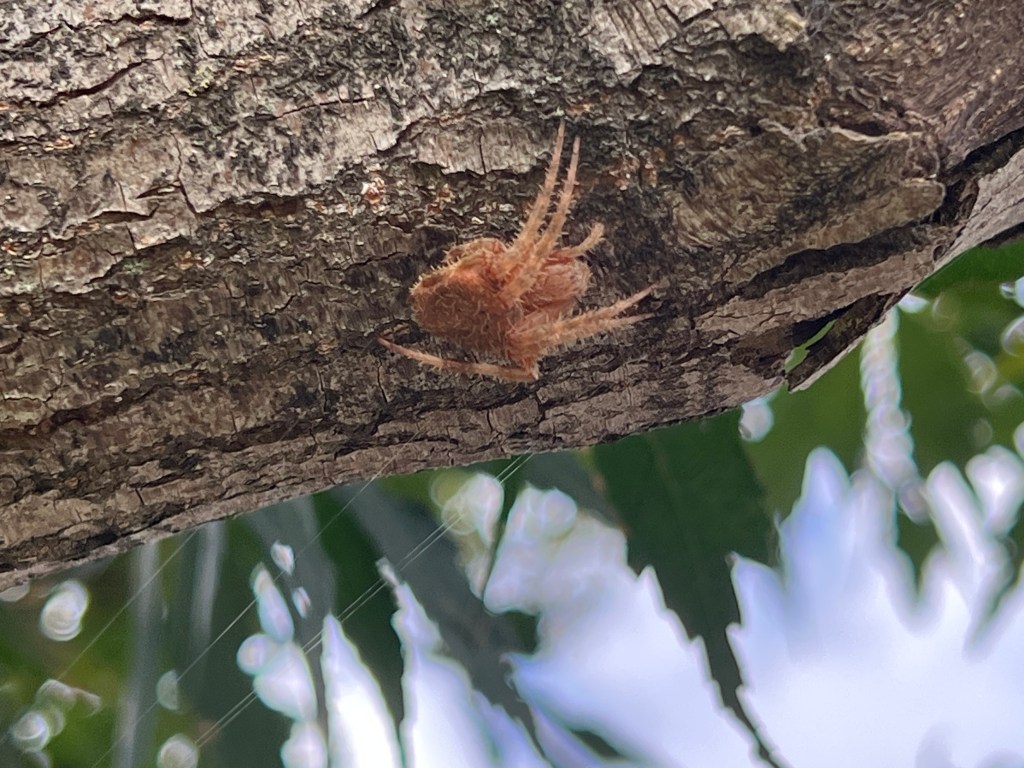
When my annual newspaper subscription expired in July, I switched to an online only subscription. This was not only cheaper, but I hoped to save the mounds of newsprint I periodically place in city recycling. My subscription was changed but the paper kept coming (obviously supply chain issues). I tried to contact the newspaper office but could not get around the automated system that took me overseas to people who told me it had been changed. I gave up, and now still go out each morning to pick up my paper (except Saturday and holidays when they do not deliver). As I was coming back to the house, I noticed a large bug sitting on a branch of the Japanese maple (Acer palmatum) in our front flower bed. At first, I thought it was one of the destructive aphids (superfamily Aphidoideas) that suck the sap out of trees. As I looked closer, I realized it was an orb-weaver spider sitting on the beginning of its web. It looked like a golden jewel as it sat motionless waiting for me to pass.
When I looked online, I found the Jewel spider (Araneus gemmoides), also known as the cat-faced spider, is a common outdoor, orb-weaver spider found in the US and Canada. Both common names reflect the special traits of the body of the spider. The abdomen is large and if seen from the front, resembles the face of a cat. Others consider the shape of the spider’s body diamond- or jewel-shaped. Hence, its two common names. The color of the spider can range from almost completely white to bright orange (like mine) and dark brown, and its color varies and changes from summer to winter. The jewel usually grows between 0.2 and 1 inch long (5 to 25 mm), with comparably short legs and a large-sized abdomen. The jewel usually makes its webs near lights, closed spaces, and on the sides of buildings, but can be found under wood, overhangs, or guarded places such as animal burrows (or perhaps in trees?). The species is easily identified by the two horn-shaped growths on its relatively large abdomen. Females have a larger abdomen and head, while males have much smaller abdomens and longer bodies.
The female dies within days of laying a single egg sac with hundreds of eggs. The egg sacs can survive through the winter. The emerging spiderlings eat their siblings, but the ones who get away ride strands of silk in warm air currents which can transport them miles away. Like all orb-weavers, the jewel spider is considered harmless. Jewel spiders are extremely timid and will always try to get away rather than fight. The spider is clumsy moving outside their webs. Even if they do bite, their venom has low toxicity and will only cause a small blemish that will fade. At their worst, they may cause a slight welt. The spider is a natural predator for insects and eat a variety of food, ranging from fish flies, house flies, and mosquitoes to other small spiders (including siblings). I left my solitary female on her web, wishing her good hunting and a favorable mating outcome as the fall is here.
Thoughts: I can tell fall is approaching as the spiders are on the move in my yard. Various species have turned up sporting babies on their backs like the rabid wolf spider (Rabidosa rabida) or egg sacs in their web like the triangulate cobweb spider (Steatoda triangulosa). The Jewel spider was just another spider species trying to prepare for winter. Many species of insects lay eggs which can survive, even if the adult will die. Many plants go dormant over the winter, and some have developed to need to become dormant to germinate as the weather warms. Birds will fly south to warmer climes. Mammals instead adapt. While some hibernate, others use their warm blood and external hair for warmth. Humans tend to alter nature (clothes and housing) to survive the cold. While this is a preservation advantage, we can be more vulnerable to extreme changes in climate. We need to accommodate nature to ensure the survival of the ecosystem, not just ourselves. Act for all. Change is coming and it starts with you.
 A travelers odyssey