
October 06, 2023
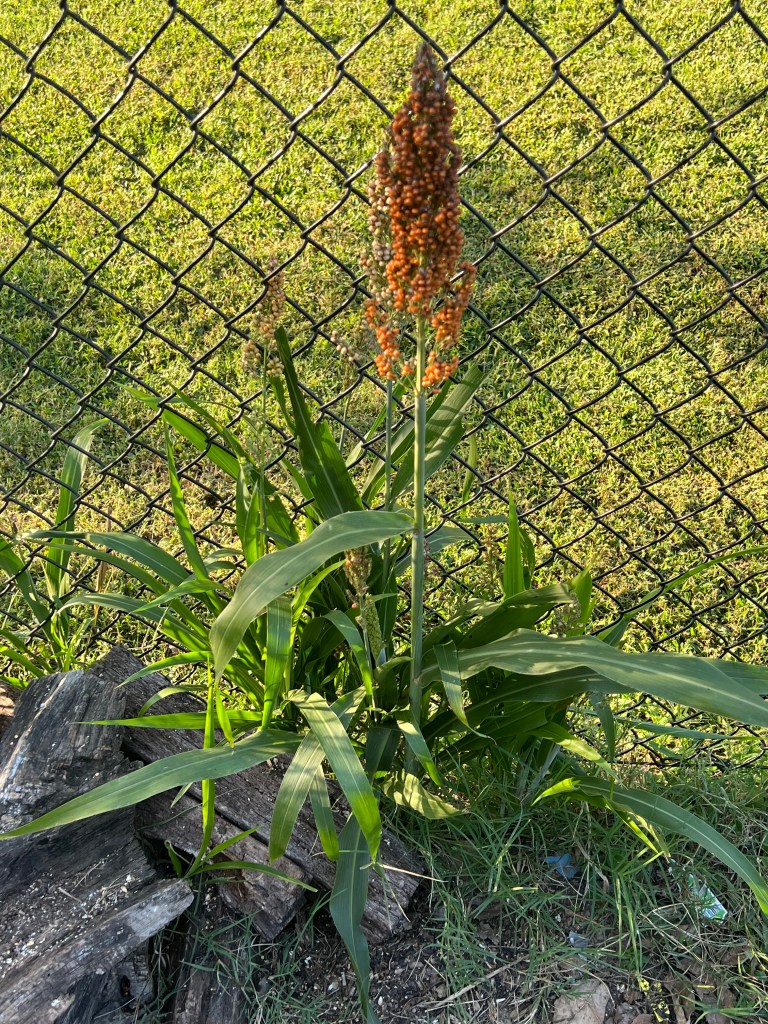
Several years ago, I spoke of the seeds that the birds throw out of my feeders. Some are tossed when the birds get in a frenzy of competition. Others are scattered because an individual bird does not like the seed and throws it out of the feeder as “unusable”. To be honest, I think most of the smaller seeds that fall to the ground are the result of several small holes in the screen in the bottom of the feeder. When I wrote, some of the scattered seed had taken root and sprouted just outside my patio fence. After the wheat (Triticum turgidum subsp. durum) matured I bound it together as a sheaf (it did not work well) and kept it on the porch to dry. Last year I was more consistent in my weed eating and the stalks were all cut down before they could develop. This year I had one stalk which grew inside the fence and out of the weed eater’s range. This has now matured as a large head of Proso millet.
When I looked online, I found Proso millet (Panicum miliaceum) is a grain crop also known as red millet, broomcorn millet, common millet, hog millet, Kashfi millet, and white millet. Archaeobotanical evidence suggests millet was first domesticated about 10,000 BP in Northern China. Now major cultivated areas include Northern China, Himachal Pradesh of India, Nepal, Russia, Ukraine, Belarus, the Middle East, Turkey, Romania, and the Great Plains states of the US. About 500,000 acres (200,000 hectares) are grown each year. Proso is noted for its extremely short lifecycle, with some varieties producing grain only 60 days after planting, and for its low water requirements, producing grain more efficiently per unit of moisture than any other grain species tested. The name “Proso millet” comes from the pan-Slavic generic name for millet (i.e., Proso). There are three types of millet used in bird seed: white Proso millet, golden millet, and red millet, but White Proso and red millet are the most common.
White Proso is a high-protein seed that is a favorite among ground-feeding birds. Doves and pigeons (family: Columbidae), juncos (genus: Junco), towhees (genus: Pipilo), and sparrows (genus: Passer), and cardinals (genus: Cardinalis), are some of the common birds that prefer millet. Larger ground birds like quails (order: Galliformes) or pheasants (family: Phasianidae) will also be interested in this seed. Most birds typically prefer white Proso to red or golden millet, and some bird enthusiasts consider these to be less desirable filler ingredients. Blackbirds (genus: Turdus) and starlings (Sturnus vulgaris) are often seen as undesirable visitors to feeders, and they will enjoy millet along with their other regular foods. Birds that eat red millet are like those that eat white Proso millet, though they will likely prefer the latter if given the choice (or perhaps just throw it out of the feeder?).
Thoughts: Most seed mixes not only tell you what seeds are included (like Proso), but also what birds the seeds tend to attract. There are many types of seed available to feed your birds, but some seeds are included as filler meant to load a bag to be put on the market at a lower cost. Cheap wild bird mixes will save you money upfront, but you might end up spending as much or even more in the long run since the filler ingredients may not be eaten. I tend to buy mid cost range seed mixes that also attract a larger variety of birds. When a flock of grackles (Quiscalus quiscula) descend they may quickly wipe out my feeders, but they are often gone as fast as they arrive. I have grown to accept any bird (or squirrel) who comes to my feeder even as the seed I provide hopes to attract certain birds. We need to see human migration and immigration in the same light. People move to find a better life. If we help migrants improve their homelands, they would be less likely to want to move. Clean water, ample food, and personal safety need to be considered as a right, and not a privilege. Act for all. Change is coming and it starts with you.
 A travelers odyssey