
October 15, 2023
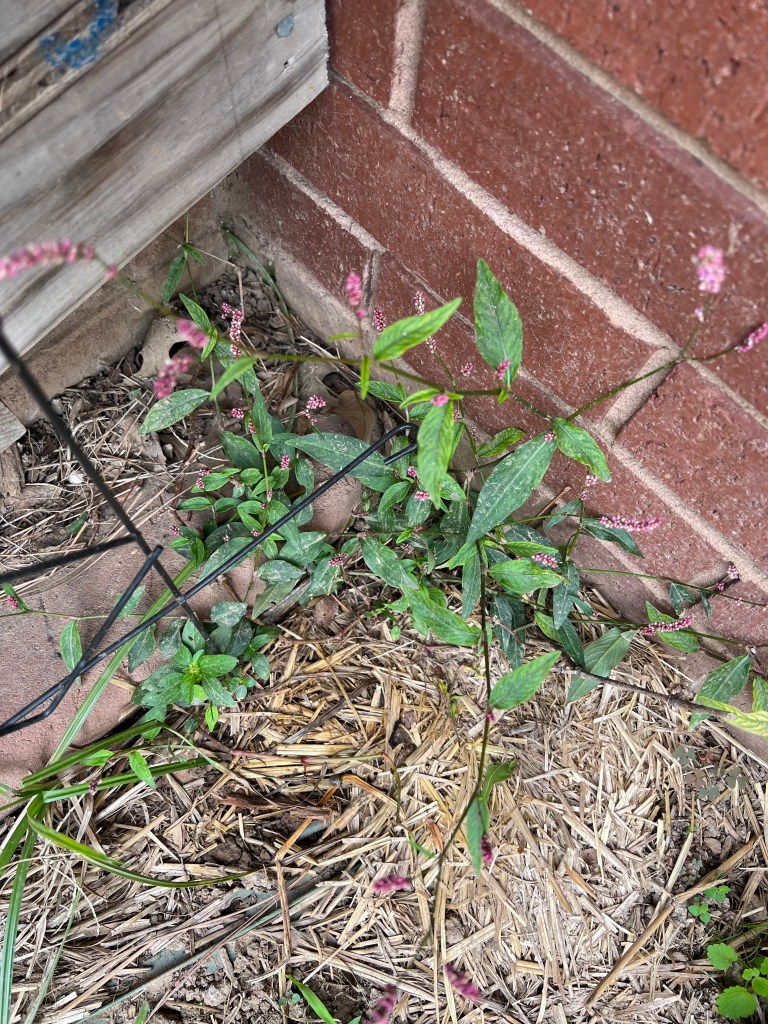
After removing the potato plants (not “harvest” because I grew so few) from one of the back beds there is not much that has taken hold. That was in part due to the straw mulch, which was still over most of the area, but also because Loki kept digging holes in the bed. While I still intend to amend the soil and mulch the bed before winter, I have not got that accomplished. When I removed the potato plants and grass there were some weeds that had already established in the perimeter along the house. Now that they have access to the sunshine they have begun to thrive. When I checked the bed this morning the plants had pink flowers that were in full bloom.
When I checked online, I found Pennsylvania Smartweed (Polygonum pensylvanicum), also known as pinkweed, is a species of flowering plant in the buckwheat family, Polygonaceae. It is native to parts of North America and is widespread in Canada and the US and has been introduced in parts of Europe and South America. Pennsylvania smartweed is a variable annual herb that grows from 4 inches (10 cm) to 6.5 feet (2 m) tall. The upright, ribbed stems can be either branched or unbranched and the lance-shaped leaves have a short stalk that attaches the leaf blade to the stem (petiole) that is able to twist the leaf to face the sun. This produces a characteristic foliage arrangement (spacing of blades). The petiole and a blade are about 1.5 to 6.5 inches (4–17 cm) long but may grow up to 9 inches (23 cm). The flowers have five pinkish or greenish tepals each a few millimeters long. The seeds are black, shiny flattened, almost round. The plant grows in moist, disturbed habitat types, such as ponds, reservoirs, riverbanks, irrigated fields, and ditches (as well as garden beds).
Pennsylvania smartweed is considered an important part of the habitat for waterfowl and other birds, which use it for food and cover. At least 50 species of birds have been observed feeding on the seeds, including ducks, geese, rails, bobwhites, mourning dove, and ring-necked pheasant. The seeds and other parts are eaten by mammals such as the white-footed mouse, muskrat, raccoon, and fox squirrel.
The smartweed family (Polygonaceae) includes around 900 species that range from annual herbs to perennial trees, and includes buckwheat, dock, and rhubarb. The genus Polygonum typically has simple leaves which often have dark blotches on them. In some manuals, Pennsylvania smartweed is called Persicaria pensylvanica. Native Americans have various uses for the plant. The Chippewa use it for epilepsy and the Iroquois use it for horse colic. The Menominee take a leaf infusion for hemorrhage of blood from the mouth and post-partum healing and the Meskwaki use it on bleeding hemorrhoids.
Thoughts: I found it interesting that smartweed was listed as an invasive weed on agricultural sites even as it is sold on garden sites as wildflower. Agricultural sites focused on the invasiveness in hay fields and cultivated lands. Garden sites point to the different types of insects that seek out the plant in search of nectar (bees, butterflies, moths, wasps, flies, and beetles). Bird sites say the plant and seeds are an important part of diet for various waterfowl and gamebirds. The seeds eaten by birds are not fully digestible, so the partially digested seed is spread in bird droppings. Yet another case of one person’s weed being a viable part of other bird and human ecosystems. Act for all. Change is coming and it starts with you.
 A travelers odyssey