
October 20, 2023
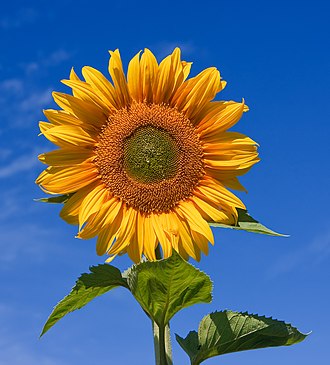
I received several likes and comments from my “Last” blog, and I thought I would share what my sister in Maine said. She had also brought in the last of her green heirloom tomatoes and hoped they would ripen on the counter. When she had cleared away the foliage and ripped up the vines there were two ugly cucumbers (Cucumis sativus) hidden among the undergrowth. Together the tomato and cucumber may provide toppings for a tasty salad. The last item was a huge sunflower that had been growing in the garden. I have occasionally grown sunflowers along the back fence (from spilled bird seed) and had intended to plant several rows of sunflowers in the front bed (maximum sunlight), but again this was one of the projects life had thwarted this year. My sister’s sunflower had been grown purposefully and she was hoping to harvest and dry the seed. Perhaps another tasty morsal for her growing salad.
When I looked online, I found the common sunflower (Helianthus annuus) is a species of large annual forb of the genus Helianthus that is commonly grown as a crop for its edible oily seeds. Apart from cooking oil production, sunflower is also used as livestock forage (as a meal or a silage plant), as bird food, in some industrial applications, and as an ornamental flower in domestic gardens. Wild sunflower is a widely branched annual plant with many flower heads, but the domestic sunflower often has only a single large flower head (inflorescence) atop an unbranched stem. The plant has an erect rough-hairy stem that reaches a typical height of 10 feet (3 m), but the tallest sunflower on record reached 30 feet 1 inch (9.17 m). Sunflower leaves are broad, coarsely toothed, rough, mostly alternate, and those nearest the bottom are largest and commonly heart shaped. The plant was first domesticated in the Americas and seeds were brought to Europe in the 16th century. The seeds and oil quickly became a widespread cooking ingredient. The bulk of industrial-scale sunflower production has now shifted to Eastern Europe. During 2020 Russia and Ukraine produce over half of worldwide seed production.
The common sunflower was one of several plants cultivated by the Indigenous peoples in prehistoric North America as part of the Eastern Agricultural Complex. It was once thought the sunflower was first domesticated in the (now) southeastern US around 5,000 years ago. Recent evidence indicates the species was instead domesticated in Mexico around 2600 BCE as the seeds were found in Tabasco, Mexico, at the San Andres dig site. The earliest known US examples of a fully domesticated sunflower have been found in Tennessee, dating to around 2300 BCE. Other early examples come from rock shelter sites in Eastern Kentucky. Many of the Americas indigenous peoples used the sunflower as the symbol of their solar deity, including the Aztecs and Otomi of Mexico and the Incas in South America. Of the four plants known to have been domesticated in eastern North America that have become important agricultural commodities, the sunflower is currently the most economically important.
Thoughts: During the 18th century, the use of sunflower oil became very popular in Russia, particularly with members of the Russian Orthodox Church, because fasting traditions only allowed plant-based fats during Lent. The sunflower was commercialized in the early 19th century in the village of Alekseyeva by a merchant named Daniil Bokaryov, who developed a technology suitable for its large-scale extraction. The town’s coat of arms has included an image of a sunflower ever since. That makes the sunflower a mix of (indigenous) American discovery and Russian ingenuity. To quote Rocky IV, “During this fight I’ve seen a lot of changing . . . if I can change, and you can change, everybody can change!” That is wisdom to strive for. Act for all. Change is coming and it starts with you.
 A travelers odyssey