
October 21, 2023
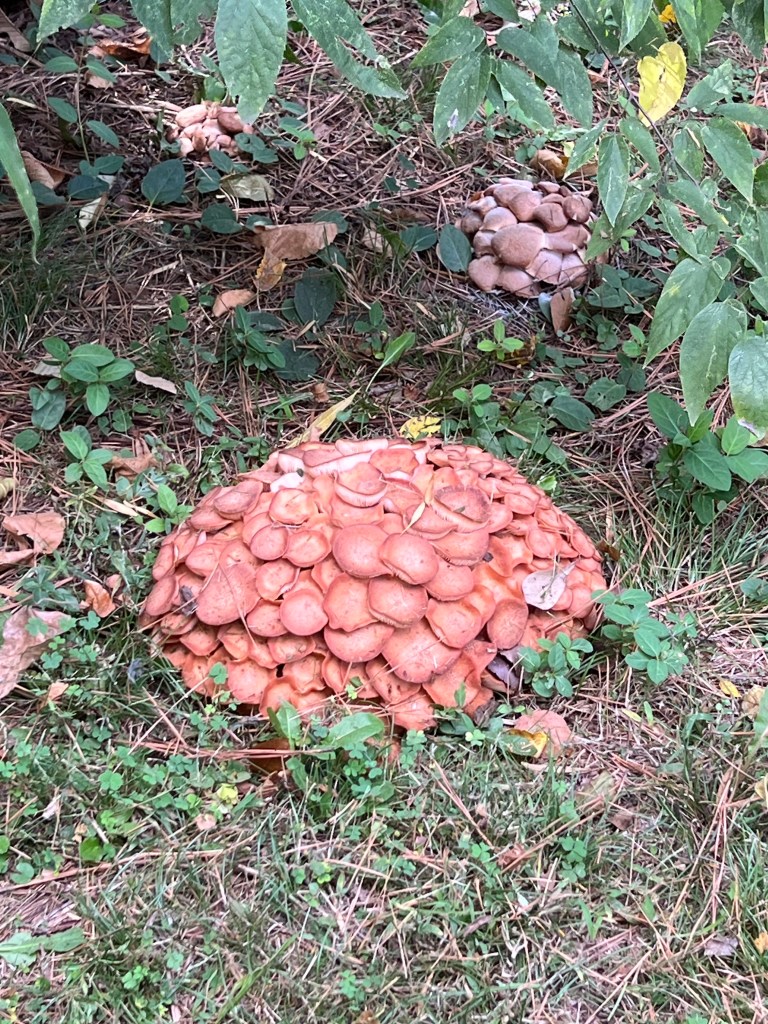
I do not always go behind our outbuilding when I mow. The view of the area is blocked by the building and the trees that are on either side. The area of only about 600 feet2 (56 m2) and much of it is covered with the dead needles of the large Loblolly Pine (Pinus taeda) on one side of the building. When I do go back to mow, I often find interesting things happening. Several years ago, I wrote about how a large portion of the area was covered with mock strawberries (Duchesnea indica). While the mock fruit is similar in appearance to wild strawberry (Fragaria vesca) it is not edible, although the plant itself has been used medicinally as an antiseptic, an anticoagulant, and in a poultice for boils and burns. The next year the gardener from the church that abuts our yard knocked on our door to say the large American elm (Ulmus americana) had blown down in the wind and was lying on their property. He asked if I would allow his friend to cut it up for firewood. I did allow it, or else I would have had to pay to have it removed. Last week when I went back to mow the area was covered with honey mushroom clusters.
When I looked online, I found the Ringless Honey Mushroom (Armillaria tabescens) is a species of fungus in the family Physalacriaceae. The mushroom is an infectious organism (pathogen) that is found in warm and dry regions, so it tends to be in southern areas. It has been found in altitudes ranging from sea level to 4,300 feet (1,300 m). the mushroom clusters frow quickly at 82 to 86F (28 to 30C) and more slowly at 41F (5C). The species has a golden, honey-colored cap, white spores, narrow to broad pinkish/brown gills, and thick, cluster stalks. This type of mushroom grows from late summer to early winter throughout the United States, including Arkansas. You can often find the Ringless Honey Mushrooms in Oak Tree Stumps and Trunks in local parks.
The honey mushroom is a plant pathogen and is often found to attack trees that are already stressed or have a wound (like what is left of my elm). The mushroom can spread its mycelia and get into the trunk or root of a tree. The fungus can spread its mycelia throughout the root and trunk system and form mycelial mats (the root-like structure of a fungus). Mycelia is damaging to trees because they absorb the nutrients by secreting enzymes to breakdown the plant material. It specifically breaks down the support tissue of the plant (lignin) because it is a white rot. The root system of the downed elm was expansive, and that explains the number of mushroom clusters I found in the back area of our yard. Another website stressed you should kill these mushrooms when you see them as they are considered a parasitic fungus that will attack and kill your trees by depleting them of water and nutrients.
Thoughts: One interesting fact is that the ringless honey mushroom grows underneath the ground, rather than on top of it. The best way to get rid of the mushroom is to destroy its roots beneath the ground. Since I had come back to the area to mow, I went ahead and mowed most of the mushroom clusters but did preserve one large cluster so I could examine it further. I was surprised when I went back to the area to see all the mushroom clusters I mowed were gone. The mower was set too high to cut them down and had only damaged the tops, but all that was left (except for the big one) was white patches on the ground. I assume that is the remains of white rot. Like most species in nature, even pathogens have purpose and worth. The mushroom in my back yard was busy breaking down the remains of the tree roots I had left in the ground. This will eventually allow another tree to grow in the same spot. Each species has a unique place in the local ecosystem. Nature will return systems disrupted by human activity back to balance, but it may take hundreds of years or more. Humans may not have that much time to wait. Act for all. Change is coming and it starts with you.
 A travelers odyssey