
October 23, 2023
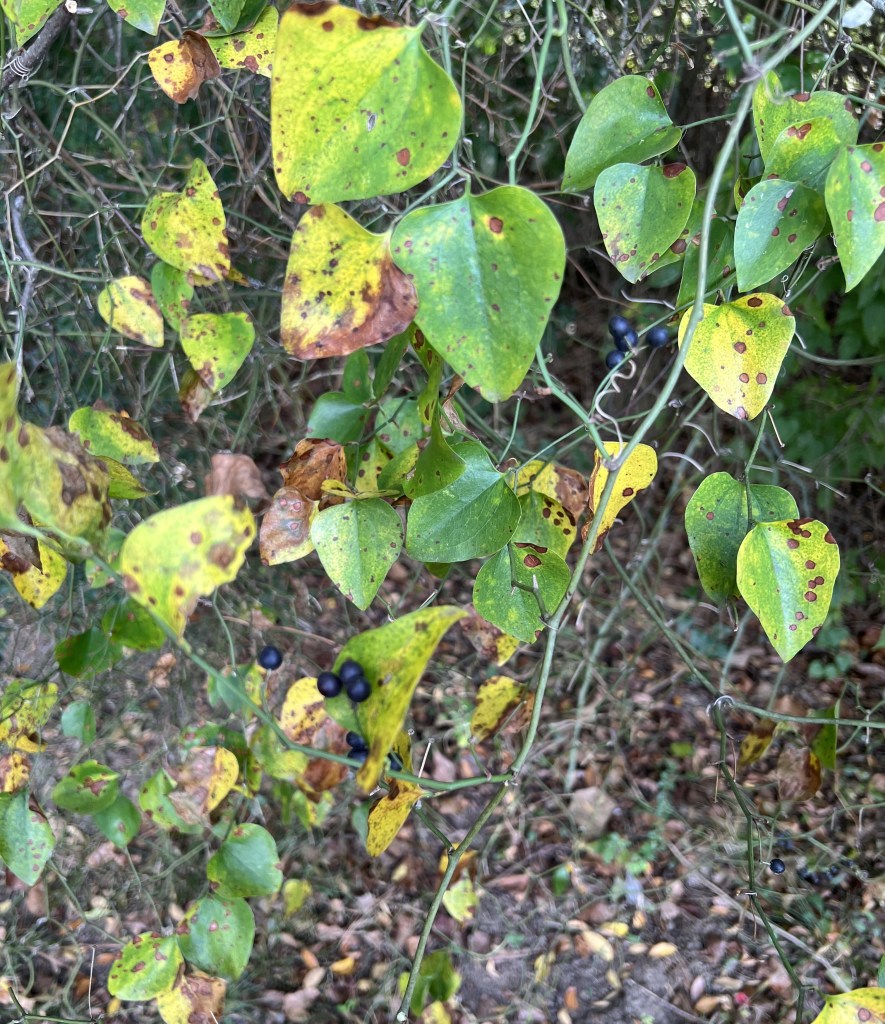
As I have been mowing along the back tree line of our yard, I have been running into a prickly vine that has slowly been taking over the overhanging limbs. I usually just ignore both the limbs and vines and mow around them. Occasionally I will plow the mower through the overhanging limbs and invariably the vines will catch on the noise reducing earmuffs I wear while mowing and pull them off. I had already cut back the limbs hanging down from the American elm (Ulmus americana) that sits near the outbuilding along with the Loblolly Pine (Pinus taeda). I had begun to cut back the limbs along the tree line at the same time but managed to break one handle off the lopping shears (I did not know you could break forged steel). Since I am in a fall cleanup mode (sorta) I decided it was time to take the garden pruners and get rid of the smaller diameter overhanging limbs along with the vines. When I examined the vines and the blackish berries that have ripened, I recognized it as greenbrier.
When I looked online, I found roundleaf greenbrier (Smilax rotundifolia), also known as common greenbrier, is a woody vine native to the southeastern and eastern US and eastern Canada. As its common names suggest, greenbrier is a green vine with thorns. Greenbrier is a crawling vine that can tangle itself within other plants and climb with small tendrils. The plant can grow up to 20 feet (6 m) long by climbing objects and vegetation, but if there is nothing to climb on it will grow along the ground. The woody stems are pale green in color and are glabrous (technical term for a lack of hair, down, setae, trichomes, or other covering), the youngest of which are often square-shaped. As the vine dies the stem turns to a dark brown color. The leaves are glossy green and are generally 2 to 5 inches (5 to 13 cm) long. The black-tipped thorns found along the stem are about 1/3 inch (.8 cm) long. Small sheaths with terminal tendrils are present at the base of each petiole (stem attaching the leaf). Greenbrier is a common and conspicuous part of the natural forest ecosystems in much of its native range.
Common greenbrier has male and female flowers that are produced on different plants (dioecious) that are both are about the same size at 1/4 inch (.6 cm) long. The flowers bloom for about two weeks in late spring and early summer and then the female flowers are replaced by a bluish-black berry that ripens in September. Common greenbrier can be found in almost all habitat types, including wetlands, and grows along roadsides, landscapes, woods, and clearings. In clearings the vines will often form dense and impassable thickets. The berries and leaves often persist into late winter and are an important food plant at a time when there are more limited food choices. Wildlife that will eat the berries and leaves in the late winter and early spring are the Northern Cardinal (Cardinalis cardinalis), white throated sparrow (Zonotrichia albicollis), white tailed deer (Odocoileus virginianus), and various species of rabbits (family Leporidae). Since my patch of greenbrier has grown to an impassible tangle, I need to remove it from the yard, but I will let it grow in the tree line as it forms an effective barrier for larger critters.
Thoughts: Common greenbrier grows from modified subterranean plant stems (rhizomes) which allow the plant to resist fire by resprouting, and fires that open the canopies of dense forests encourage the vines. A New Hampshire analysis found greenbrier responds to fire with rapid growth. Two years after a prescribed burn the amount of greenbrier was back to its original density, and different frequencies and intensities of fire made no difference. The findings suggest my task with the greenbrier will be ongoing, especially as I encourage the plant in some areas to feed wildlife and deter trespassers. Melissa’s mom kept beautiful flower beds and hanging flowerpots. I asked Melissa how she did it and was told, “by constant work”. Being a steward of the land is a never ending task but the cost to the environment by ignoring the land is greater than we can bear. Act for all. Change is coming and it starts with you.
 A travelers odyssey