
October 30, 2023
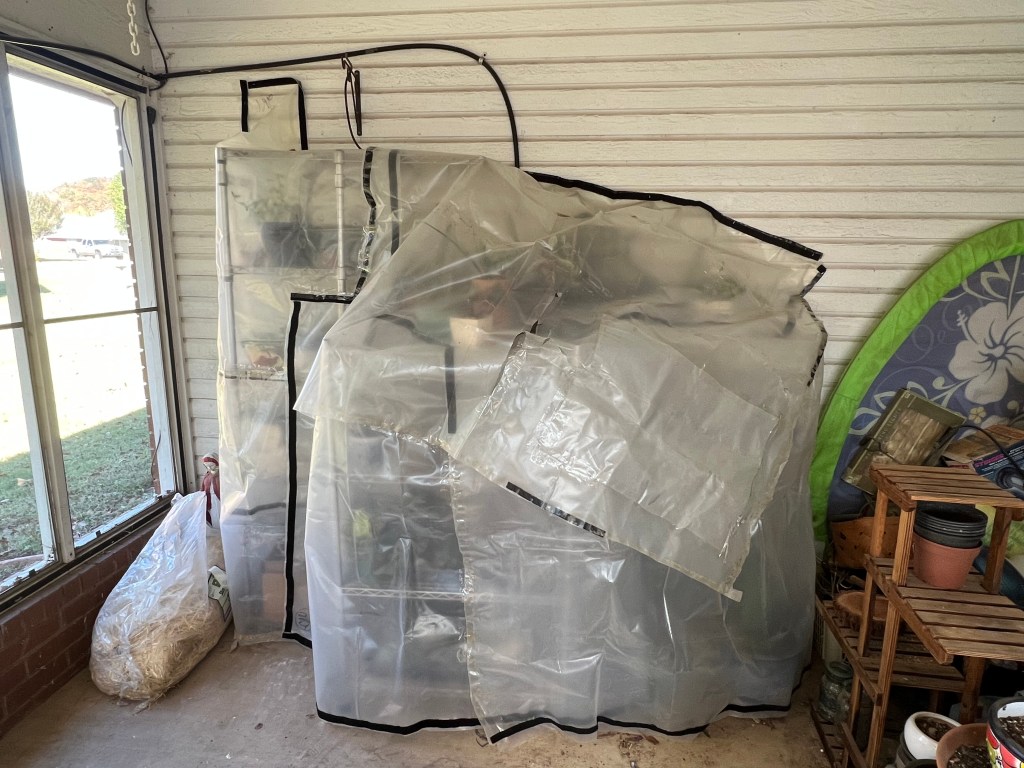
As we approached the first winter after Melissa started her succulent business (Uliyesdi Succulent Design) we faced a problem. The cacti and succulents she grew and propagated had taken over the house and moved onto the covered front entry and back screen porch. Both areas provided indirect light along with a cool breeze to help the plants flourish as many of the plants originated in tropical climates. While they were innately attuned to warm and even arid conditions, many were not able to withstand freezing (32F/0C), and especially temperatures below 28F (-2.2C) for extended periods of time (hard freeze). We checked several window dealers and were told the porch required custom windows that were well above our price range. We came up with a solution of attaching heavy mil plastic to the screens with Velcro. This allowed an insulation buffer to keep out the cold and Melissa could open the wrap for ventilation on warmer days. This stopgap measure has worked well for the last two winters.
When I looked online, I found stopgap (or stop-gap) applies to something used temporarily as an emergency measure. According to dictionary.com, stopgap is an adjective used for the verb phrase “stop a gap” (i.e., to plug a hole) and emerged around 1525-1535. Merriam-Webster has the first known use in 1684. Google Ngrams indicates “stopgap” appeared briefly in the 1700’s then disappeared until the middle of the 1800’s. After its reappearance, the word took off dramatically although it has begun to wane slightly in the last 60 years. Use of the word originated where there is a gap somewhere (or in something). As a temporary fix you just jamb something into the gap to close it. This emergency repair is a “stopgap”. This temporary fix could be given to a leaky boat, a hole in the wall of a house, or to fix a hole in a bucket. The word also implies there will be a more permanent solution in the future. The metaphor is now used in many diverse situations.
While our stopgap porch greenhouse has been effective over the last two years, we always knew it was a temporary solution. The plastic is still pliable and has only suffered a few tears during its use. The bigger problem has been the Velcro. The glue that adheres to the back of the plastic degrades. This worked well the first year, but there were places where it would come loose. Last year we ended up replacing around 25% of the Velcro as it would no longer adhere. When I removed the screens last spring, I noticed there was more Velcro that would need to be replaced. I asked Melissa to order several more rolls of the double-backed system and had them ready to go. Then Melissa told me about a friend from college who had a construction business that specialized in building sunrooms and porches. We called him and he came over to give us an estimate. Rather than install 15 individual custom windows, he suggested replacing the old wooden frames with the window systems sponsored by his supplier. Now we are scheduled to have five 60 inch (1.5m) sliding windows and exterior door. The plants will love it.
Thoughts: We ordered the window system and were assured it would be here in 3 to 4 weeks and would be installed in 1 to 2 days. That places the completed order well before the intense cold that usually arrives in December and January. The problem is we are predicted to have two nights this week that fall into the hard freeze range before warming back up to our normal night temperatures in the 40’s and 50’sF (4.5’s and 10’sC). Rather than replacing the Velcro and plastic system we are again applying a stopgap. We need to move the plants and shelving to install the windows anyway, so Melissa decided to bring several shelves inside along with the more vulnerable plants and then group the remaining shelves and plants along the interior wall where I can cover them with last year’s plastic. I am seeing stopgap to also mean ingenuity. Perhaps we should all be more willing to innovate with stopgap measures. Act for all. Change is coming and it starts with you.
 A travelers odyssey