
November 08, 2023
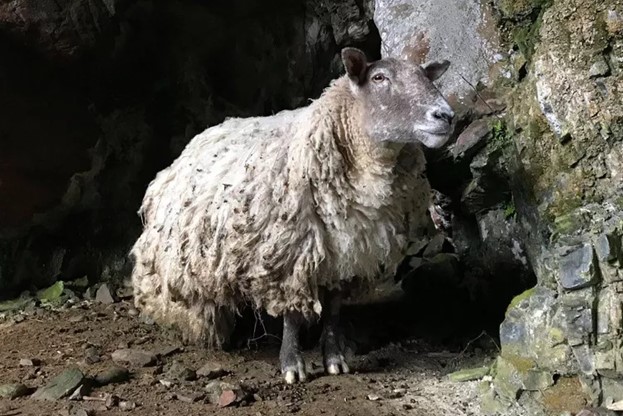
PHOTO: ANIMAL RISING
Last year I commented on Fiona the Hippo who had just turned five (now six) and all the fanfare that has marked her life. Fiona was born six weeks premature in 2017 and only weighed 29 pounds (13 kg). The story captured the attention of Cincinnati and the world. The zoo’s marketing spokesperson called Fiona “the story of hope” and her INL brand has been attached to cookies, coffee, shirts, mugs, and books. I came across another animal named Fiona that contrasted with the love and attention showered on her hippopotamus (Hippopotamus amphibius) namesake. After spending at least two years stuck at the bottom of a cliff in Scotland, Fiona the sheep was finally rescued and is now living at a farm about 25 miles north of the border with England. Once known as Britain’s loneliest sheep, she is no longer alone.
When I looked online, I found the Border Cheviot (Ovis aries var.), also known as the South Country Cheviot, is a breed of domesticated sheep from the UK native to the Cheviot Hills between Scotland and England. The beginnings of the Cheviot breed existed in the Cheviot Hills of Northern England as far back as the early 1300’s. These sheep were described as small hardy animals with a “long white face” and other physical attributes of the present day Cheviot. The Cheviot is a distinctive white-faced sheep, with a wool-free face and legs, pricked ears, black muzzle, and black feet. About 1370 CE considerable numbers of these “longfaces” found their way north from the English hills into the border country in the south of Scotland where they mingled with and gradually displaced the primitive tan-faced sheep that had been reared mainly for their hardiness and mutton qualities without much regard for wool. The breed was recognized as early as 1372 and is prized for its wool, although bred primarily for meat. The rams can have horns, but the ewes are naturally polled. The live weight of a mature Border Cheviot ram ranges from 154 to 187 pounds (70 to 85 kg) and a mature ewe is from 121 to 154 pounds (55 to 70kg). Border Cheviot are very hardy and strong animals that are well suited to their local harsh climates and rugged conditions. This no doubt helped the loneliest sheep survive for two years on her own.
The rescue of the “loneliest sheep” came when five farmers from the Scottish Highlands used an all-terrain vehicle with a winch to haul her up the cliff. Last month, kayaker Jillian Turner saw Fiona on the shores of Cromarty Firth in the Scottish Highlands. This was two years after the sheep was first spotted at the same location. Over 50,000 people signed a petition asking for Fiona’s rescue on Change.org, but the Coast Guard and the Scottish Society for the Prevention of Cruelty to Animals (SPCA) hesitated over performing a rescue operation, believing Fiona’s position was too dangerous to reach. Despite this, the five farmers used an all-terrain vehicle with a winch attached to it to lower themselves 820 feet (250 m) down the cliffside and then to bring them back up with the sheep. Graeme Parker who headed the group said, “When we got down there, sure enough, Fiona was . . . right in the middle of the cave in a little patch of sunlight that’s coming through a craggy hole in the ceiling of the cave.” Fiona is no longer the loneliest sheep in the UK.
Thoughts: Fiona was taken to a farm to live in a pen alone where she will be slowly integrated with a small herd of other animals. Animal Rising, an animal rights group, has argued that Fiona should have been taken to a sanctuary where she could “live out the rest of her life in peace and security.” The group added it was planning its own rescue of Fiona, but the farmers completed their rescue first. My question is why someone did not do something two years ago, and how did Fiona get there in the first place? Humans tend to wait to act until there is a crisis or public outcry, then criticize others who accomplish what we were reluctant to attempt. Act for all. Change is coming and it starts with you.
 A travelers odyssey