
November 10, 2023
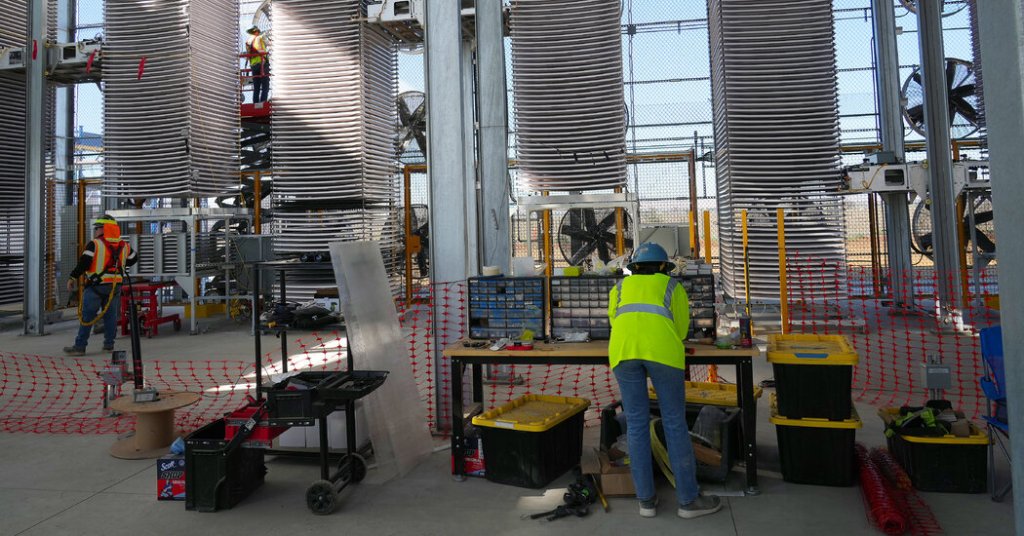
While scrolling my NY Times Morning feed I found a climate blurb about a new US plant designed to pull carbon (CO2) from the air. Heirloom Carbon Technologies calls this the first commercial plant in the US to use direct air capture to remove greenhouse gases from the atmosphere. The open-air warehouse in California’s Central Valley uses 40-foot-tall (12 m) racks holding 100’s of trays filled with a white powder that turns crusty as it absorbs carbon dioxide. The carbon dioxide pulled is then permanently sealed in concrete. Heirloom’s revenue comes from selling carbon removal credits to companies paying to offset their own emissions. Microsoft has already signed a deal with Heirloom to remove 315,000 tons of CO2 from the atmosphere. The plant can absorb up to 1,000 tons of carbon dioxide per year, equal to the exhaust from 200 cars, but Heirloom hopes to expand quickly. Another larger carbon capture plant is already operating in Iceland and scientists say the technique could be crucial for fighting climate change.
When I looked online, I found the Orca project in Iceland purposes to capture about 4,000 tons of carbon dioxide a year and store it deep underground. Orca was launched on September 8, 2021, as the first and largest direct air capture and storage plant in the world. The facilities eight collector containers have an annual capture capacity of 500 tons each. The plant was built by Zurich-based Climeworks and the heat and electricity required to run the process is supplied by the Hellisheidi Geothermal Power Plant. The 4,000 tons of captured carbon is stored underground and turned into stone. The plant uses massive fans to draw in large amounts of air to contact chemicals which can selectively remove carbon dioxide. The carbon-rich chemicals are then heated to about 212F (100C) to release carbon dioxide as a pure gas. The Icelandic startup Carbfix partnered with Orca to then mix the pure gas with water and pump it deep into basaltic rock where it will crystallize into a mineral in about two years. The carbon offsets gained by the Orca project are the most expensive in the world.
Even 4,000 tons of carbon represents a fraction of global carbon emissions, which has been forecast by the International Energy Agency (IEA) to reach up to 33 billion tons this year. The Orca company originally sought to capture 1% of annual global emissions, or more than 300 million tons, by 2025 but has since lowered the target to 500,000 tons by that same date. Climeworks has plans for a facility that will be 10 times larger and could collect millions of tons of carbon dioxide in the next three years. The high demand for carbon offsets has surprised some as the plant charges up to €1,000 (US$1,067) for a ton of CO2 removed. Climeworks will need to lower carbon capture prices to attract and encourage large polluting companies to purchase carbon offsets rather than play the penalty. Some critics argue global efforts should focus more on reducing carbon emissions than on technology to capture and store carbon. Throwing this much resource and energy could become a distraction for the immediate carbon reduction goals set out in the Paris Agreement.
Thoughts: The capture of carbon from the air is an innovative technology that could go a long way toward reducing carbon dioxide that causes global warming. It also appears to be one of the ways polluting corporations have found to honor their pledge to reduce their carbon footprint to zero by 2030 (or 2050?). Rather than investing in technology that will eliminate production of carbon dioxide, they are able to maintain their current practice and pay someone else to eliminate existing carbon. Big corporations are about the bottom line. The carbon removal credits were intended to reward big polluters for redesigning the production process. If it is cheaper to continue to pollute and pay someone else to reduce the overall level of pollution many may take this tact. Global warming should not be treated as an either/or, but as a both/and. Act for all. Change is coming and it starts with you.
 A travelers odyssey