
November 12, 2023
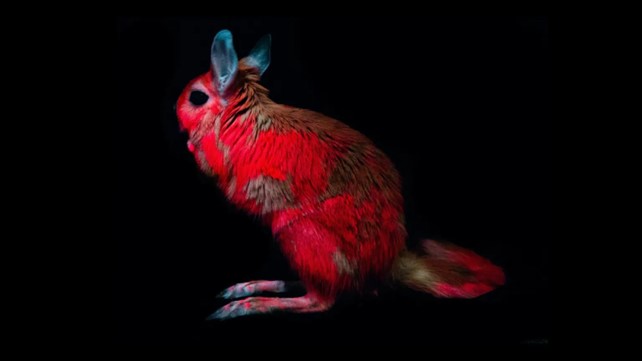
© J. Martin and E. Olson, Northland College; from Olson et al. 2021, Scientific Reports.
One of my favorite pastimes on summer nights as a child was catching fireflies (family: Lampyridae). My brother and I would catch the blinking insects as they flew around our yard and place them in glass jars. By the time we were called into the house we would always have a glowing lantern of fireflies that would blink on and off, lighting up the jar and giving us great delight. When I looked at one of the side posts from my NY Times feed today, I found these insects are not the only fluorescent animals in the world. There is a growing body of research that lists large numbers of bioluminescent mammals. The latest addition is a jumping rodent called the South African springhare (Pedetes capensis). Scientists found when the animal’s brown fur is exposed to ultraviolet (UV) rays it displays swirling disco patterns of pink and orange. This striking fluorescence was detected in both live animals and museum collections. The scientists reporting on the find called the springhare’s fluorescent colors “funky and vivid,” forming patterns that were highly diverse “relative to biofluorescence found in other mammals.”
When I looked online, I found biofluorescence occurs when higher energy wavelengths of light (e.g. ultra-violet or blue light) are absorbed and subsequently reemitted at lower energy wavelengths in living organisms. This results in a glow of brilliant fluorescent colors including blues, greens, and reds. The phenomenon is widespread among animals and can be caused by several different proteins, pigments, metabolites, and chemical reactions. The process of biofluorescence has long fascinated humans, and as far back as 79 AD humans experimented with the concept. Gaius Plinius Secundus (AD 23/24 – AD 79), called Pliny the Elder, was a Roman author, naturalist, natural philosopher, a commander of the early Roman Empire, and a friend of the emperor Vespasian. He recorded the first use of bioluminescence as a kind of torch by rubbing a stick against jellyfish slime. It was only recently that scientists accidentally discovered that mammals can also shine. Jon Martin, a forestry professor, was exploring the forest at night using a UV flashlight to scan the canopy for biofluorescence from lichens, fungi, plants, and frogs. He heard the chirp of a northern flying squirrel (Glaucomys sabrinus) and pointing the flashlight at it, was amazed to see pink fluorescence.
Until Martin found biofluorescence in the squirrels, the only other mammals known to have fluorescent fur were about two dozen species of opossum (order: Didelphimorphia) . These marsupials are scattered across the Americas and are not closely related to flying squirrels. They live in different ecosystems and have a different diet, suggesting that the glowing characteristic could be much more widespread than thought. The small mammals do share one thing in common in they are all active at night and twilight, where other squirrels are mostly active in daylight (diurnal). Many of the other biofluorescent mammals identified are either nocturnal (night) or crepuscular (twilight), suggesting the reason the animals glow is linked to their night life. However, biofluorescence requires a light source for the glow to re-emit, and there is less UV light at night. There may be more to the mammals biofluorescence.
Thoughts: Field studies are required to examine if there are any advantages or disadvantages of this ability within these species’ natural environment and to see whether biofluorescence has a role in communication, sexual selection, camouflage, or no obvious function at all. Australian Museum wildlife forensic scientist Greta Frankham adds, “Predators don’t seem to glow. I think this is because if predators could be seen, they would lose all chance of catching their prey.” As mammal predators humans do not glow either, except when we are really happy. Although it is detectable by other humans, it is not biofluorescence. Act for all. Change is coming and it starts with you.
 A travelers odyssey