
November 12, 2023
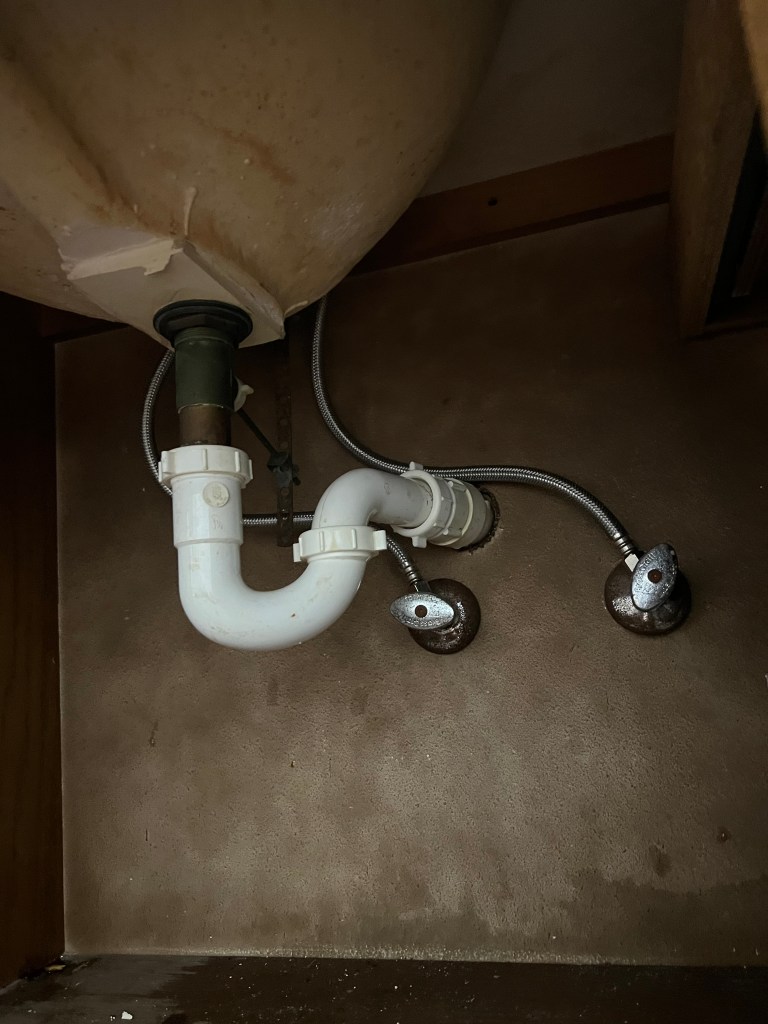
Yesterday I decided it was time to test my Do-It-Yourself (DIY) skills. I had contacted a plumbing firm to do an an inspection of my water heater and while they were not able to drain my water heater (what I wanted) they gave me the “courtesy” of looking at my sinks and faucets. The assessment was I needed to replace the water heater, the water lines for the sinks, and the kitchen faucet was leaking. This could all be repaired for 5 to 10,000 US$. I decided to skip the expense, but then the kitchen faucet went completely out. I went to my local hardware store and purchased a similar faucet and the eight water lines (flex steel) I needed. The threads for the kitchen water line had frozen shut and I was unable to replace them. I called my usual plumber and was told he could come today. I had intended to have him work on all the projects, but since I had time, I set to work replacing the water lines in the bathroom sink. This was a start-and-stop process that sent me back to the store for tools and supplies. I was finally able to replace the lines (I do not fit well beneath the vanity) and was proud of my accomplishment. That made me think I could do anything, so I went back to work on the kitchen faucet. I quickly broke off the shutoff valve. I decided to wait for the man to fix my plumbing.
When I looked online, I found plumbing for clean water and sanitation has been around since the stone age (Neolithic). Where water resources, infrastructure, or sanitation systems were insufficient, diseases spread, and people fell sick or died prematurely. That meant large human settlements could only develop around fresh water like rivers or springs. People have historically devised systems to get water into their communities and dispose of wastewater. Early on, raw sewage was transported by a natural body of water (river or ocean) where it was diluted and dissipated. With the Neolithic, humans dug the first permanent water wells, and the water was carried to homes in handheld pots. Wells dug around 8500 BCE have been found on Cyprus, and by 6500 BCE in the Jezreel Valley (now Israel). Skara Brae, a Neolithic village in Orkney, Scotland, was found to have water-flushing toilets from 3180 BCE to 2500 BCE. This consisted of two stone channels lined with tree bark (for fresh and wastewater) in the city’s houses. A cell-like enclave from 3000 BCE was also found in several houses in Skara Brae that are suggested to have served early indoor latrine.
Constructing irrigation systems to bring fresh water into urban areas is one of the concepts that define a civilization. However, you also needed to get rid of the wastewater. The reuse of wastewater has been used since the earliest human settlements as an ancient sanitation process and served as a corollary to just diverting human waste outside urban settlements. Domestic wastewater was used for irrigation by prehistoric civilizations like the Mesopotamian, Indus Valley, and the Minoan since the Bronze Age (3200 to 1100 BCE). Wastewater was used for disposal, irrigation, and crop fertilization by Hellenic (Athens) civilizations and then by the Romans (Rome) in areas around larger cities. Plumbing is also known to have been used in East Asia since the Qin (750 BCE) and Han (200 BCE to 200 CE) Dynasties of China.
Thoughts: The Roman Empire had indoor plumbing consisting of a system of aqueducts and pipes that terminated in homes and at public wells and fountains. Rome (and others) used lead pipes which are commonly thought to be the cause of lead poisoning in the Roman Empire (and Nero’s madness), but the combination of running water which did not stay in the pipe for long and the precipitation scale that accumulated mitigated the risk from lead pipes. This is another urban myth that ranks up there with my DIY skills. There are times to defer to the experts. Act for all. Change is coming and it starts with you.
 A travelers odyssey