
November 16, 2023
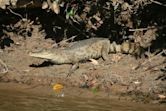
My NY Times feed reported on a new University of Florida (UF) study published in the journal Management of Biological Invasions saying wildlife biologists at the Institute of Food and Agricultural Sciences (IFAS) found a series of strategies to successfully control and remove caimans in some areas of the Everglades. Caiman have been established in Florida since the 1970’s since the pet trade (escapes and deliberate releases) made it possible for the species to invade the Florida Everglades. They pose a threat to native wildlife by occupying the same habitat as native alligators and crocodiles and compete for food and other resources. Scientists consider the removal efforts and results of the study a significant milestone for invasion science that has applications for other invasive species statewide and globally. Frank Mazzotti, a UF/IFAS professor of wildlife ecology and principal investigator for the caiman removal project, said “Managing invasive wildlife will not be an in-and-out process . . . early detection and rapid response, long-term removal efforts and multi-agency cooperation, . . . will be key to success.”
When I looked online, I found the spectacled caiman (Caiman crocodilus), also known as the white caiman, common caiman, and speckled caiman, is a crocodilian in the family Alligatoridae. The common name comes from a spectacle-like ridge between the animal’s eyes. The caiman was described by Carl Linnaeus in 1758 as Lacerta crocodilus but has since been redescribed several times, including as Caiman sclerops by Schneider in 1801. There are four subspecies of Caiman: the Rio Apaporis caiman (C. c. apaporiensis) endemic to Colombia and possibly the Venezuelan Llanos; the Chiapasius (C. c. chiapasius) in Mexico, Central America, and northern South America; the spectacled caiman (C. c. crocodilus) found in parts of South America; and the brown caiman (C. c. fuscus) in Nicaragua, Colombia, Ecuador, and Venezuela.The color is brownish-, greenish-, or yellowish-gray and grows to a length of 4 feet 7 inches to 8 feet 2 inches (1.4 to 2.5 m) and a weight of 15 to 88 pounds (7 to 40 kg). The males are both longer and heavier than females. Their diet varies seasonally, but consists of crabs, fish, small mammals, amphibians, and snails. Breeding ois from May to August and 14 to 40 eggs are laid in July and August.
Scientists at state and federal agencies see promise in the results and continued use of these strategies because they believe the caiman invasion has also impacted the restoration goals of the Comprehensive Everglades Restoration Plan (CERP). CERP is the largest ecosystem restoration project undertaken in the US to restore, preserve and protect the South Florida ecosystem, while providing for other needs of the region, including water supply and flood protection, with a cost of more than US$24.5 billion. A critical outcome of the team’s efforts was successfully reducing caimans in the Biscayne Bay Coastal Wetlands and C-111 Canal Project areas, important arteries in South Florida’s water management infrastructure designed to improve freshwater flow to Everglades National Park, Florida Bay, and Biscayne Bay. The study team compiled data from 2012 through 2021 of the project’s removal efforts, conducting weekly surveys, rapid responses for removal of reported caiman sightings, and performing necropsies of captured caimans.
Thoughts: Complete removal of the invasive caiman may not be possible. The Rio Apaporis caiman was believed to be extinct by 1981 when the last known zoo specimen died, but a specimen was captured for the TV show Extinct or Alive in 2019 and identified by DNA sampling. A “good idea” to introduce new species always has devastating effects on native species and the ecosystems they create. Nature is a balance created over thousands (millions?) of years. This lesson is critical as humans plan to move into the ocean and space. Act for all. Change is coming and it starts with you.
 A travelers odyssey