
November 21, 2023
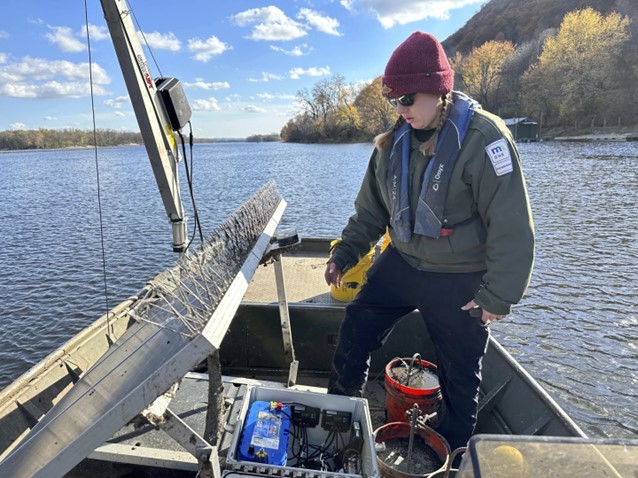
AP Photo/Todd Richmond
Hidden in the middle of the back section of my local newspaper I found an AP article on a new method of removing invasive carp in the Mississippi watershed of the central US. Last March I wrote about the invasive carp and the attempt by Canada to keep them out of their waters. Another attempt is to use the carp against their own species. Over the last five years the US Fish and Wildlife Service (USFWS) and Minnesota Department of Natural Resources (DNR) have employed turncoat carp to lead them to the fish’s hideouts. Agency workers capture carp, implant them with transmitters, and then release them. Floating receivers along the rivers send real-time notifications when a tagged carp swims past. The carp clump in schools in the spring and fall and the traitor carp’s location allows agency workers and commercial fishers to drop their nets and remove multiple fish. Kayla Stampfle, invasive carp field lead for the Minnesota DNR, said the goal is to monitor when carp start moving and use the tagged fish to ambush the school. “We use these fish as a traitor fish and set the nets around this fish,” she said.
When I looked online, I found there are four different carp species that are considered invasive: bighead (Hypophthalmichthys nobilis), black (Mylopharyngodon piceus), grass (Ctenopharyngodon idella), and silver (Hypophthalmichthys molitrix). All four were imported to the US in the 1960’s and 1970’s to help rid southern aquaculture farms of algae, weeds, and parasites. Flooding and accidental releases allowed them to escape, and they found their way into the Mississippi River where they have been spreading north through the rivers and streams ever since. The carp are voracious eaters (up to 40% of their bodyweight a day) and easily out-compete native species. The Associate Press reported state and federal agencies have spent US$607 million to stop the fish, and this is expected to hit US$1.5 billion over the next decade. Experts have employed defenses like electric barriers, walls of bubbles, and herding the carp into nets using underwater speakers. Tagging and releasing traitor fish began in the early 2000’s with the first receivers deployed in the Illinois River to stem migration into Lake Michigan.
Beginning around 2018, managers started placing solar-powered receivers around the Great Lakes region to track tagged traitor carp. The real-time notifications reveal where carp may be massing before a migration and show movement patterns. The receivers consist of a raft supporting three solar panels and a locked box with a modem and a computer that records contacts with tagged carp that pick up signals from over a mile away. Each receiver costs about $10,000. The federal Water Resources Reform and Development Act of 2014 authorized a multi-agency offensive against invasive carp which allows the USFWS to buy the receivers through its existing budget. The Minnesota DNR began deploying real-time receivers in the Mississippi backwaters forming the Minnesota-Wisconsin border around La Crosse three years ago, with four receivers out this year and plans for seven next year. Traitor carp helped wildlife managers and anglers double the poundage of invasive carp pulled from that area of river annually.
Thoughts: The use of traitor carp has drawn criticism from the fisheries industry because managers return tagged carp to the wild where they can breed, said Marc Smith, policy director at the National Wildlife Federation’s Great Lakes Regional Center. “In theory, it works,” Smith said. “We think the rewards outweigh the risk.” Funny, this is like what the Arkansas aquaculture farms thought when they imported the fish from Asia. It is always better for the existing ecosystem to avoid transplanting any new species. The actual risks are rarely known. Act for all. Change is coming and it starts with you.
 A travelers odyssey