
November 22, 2023
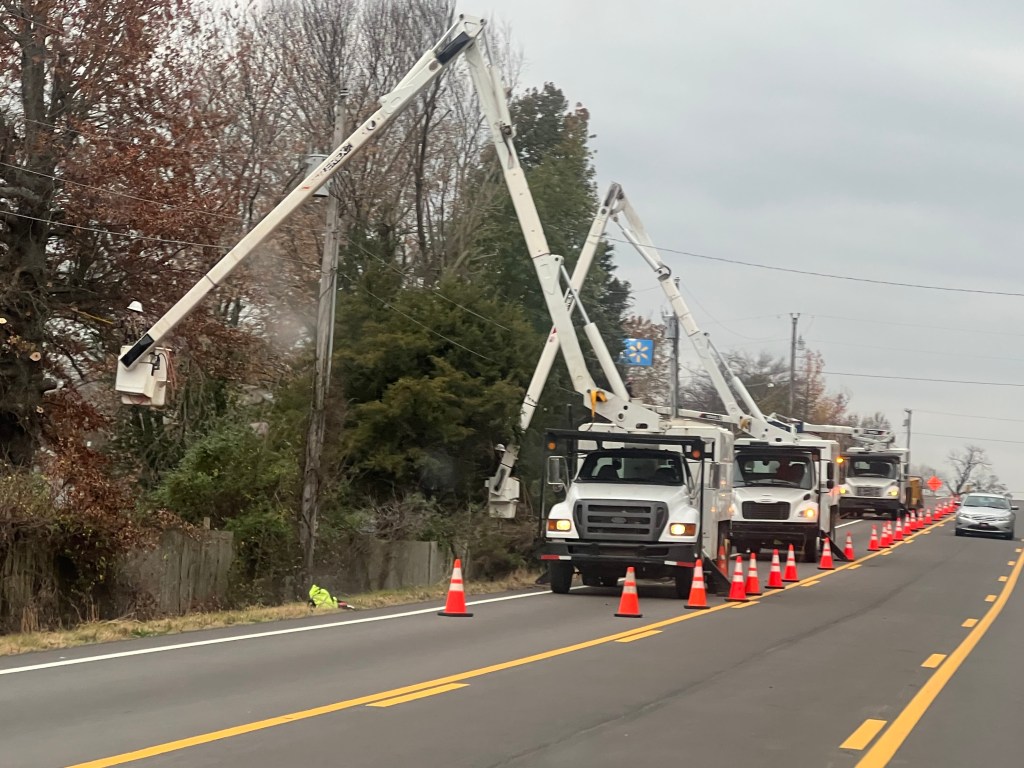
I decided yesterday to get to the store before the mad rush that takes place the day before Thanksgiving. As I drove along one of the two roads leading into our town, I was surprised to see traffic was backed up. I slowed and as I got closer to the snarl, noticed three bucket trucks parked along one side of the road completely blocking the oncoming lane. Although they had set up in a place where a middle turn lane was available, my lane was slowing down as the oncoming traffic was cautiously moving into the turn lane to get around the trucks. I was wondering what was so important that three trucks had been dispatched to this one location. Since they were bucket trucks and appeared to be working around the utility lines, I assumed there must have been an electrical problem that needed fixed immediately. Driving by the trucks I found all three trucks were there to trim the trees along the road.
When I looked online, I found one of the worst instances of planting the wrong tree in the wrong place is when it comes to overhead utility lines. Many trees must undergo drastic pruning or removal to make way for the power lines. The main cause of power line damage is from trees, and the utility companies need to vigilantly trim the trees to keep them away from the lines. When a tree is growing into power lines, it’s usually because someone chose a tree species without understanding how the tree’s mature size or growth habits might conflict with utility lines. Pruning is almost always less expensive and disruptive than repairing damage after a tree has caused an outage. When companies trim a tree around utility lines they often use “directional pruning”. Unlike residential or aesthetic pruning that enhances a tree’s natural form, directional pruning removes whole branches back to the main trunk to direct the tree’s growth around the overhead lines. Directional pruning often results in a V-shaped tree. It is the power line clearance requirements that dictate the tree’s shape, not aesthetics.
The trees I passed yesterday were along a road right-of-way, so the utility company had full rights to trim the trees. The trees were cut back to the fence line that abutted the homeowner’s property. Generally, a utility company may have access to lines when maintenance is needed, even if the lines run over your property. Other times the utilities are granted egress (access) to use a corridor through your property to maintain the lines. Utility companies generally try to notify you in advance if they will be on your land, but they (and their contractors) can enter your property to access trees that need to be trimmed even if you are not home or received a notification. On my way back from the market I saw the trim was complete and the trucks were gone. Even though the three trucks had caused traffic delays, it was done in the middle of the afternoon (before most traffic) and the number of trucks made the trim go quickly.
Thoughts: One of the features I added to the camp I directed in Kansas was a hiking trail. We grew native grasses and planted native flowers and then mowed trails through the tall grass. I always wanted to cut a trail along the fence line that went through a wooded section of the property, but the task of cutting and removing the trees seemed too daunting. The utility company ultimately resolved the issue for me. The utility lines went along the fence and the trees were impacting the lines. The company sent a team to trim the trees and in two days cut a swath for a 1/4 mile (.4 km) through the trees. This opened the area for my trail and laid down a mulch to keep the weeds down as the trees were cut. I never again complained about the odd trim jobs. After every major storm 1000’s of customers are left without power and millions of US$ are spent to rebuild the infrastructure. Nationally, roughly 25% of new distribution and transmission lines are built underground, according to a 2012 industry study. Burying power lines costs roughly US$1 million per mile. The US seems better at responding to an emergency than being proactive. Act for all. Change is coming and it starts with you.
 A travelers odyssey