
November 28, 2023
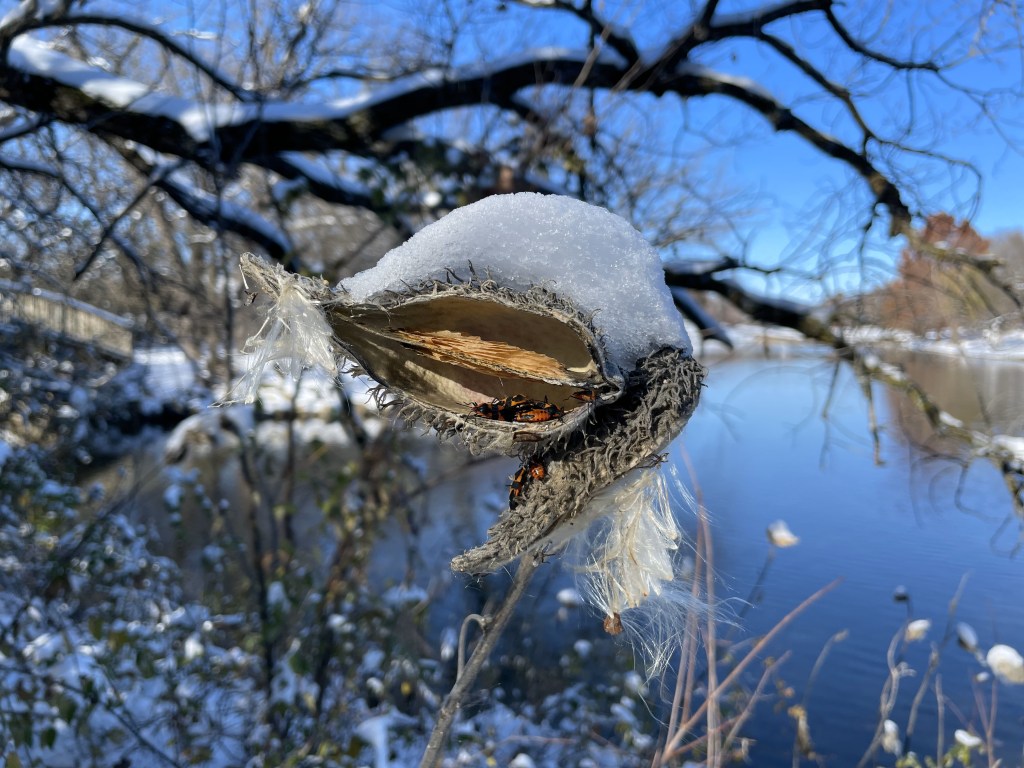
My brother in Kansas sent a picture that was taken shortly after the big snowstorm that came through their area last weekend. He lives next to a pond with a greenspace on the other side. While he was out for a walk, he took the picture that accompanies today’s blog. When I received the picture, I struggled to make out what was depicted. My sibs began a period of discovery to try and discern the nature of the photo. could not figure out what it was. My sister was the first to identify the dried husk (follicle) of the common milkweed (Asclepias syriaca). The plant requires a period of cold (cold stratification) to allow the pod to open and the seeds to germinate, and the cold weather is indicated by the covering of snow on top of the pod. The next clue came with the bugs contained inside the opened pod. My first thought was boxelder bugs (Boisea trivittata) because of their orange and black markings but they did not look quite right and their presence outside in winter belied the fact boxelder bugs often congregate in the siding and insulation of houses during this time. Then I realized these were milkweed bugs.
When I looked online, I found milkweed bugs (Oncopeltus fasciatus) are a medium-sized hemipteran (true bug) of the family Lygaeidae. The bugs are distributed throughout North America, from Central America through Mexico and the Caribbean to southern areas in Canada, with Costa Rica being its southern limit. Milkweed bugs often inhabit disturbed areas, roadsides, and open pastures. The widespread geographic distribution of the bugs creates a varying life history trade-off depending on the population location, including differences in wing length and other traits. Adults can range from .43 to .47 inches (11 to 12 mm) in length. They display a red/orange and black X-shaped pattern on their wings underneath the triangle that is typical to hemipterans. This feature makes the bugs easily seen and acts as a warning (aposematic) of distastefulness as the bugs are noxious to predators.
Milkweed bugs are a specialist herbivore that frequently consumes common milkweed seeds in the north, while the southern populations often consume a tropical milkweed (Asclepias curassavica). The toxic compounds in milkweeds are appropriated (sequestered) to give the insect its toxicity. Adults will wander in search of food in the daytime as milkweeds live in patches that can vary in size and distance from one another. When a follicle is found, they inject saliva into it through their long beaks (rostrums) to pre-digest the seed which allows the bug to suck it up through their anterior pump and pharynx (throat). Multiple individuals will feed on one follicle (as in my brother’s picture), suggesting that a signal is released by feeding bugs that indicates a good food source. While adults can survive on other types of seed, juveniles require milkweed seed for development and growth. During winter in temperate regions (Kansas) the bugs will exhibit a delay in development or dormancy (diapause). This occurs on short days and cold days and occasionally occurs during dry season in tropical regions.
Thoughts: Milkweed bugs can be separated into migrators and non-migrators. Northern populations have the greatest tendency for long-distance flight and migration while southern populations show the lowest tendency and are sedentary. Tropical populations also migrate shorter distances than temperate populations because spatial variation of their choice host (milkweed) is greater, and it is advantageous to seek congregations of new plants rather than tolerate depleted resources. The milkweed bugs seen by my brother were non-migratory and had gathered around the limited resources in the green space field. Humans take a similar tact and tend to stay put when resources are abundant, only leaving when they become depleted. Safety and adequate resources are what allow migrants to be able to stay in place. Act for all. Change is coming and it starts with you.
 A travelers odyssey