
December 09, 2023
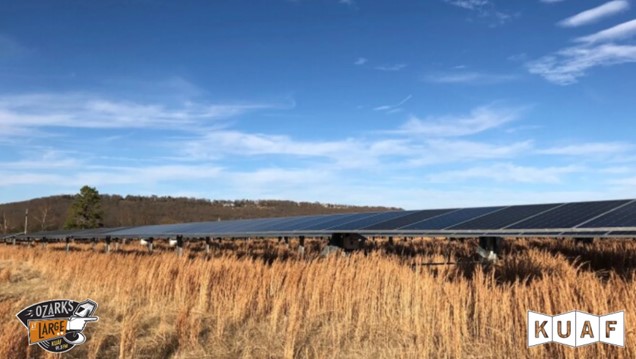
J .Froelich/KUAF
Melissa sent me an article reposted by the Northwest Arkansas Audubon Society describing a project in a local solar field. The 5-megawatt grid-tied 20-acre solar array was installed four years ago by Today’s Power, Inc., in partnership with Ozarks Electric Cooperative on turf grass pasture owned by the city of Fayetteville. Turf grass refers to the sod generally used in lawns and is often comprised of tall (Festuca spp.) and fine fescues (Festuca rubra, Festuca ovina, and Festuca trichophylla) or Bermuda grass (Cynodon dactylon). As Isaac Ogle, who specializes in solar grounds maintenance, walked the solar field he found waist-high broomsedge bluestem. Ogle’s maintenance company has a goal to plant low growing native plant species under the arrays and knew once the broomsedge was coming up there was no way to get rid of it. Instead, they embraced it and the native broomsedge has completely overtaken the non-native grass. Ogle said that compared to turf grass, native grasses on solar fields can boost power generation and provide natural habitat for native creatures.
When I went online, I found broomsedge bluestem (Andropogon virginicus) is a species of grass also known as yellowsedge bluestem and whiskey grass in Australia. Broomsedge is native to southeastern US and as far north as the Great Lakes. Broomsedge is a perennial grass forming narrow clumps of stems growing to around 3 feet 3 inches (just under a meter) in height. Its stems and leaves are green when new, then turn purplish to orange and finally straw-colored with age. The species produces large amounts of seeds small enough to disperse on the wind. It is an introduced species in California and Hawaii and is an introduced invasive species in Japan and Australia where it takes over pastures and grazing ranges and is less palatable and nutritious to cattle than other grasses. The grass is successful in a wide range of habitats as it is a prolific seed producer, has a high germination rate and seedling survival rate, and it thrives in poor soils. The Australian name comes from it being used as packaging for bottles of American whiskey, while the common name comes from use of the straw base to produce handmade brooms in the southeastern US.
Jennifer Ogle is Collections Manager at the University of Arkansas Herbarium, which documents the diversity and distribution of Arkansas plants. She said native grasslands (like broomsedge) also provide benefits to large-scale solar system ecosystems. Native grasses and wildflowers occupy much more of the soil profile and can grow up to 4 feet (1.2 m) deep, providing better soil stabilization, less erosion, and better water quality. Using native plants on solar arrays also benefits pollinators. Turf grass does not attract pollinators, but a diversity of native wildflowers and grasses will. Insects also attract birds, reptiles, amphibians, small and even large mammals, and they use the native plants by eating the stems or seeds. J.D. Willson, a herpetology professor in the Department of Biological Sciences at the University of Arkansas, is part of a research grant examining large-scale solar array habitats. Willson praises solar development across the US over the past five years to reduce carbon emissions but creating biodiversity along with solar sites has tremendous potential, especially with grassland species.
Thoughts: One aspect of my job with the state of Utah was to monitor rehabilitation of mining and fossil fuel extraction sites to help find ways to mitigate the environmental destruction caused by the process. Audubon pointed out the solar sites not only produced a clean energy source, but novel maintenance of the solar field also enhances output and creates viable grassland ecosystems. The human thirst for energy can be achievable in a way that creates a win/win. We just need to think in terms that prioritize the environment along with energy production. Act for all. Change is coming and it starts with you.
 A travelers odyssey