
December 11, 2023
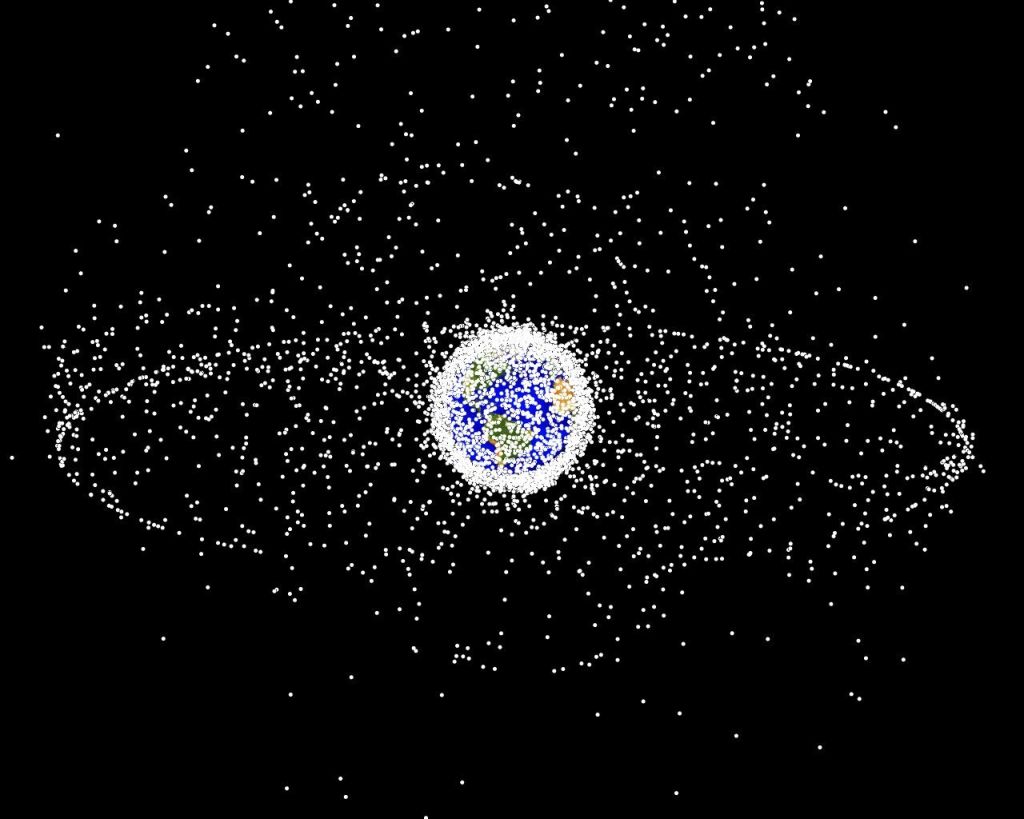
Nearly a month ago I came across an article in my local newspaper that reported an astronaut’s tool bag had been lost in space. The satchel-sized bag slipped away from two astronauts during a rare all female space walk on November 1 as they performed maintenance on the International Space Station (ISS). No word was issued on what the bag contained, but it was spotted by a Japanese astronomer as it floated over Mount Fuji. The bag is now catalogued as space junk and given the ID: 58229/1998-067WC. This is not even the first tool bag to be lost in space. In November 2008 another female astronaut lost her grip on a backpack sized tool kit while working on the Endeavor. The US$100,000 tool bag circled the Earth for four months before it plunged into the atmosphere and disintegrated. It is believed the current tool bag will have the same fate, but for now it is listed as space debris.
When I went online, I found Space debris (also known as space junk, space pollution, and space trash), are defunct human-made objects in space which no longer serve a useful function. These generally refer to items in Earth orbit and include derelict spacecraft, launch vehicle stages, mission-related debris, and fragmentation debris from the breakup of derelict rocket bodies and spacecraft, still in Earth orbit. Other examples include fragments from their disintegration, erosion, and collisions, paint flecks, solid liquids expelled from spacecraft, and unburned particles from solid rocket motors. As of November 2022, the US Space Surveillance Network reported 25,857 artificial objects in orbit above the Earth, including 5,465 operational satellites, and these are just objects large enough to be tracked. This September the European Space Agency estimated 11,000 tons of objects orbiting the Earth, with 36,500 debris pieces greater than 4 inches (10 cm). Collisions with debris have become a hazard to spacecraft and even the smallest objects cause damage (like sandblasting).
Space debris began to accumulate in Earth orbit with the first artificial satellite (Sputnik 1) launched in October 1957. The North American Aerospace Defense Command (NORAD) immediately began compiling a catalog of all known rocket launches and objects reaching orbit. The database became publicly available in the 1970’s. During the 1980’s NASA and others attempted to limit the growth of space debris. The ISS uses a type of spaced armor shielding (Whipple shielding) to protect its interior from minor debris, but exterior portions (and solar panels) cannot be easily protected. In 1989, the ISS panels were predicted to degrade approximately 0.23% in four years due to the “sandblasting” effect of impacts with small orbital debris. The ISS typically performs an avoidance maneuver if “there is a greater than one-in-10,000 chance of a debris strike”. There were 16 such maneuvers in the first 15 years the ISS had been in orbit. By 2019, over 1,400 meteoroid and orbital debris (MMOD) impacts had occurred.
Thoughts: Space debris is not only a problem on the exterior of the ISS but also on the inside. Today’s newspaper reported on the tomato that had gone missing in March of this year. Toward the end of astronaut Frank Rubio’s historic 371 days in orbit he lost a zip-lock bag containing a tomato from the ISS’s space harvest project. The crew jokingly accused Rubio of eating the fruit, but he was vindicated last Wednesday when they confessed the tomato had been found. The orbits of debris gradually degrade, and it enters the atmosphere, but not all of it disintegrates. The spacecraft cemetery (officially the South Pacific Ocean(ic) Uninhabited Area) east of New Zealand is where derelict spacecraft are routinely crashed. New processes for space debris removal are being developed to reduce the exponential growth of space debris orbiting earth, such as nets and magnetized collecting arms. It seems it is not enough to just pollute the land. We also spread our debris in space and the ocean. Act for all. Change is coming and it starts with you.
 A travelers odyssey