
December 18, 2023
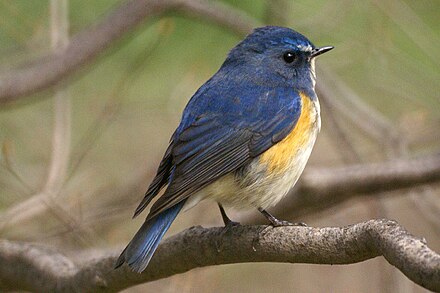
Tucked into the back section of my local newspaper was a USA Today article on the appearance of a new bird along the eastern coast of the US. The rare bird popped up in the feeders outside of birder Harry Riker’s house in Ocean County, New Jersey. Riker did not recognize the species, but took a photograph and had no luck finding it on his birding app. When he posted to his local bird watching community on Facebook one of the members identified the bird as a red-flanked bluetail. Cornell Lab of Ornithology says the birds are typically found in northern Europe and Asia. Only a few confirmed reports of the bird have been made within the US, and those were all in the western half of the country. Jenna Curtis, a bird expert for Cornell’s eBird.org website, confirmed Riker’s photographs marked “the first-ever confirmed red-flanked bluetail in the eastern US. . . The next nearest report was a bird in Laramie, Wyoming in November 2019.” Since the appearance of the bluetail outside of Riker’s house, bird lovers have flocked to his community from across the country to catch a glimpse.
When I went online, I found the red-flanked bluetail (Tarsiger cyanurus), also known as the orange-flanked bush-robin, is a small passerine (Order of perching birds) bird that was formerly classed as a member of the thrush family (Turdidae) but is now classified as an Old World flycatcher (Muscicapidae). The genus name (Tarsiger) is from Ancient Greek tarsos (“flat of the foot”) and Latin gerere (“to carry”). The species name (cyanurus) is derived from Greek kuanos (‘dark-blue”) and oura (“tail”). The small bird is from 5 to 5 1/2 inches (13–14 cm) long and .35 to .63 ounces (10–18 g) in weight, or just slightly smaller than the European robin (Erithacus rubecula). Both sexes have a blue tail and rump, and orange-red flanks, along with a white throat and greyish-white underparts. The adult male has additional dark blue upperparts, while females and immature males are plain brown above apart from the blue rump and tail and have dusky breasts. Bluetail are insectivores, flying from perch to perch and catching insects in the air or on the ground.
The red-flanked bluetail is a migratory species breeding in mixed coniferous forests with undergrowth in northern Asia and northeastern Europe, from Finland east across Siberia to Kamchatka, and south to Japan. It mainly winters in southeastern Asia, in the Indian Subcontinent, the Himalayas, Taiwan, and northern Indochina. The breeding range is slowly expanding westwards through Finland, and it is a rare but increasing vagrant to Great Britain. There have been a few sighted in North America, mostly in western Alaska as well as one on San Clemente Island off the southern California coast, even one overwintering on the Central California coast in Santa Cruz, California, in 2023. Sightings now include the one spotted in New Jersey this December. According to the American Birding Association, it may be impossible to determine which direction the bird in Rikers’ yard came from, “as the species is a rare but increasing vagrant to western Europe with several records now in Iceland, including two earlier this fall.” Apparently, this bird species likes to get around.
Thoughts: I was amused by Riker’s saying bird lovers are now flocking to his community to try and catch a glimpse of the rare red-flanked bluetail and are all over the neighborhood. “We’re all retired and we’re really enjoying it. … This is good excitement.” Over the holidays it is easy to get caught up in the hustle and bustle and forget to take time to step back and enjoy the changing season. Pleasure can be found most anywhere, from the birders watching the birds to the people watching the birders. Take time to enjoy your surroundings. Act for all. Change is coming and it starts with you.
 A travelers odyssey