
December 27, 2023
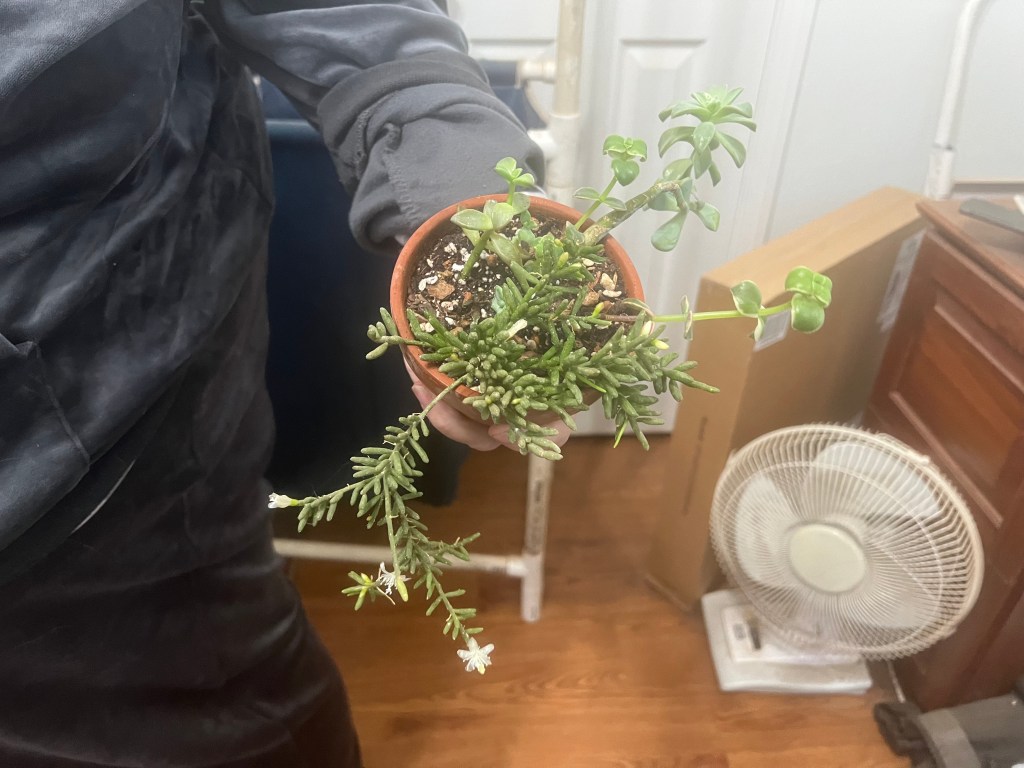
Melissa had taken a quick break from work and used the time to water a few of her winter growing cacti. I have mentioned the holiday cacti of the genus Schlumbergera are often referred to by the times they bloom (Christmas and Thanksgiving) while the Easter cactus (Rhipsalidopsis gaertneri) bloom later in the spring. She noticed another of her plants of the same tribe (Rhipsalideae) was also now in bloom and she brought it into my office to show it off. The flowering plant was small, so Melissa had used the pot to try and resuscitate several other “cuttings” (knocked off by activity) which were also beginning to take hold. Melissa told me the flowing plant was called a Mistletoe cactus as it resembles the Mistletoe plant (Phoradendron leucarpum) native to North America and blooms around the same time.
When I checked online, I found the mistletoe cactus (Rhipsalis baccifera) is an epiphytic cactus native to the rainforests and originates from Central and South America, the Caribbean, and Florida. Epiphytic plants grow upon another plant or object for physical support and derive their moisture and nutrients from the air, rain (or water for marine species), or debris accumulating around it. Mistletoe cactus is also found throughout the tropics of Africa and into Sri Lanka (known as “nawahandi”) and is the only species of cactus naturally occurring outside the Americas. One hypothesis is that the cactus was introduced to the Old World by migratory birds, and this occurred long enough ago for the Old World populations to be regarded as distinct subspecies. An alternative hypothesis is that the species crossed the Atlantic Ocean on European trading ships between South America and Africa and was then spread more widely by birds. The species shows considerable polymorphism and can be divided into numerous subspecies. Mesoamerican specimens usually have four homologous sets of chromosomes (tetraploid) and South American specimens have two homologous sets of chromosomes (diploid). The genera currently assigned to the tribe Rhipsalideae were subject to considerable confusion and disagreement prior to the clarification by Wilhelm Barthlott and Nigel Taylor in 1995.
Sophia Lee is a self-described cacti aficionado and extols the virtues of the Mistletoe cactus. Lee says the cactus is also known as the wickerwork cactus, small-seeded mistletoe, or spaghetti cactus, and each of these common names carry a unique story that hints at the distinctive characteristics of the plant. Rhipsalis Baccifera’s common name (Mistletoe cactus) reflects more than the small white flowers that resemble mistletoe berries. Like the mistletoe that people hang during the holidays, these cacti and their mistletoe-like white flowers “capture hearts and transcend boundaries”. Their delicate stems reach out like interconnecting lives and reflect the creation of a tapestry of relationships. Resilient yet tender, the Mistletoe cactus seems to whisper tales of unity and love, all in the language of botanical beauty. Lee goes on to say each subspecies of the cacti has their own allure. “For real cacti enthusiasts, the Rhipsalis genus is a treasure trove of wonder, a genuine nexus of botanical delight” that brings her to awe. While Lee’s description may seem a bit flowery or even anthropomorphic (reflecting human characteristics), like Melissa, she obviously enjoys her plants.
Thoughts: Both Lee and Melissa have mentioned they use the care and nurturing of their plants to relax and destress from the tedium of other work. Events like the blooms on the Holiday and Mistletoe cacti then become a bright spot to further enhance the experience. One of the downsides of retirement for many is that their “work” has defined who they are for the last 50 years. If we are unable to redefine who we are and reevaluate our self-worth based on that new image we can quickly sink into depression or worse. You are not defined by your job, or the labels given to you by others. We need to find our own self-worth and live it proudly. Act for all. Change is coming and it starts with you.
 A travelers odyssey