
December 29, 2023
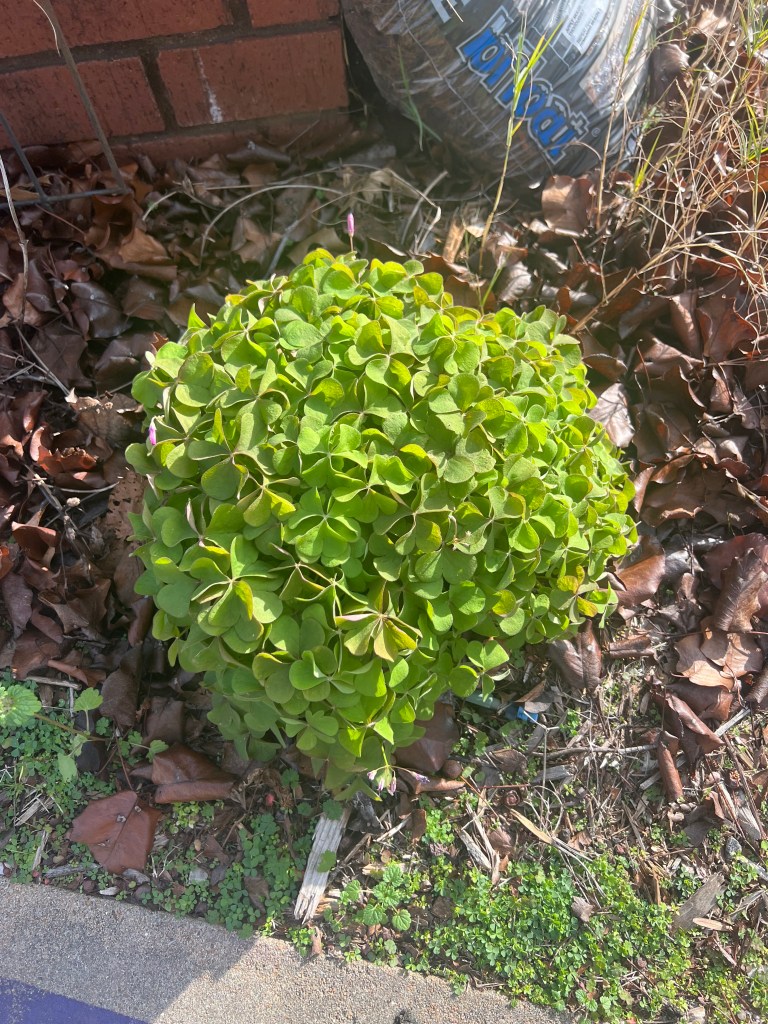
For the last five years we have lived in Arkansas I have been amazed by the resiliency of the clover-like plant that thrives in the mailbox flower bed. It seems to flourish early in the spring and then it blooms and dies back in the summer. I have considered this a weed and tend to rip out the dead foliage, only to be surprised when the plant returns in the fall. This year we had cold weather interspersed by unusually warm days in the 60+F (15.5+C) range and the plant has again grown into a bulbous circle of leaves. This morning I also noticed small pink flowers that were tightly closed. I assumed they had withered from the freezing cold we had last night but they still seemed viable. I finally realized this was neither clover nor a weed but something else. It was pink wood sorrel.
When I checked online, I found pink wood sorrel (Oxalis debilis) is a perennial deciduous plant and herb in the family Oxalidaceae. The plant is indigenous to South America, but it has become a cosmopolitan species that occurs in all continents except Antarctica. The species is also found in both temperate and tropical areas. Wood Sorrel grows from bulbs but has a modified subterranean plant stem that also sends out roots and shoots from its nodes (a rhizome). This creates a dense and mounded cluster that grows up to 1 foot (30 cm) tall. The flowers bloom once in the spring and again in the fall and may be partially concealed by the four leaved foliage that resembles large clover (genus Trifolium). The flowers and leaves both fold at night. The fruit is a dry capsule that contains projected seeds which have an elastic outer layer (integument). In Europe the plant is sterile and can only be propagated by bulbs. This is not well-loved in the UK, and the Royal Horticultural Society advises pink wood sorrel can be a weed.
Wood sorrel may go dormant in dry, hot summers (as mine frequently does) if it is not watered. The flowers, roots and leaves of wood sorrel are all edible, and the leaves have what many describe as “a zesty lemony flavor”. There is some concern that the plant should only be consumed in small amounts as the leaves contain oxalic acid that is classified as poisonous and can cause calcium deficiency if eaten in larger amounts. Recent studies have shown this fear is exaggerated as the effects are local and not systemic or internal. Sorrel is tolerant of full sun to partial shade and although it prefers moist, well-drained soil and while it will tolerate dry soil it will go dormant. It is almost impossible to kill sorrel and it is easily propagated by division of the bulb-like rhizomes in the fall or spring. Pink wood sorrel is commonly used as an indoor potted plant as well as a border perennial. It is well suited to my mailbox.
Thoughts: I am constantly intrigued by the change in attitude toward a plant or animal when I learn more about its nature. Over the last five years I basically ignored the pink wood sorrel that grew in the planter. It grew on its own without attention, so I mostly left it alone. Now I know this is a decorative herb that was purposely planted by my mother-in-law, and this gives the plant new meaning. Rather than a weed to be tolerated it is part of the ground cover that adds color to our yard during different times of the year. A similar effect happens when we take the time to learn about the nature of people we do not know and rarely interact with. We generally ignore them unless their actions force us to take notice. Our first response is often to get rid of them (or keep them from coming) because they are just “weeds” in our carefully tended lawn (country). Getting to know others as individuals rather than categories opens us to change our attitudes. Act for all. Change is coming and it starts with you.
 A travelers odyssey