
January 04, 2024
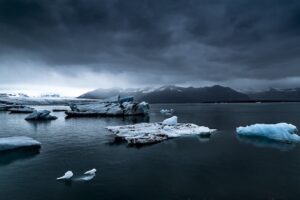
Just after Christmas my local newspaper carried a USA Today article on the arrival of the first humans in North America. Archaeologists have traditionally argued that people walked through an ice-free corridor that briefly opened between ice sheets an estimated 13,000 years ago (BP). Human arrival was a hotly debated topic when I studied archeology at the University of Utah 40 years ago, but a growing number of archeological and genetic finds suggests people made their way onto the continent much earlier. These early Americans likely traveled along the Pacific coastline from Beringia, the land bridge between Asia and North America that emerged during the last glacial maximum when ice sheets bound up large amounts of water causing sea levels to fall. Research presented by Summer Praetorius at the American Geophysical Union Annual Meeting (AGU23) in San Franciso on December 15th said paleoclimate reconstructions of the Pacific Northwest hint that sea ice may have been one way for people to move south.
The idea that early Americans may have traveled along the Pacific Coast is not new. People were likely south of the massive ice sheets that covered much of the continent by at least 16,000 years ago, and then there are the human footprints in New Mexico dated to around 23,000 BP. Since the ice-free corridor would not be open for another thousands of years for these arrivals, scientists proposed people may have moved along a “kelp highway”. This theory holds early Americans slowly traveled down into North America in boats while following the bountiful goods found in coastal waters. This theory is supported by archeological evidence of coastal settlements in western Canada dating from as early as 14,000 BP. However, in 2020 researchers noted that freshwater from melting glaciers may have created a strong current that would have made it difficult for people to travel along the coast. Praetorius and her colleagues looked at tiny, fossilized plankton in ocean sediment from the coast to determine ocean conditions. The abundance and chemistry of these organisms help reconstruct ocean temperatures, salinity, and sea ice cover.
Praetorious and her team also used climate models and found that ocean currents were more than twice the strength they are today during the height of the last glacial maximum (20,000 BP) due to glacial winds and lower sea levels. Paddling a boat against these currents would have been very difficult. The records also showed that much of the area was home to winter sea ice until around 15,000 BP. As a cold-adapted people, “rather than having to paddle against this horrible glacial current, maybe they were using the sea ice as a platform”. The climate data suggests conditions along the coastal route may have been conducive to migration between 24,500 BP to 22,000 BP and 16,400 BP to 14,800 BP, possibly aided by the winter sea ice. Most of the archeological sites associated with this migration are underwater, but the theory provides a new framework for understanding how humans may have arrived in North America. This theory is not exclusive to other means of human migration. Praetorious said, “We will always be surprised by ancient human ingenuity.”
THOUGHTS: The surprise in ancient human ingenuity by Praetorious can only be matched by that of humans in general. Humans as a collective consider, invent, and test innovative ideas to solve challenges and answer questions. It is how we both create and transform society. Human ingenuity also considers the consequences of our collective actions and how our decisions today will impact future generations. This worked to get around/through the glacial ice. This could also work to get around/through the issues of climate change. Act for all. Change is coming and it starts with you.
 A travelers odyssey