
January 05, 2024
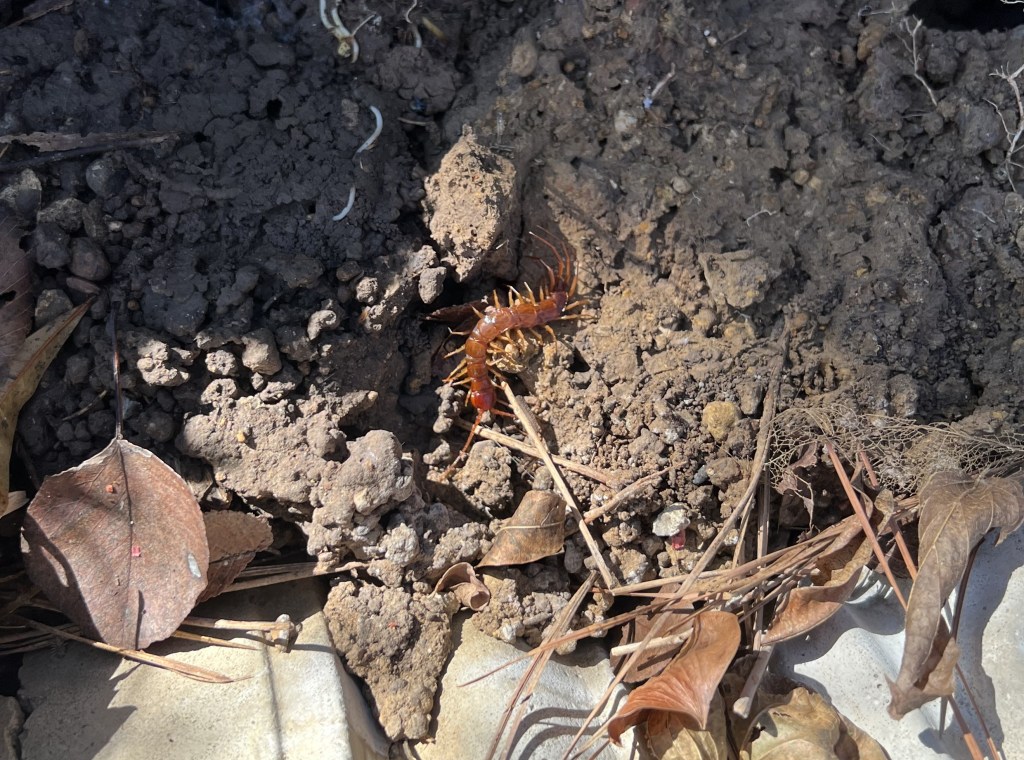
Melissa and I have been talking about installing a chain link fence along our back property line to provide more room for the dogs to play. Melissa prefers a chain link fence over cedar slats as they are open and allow her to watch traffic around the neighborhood while she works. We hired a contractor, and they came out this week to start the project. The first step was to trim the brush back from along the back fence. As the brush was being cleared, I noticed a broken bird bath that had been disposed of in the tree line. While the pedestal was clearly broken, I thought I might be able to salvage the basin. When I tried to move the basin, I was surprised at how heavy it was. Using all my effort I was able to dislodge the basin from the soil and lift it to its side. As I lifted the basin, a reddish-orange centipede scattered across the exposed ground to escape exposure to the sun.
When I went online, I found a centipede is an order of predatory arthropods belonging to the class Chilopoda. The name comes from the Neo-Latin “centi” (hundred), and Latin “pes or pedis” (foot). They are from the subphylum Myriapoda, an arthropod group which includes millipedes and other multi-legged animals. Centipedes are elongated segmented (metameric) creatures with one pair of legs per body segment. All centipedes are venomous and can inflict painful stings, injecting their venom through pincer-like appendages known as forcipules (toxicognaths), which are modified legs rather than fangs. No centipede has exactly 100 pairs of legs. Instead, the pairs range from 15 to 191 pairs, and there is always an odd number (mine had 17 pairs). Centipedes are generalist carnivores and hunt any prey that can be overpowered and eaten. They have a wide geographical range and can be found in terrestrial habitats from tropical rainforests to deserts. Whatever habitat, they require a microhabitat that is moist as they lack the waxy cuticle of other insects and arachnids and will rapidly lose water. Centipedes avoid direct sunlight by staying under cover or by being active at night.
The first year we moved back to Arkansas I decided to trim several of the tree branches that were scraping the car as I pulled into our drive. After pruning the small limbs, I asked Melissa what I should do with them, and she told me they had always put these trimmings in the tree row along the back fence line. I continued this practice for the next three years as the trimmings piled up. Last year my neighbor cut down several wind damaged trees and severely pruned back three others. I noticed he cut the limbs into 4-foot (1.2 m) lengths and then piled them up along the curb, but out of the gutter. When I asked him about this, he informed me the city trash picked the limbs up on the first Monday of the month. Melissa, her dad, and now I had been needlessly hauling the debris to the back of the yard. I am now hauling my limb trimmings and yards debris out to the curb, and the contractor removed what had accumulated over the last 25 years. We had created the perfect hideout for a centipede.
THOUGHTS: I found out while I was writing my blog that Melissa had known about the city trash pickup all along. Even knowing, she was trying to create a compost pile. Limbs, leaves, old bulbs, and grass clippings had all been dumped in the tree line. Had I known this, I would have been using the tree lines in a different manner. There was never enough debris (or purposeful care) to create any compost, but there was enough to create a moist hideout for the centipede. By avoiding sunlight and injecting their victims through their fang like legs, centipedes remind me of the tales of Dracula. Our care for the earth cannot be haphazard. A centipede may be able to survive on a decimated earth, humans not so much. Act for all. Change is coming and it starts with you.
 A travelers odyssey