
January 06, 2024
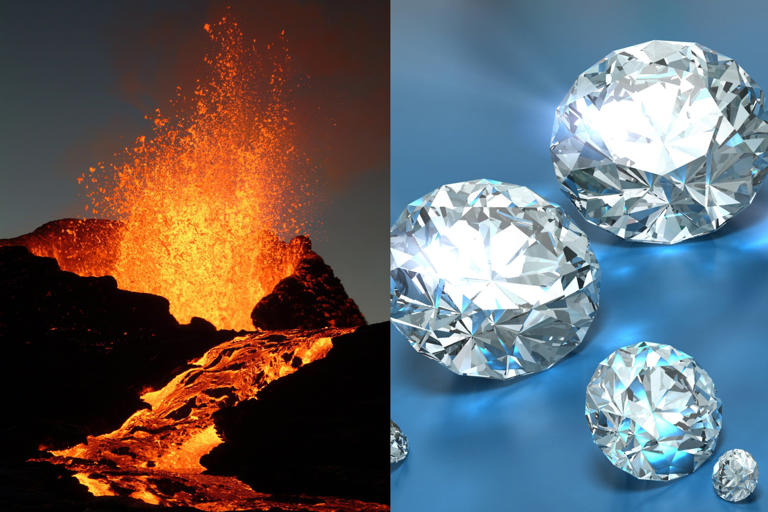
Trending news on Microsoft Bing this week reported how diamonds fall from the sky during volcanic eruptions. These “fountains of diamonds” could be sent shooting up to the surface of the Earth as part of a major geological event. The breakup of supercontinents brings the diamonds up from deep in the earth’s core according to research by Thomas Gernon, professor of Earth and climate science at the University of Southampton, UK. The pulling apart of the tectonic plates leads to rock from the upper mantle and lower crust to mix and flow against each other, causing instability and leading to eruptions. The plate activity also leads to rock, water, and carbon dioxide combining with minerals (diamonds) which all mix together to create explosive rushes towards the Earth’s surface. Gernon hopes the work could help in the search for unexplored diamond deposits. These fountains of diamonds can erupt from the Earth’s center in explosive eruptions called kimberlites.
When I looked online, I found kimberlite is an igneous rock and a rare variant of peridotite that is commonly known to be the main host matrix for diamonds. The rock is named after the town of Kimberley, South Africa. The discovery of an 83.5 carat (16.70 g) diamond called the Star of South Africa in 1869 spawned a diamond rush and the digging of the open pit mine called the Big Hole. Kimberlite occurs in the Earth’s crust in vertical structures known as kimberlite pipes, in igneous dikes, and as horizontal sills. Kimberlite pipes are the most important source of mined diamonds today. The consensus about kimberlites is they are formed deep within the mantle at depths between 93 to 280 miles (150 to 450 km), potentially from anomalously enriched exotic mantle compositions. They erupt rapidly and violently and are often accompanied with considerable carbon dioxide and other volatile components. It is this depth of melting and generation that makes kimberlites prone to hosting diamond crystals.
Despite their relative rarity, kimberlites have attracted attention because they serve as a carrier of diamonds and garnet peridotite mantle rock fragments (country rock) that become enveloped in a larger rock during the latter’s development and solidification (xenoliths) to the Earth’s surface. Diamonds form at around 93 miles (150 kilometers) down in the Earth’s crust and are brought up to the surface very quickly in these eruptions. Kimberlite eruptions can travel up to 82.6 miles (133 km) per hour and create enormous explosions on the surface, according to research published in Nature. Gernon and his team looked at these kimberlites and their research found that eruptions regularly take place around 22 million to 30 million years after the plates begin to pull apart. One of the cases pointed to in their research came around 25 million years after the supercontinent Gondwana began breaking up in what is now Africa and South America. According to Gernon, “The diamonds have been sat at the base of the continents for hundreds of millions or even billions of years. There must be some stimulus that just drives them suddenly because these eruptions . . . are powerful”.
THOUGHTS: Gernon likened the kimberlite eruptions to shaking up a soda bottle. For some kids (not me, of course) it was a funny joke to shake up a bottle of soda and leave it for an unsuspecting person. Carbonated drinks are made by forcing carbon gas (CO2) into a beverage under pressure. Opening the bottle results in fizzing as the pressure that has kept the carbon dissolved is released. The pressure found deep beneath the earth results in the formation of diamonds and the kimberlite eruptions. I would rather find diamonds than be sprayed by soda. Act for all. Change is coming and it starts with you.
 A travelers odyssey