
January 11, 2024
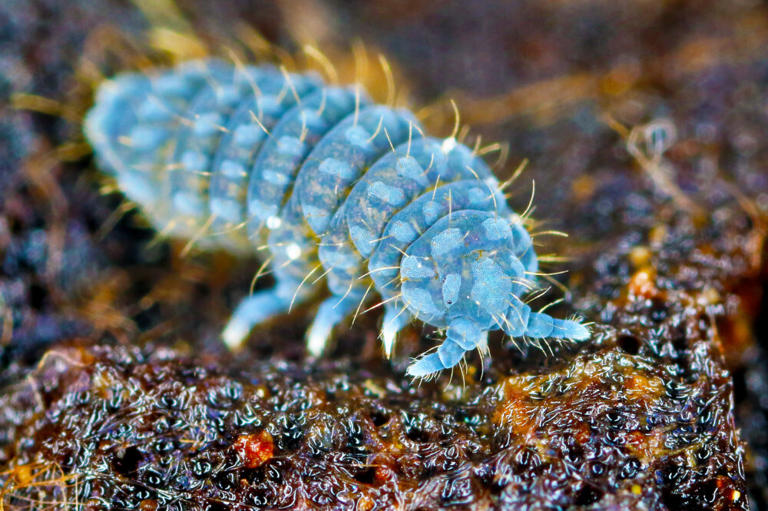
Hidden deep down in my browser I came across a story about a class of tiny creatures that survived the transition that occurred at the end of the Ordovician period around 450 million years ago. The hot and humid environment that had allowed life to flourish changed as the land masses began to freeze and a vast ice cap expanded across the surface. Over a brief span the Earth saw its second-worst mass extinction event as half of all known species perished. However, the springtails survived. Over 9,000 species of springtails have been identified, and their habitats range from the soils of backyards to the foliage of dense forests. The class gets their name from a forked tail (furcula) located on the fourth abdominal segment and folded beneath the body. When released, the tail snaps against the substrate in as little as 18 milliseconds and allows them to jump (spring) up to 4 inches (10 cm) high when threatened, allowing for rapid evasion and travel.
When I looked online, I found Springtails (Collembola) form the largest of the three lineages of modern hexapods no longer considered insects (the other two are the Protura and Diplura). The three orders are sometimes grouped together in class Entognatha as all have internal mouthparts, but they are no more closely related to each other than they are to their previous class Insecta, which have external mouthparts. The word Collembola is from the ancient Greek kólla (glue) and émbolos (peg). Springtails are normally less than 0.24 inches (6 mm) long, have six or fewer abdominal segments, and possess a tubular appendage (collophore) with reversible, sticky vesicles, projecting ventrally from the first abdominal segment. The appendage is the reason for the common name and was previously thought to stick to surfaces to stabilize the creature. Current scientific consensus is that this structure plays a role in water intake and excretion (osmoregulation). Springtails are omnivorous (eat animal and vegetable mater), free-living organisms that prefer moist conditions.
Springtails have another impressive adaptation. Researchers from Aarhus University and Queen’s University in Canada suggests that the springtails may have been the first animal to ever produce antifreeze proteins. Prior to this discovery, the scientific consensus was that animals did not develop this ability until much later. “We knew that antifreeze proteins had developed independently of each other several times during evolutionary history. Fish have them. Insects have them. Some spiders have them. But until we saw these results, we didn’t know that they’d developed so early in the animal world,” says Martin Holmstrup of the Department of Ecoscience at Aarhus University. The gene mutation leading to antifreeze protein genesis for the springtails occurred during the Ordovician period. Another survival adaptation is that springtails protect their cells from freezing by drying out completely, much like a freeze-dried raisin, and their metabolism drops to near-undetectable levels. In spring they absorb water and swell back to normal size, good as new.
THOUGHTS: The springtails were not the only species to emerge during this period, which spanned from 485 to 443 million years ago. The Ordovician experienced an explosion in marine life as trilobites, brachiopods, graptolites, and nautiloids dominated the oceans. This period also gave rise to the first fish and corals begin constructing the first reef systems that laid the foundation for today’s marine ecosystem. The world’s continents also transformed during the Ordovician and by the end of the period evidence of life on land began to emerge with non-vascular plants (bryophytes) taking root on shore. The antifreeze proteins of springtails continue to be researched and reaches beyond our understanding of evolutionary survival. The food industry (particularly the frozen sector) has taken a keen interest. Humans still have much to learn from the myriad of tiny creatures that thrive around us. Act for all. Change is coming and it starts with you.
 A travelers odyssey
Very interesting and informative, thank you.
LikeLike