
January 25, 2024
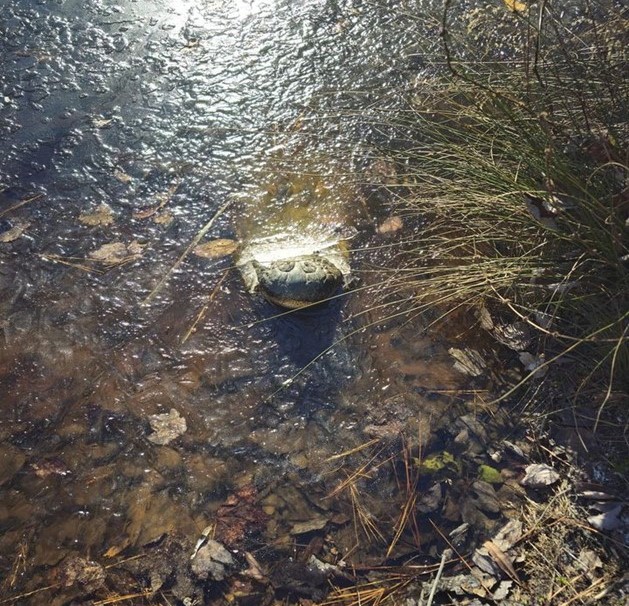
Hidden inside the back section of my local newspaper was a USA Today article about alligators found frozen in the ice. The photos and videos of frozen alligators are coming from North Carolina and Texas and are going viral on social media. The images show the frozen alligators with their snouts and mouths sticking out of the ice. While this may seem alarming, the reptiles are not dead but are instead practicing a survival instinct. As temperatures in the South have dropped over the last few days, the alligators rely on this adaptation. Since the temperatures rarely drop below freezing (32F/0C) long enough to freeze the lakes and ponds where the alligators live, the sight of frozen alligators is rarely seen. The astonishing image of the frozen alligators is thanks to an adaptation technique known as brumation.
When I went online, I found that while mammals go into hibernation, reptiles go into brumation. Both are a type of dormancy or a period in an organism’s life cycle when growth, development, and (in animals) physical activity are temporarily stopped. While warm-blooded animals (endotherms) and animals that vary between self-regulating body temperature and allowing the surrounding environment to affect it (heterotherms) are described scientifically as hibernating, the way cold-blooded animals (ectotherms) like alligators (Alligator mississippiensis) become dormant is different. The word brumation was coined in the 1920’s to explain this as a very different metabolic process than hibernation. In colder climes reptiles generally begin brumation in late autumn (times depend on the species). They wake up to drink water and then return to their dormant state and can go without food for months. Reptiles may eat more than usual before the brumation time but eat less or refuse food as the temperature drops. The brumation period is anywhere from one to eight months depending on the air temperature and the size, age, and health of the reptile. Like hibernation, brumation is triggered by a lack of heat and a decrease in the hours of daylight in winter.
The alligators in North Carolina and Texas are entering brumation to survive the cold snap. They suspend their bodies in pond water and let it freeze solid around them. Their snouts and front teeth poke through the ice and allow the alligators to breathe while they wait for the water to thaw. The frozen alligators were found suspended in ice at Swamp Park, a tourist attraction and alligator sanctuary near Ocean Isle Beach, North Carolina. Another alligator was spotted suspended in an icy pond at the Gator Country rescue center in Beaumont, Texas. An employee of the Swamp Park & Outdoor Center, located about 45 miles south of Wilmington, North Carolina, explained that when it gets too cold, alligators “will instinctively tilt their nose up, to the point where it’s out of the water, so they don’t just suffocate. We literally have ‘gatorcicles’ right now.”
THOUGHTS: When Melissa and I attended the final week of Mardis Gras (a bucket-list) several years ago we were tempted to take one of the Airboat Swamp Tours that are popular around New Orleans. While it was not freezing, the temperatures were cold and there was intermittent rain for our whole trip. We decided not to get on the water. Instead, we went to Avery Island which is known as the source of Tabasco sauce (another bucket-list). The island is also home to a salt mine, a vast collection of exotic plants, and a bird sanctuary. Several locations along the tour route were ponds containing alligators, but they were apparently in brumation, and we never saw one. We did meet a lady who had just taken a Swamp Tour, and she said they never saw alligators either. The gardens and sanctuary were amazing, but the cold made me wonder if the alligators in brumation may have had the right idea. Act for all. Change is coming and it starts with you.
 A travelers odyssey