
January 27, 2024
I have been getting notifications from my gardening sites that January is the time to get your seeds started indoors so they will be ready to transplant after the last frost in mid-April (zone 7). That has caused me to pour over my seeds and YouTube sites to determine what I am going to plant. I have watched videos on the 10 best vegetables to plant in hot weather, the ten best vegetables to plant in cold weather, the 20 hardiest vegetables, and the best vegetables to plant if you are in a survival situation. Since I am trying to build my garden to subsistence agriculture this includes me (the survival sites noted we are all in a survival situation). I gleaned what I could from all the sites and came up with a good idea of what I would like to plant this year. All the sites said you could use combinations of plants by growing things like carrots and onions as filler crops beneath taller plants. Another plant combination I came across was called the “three sisters”.
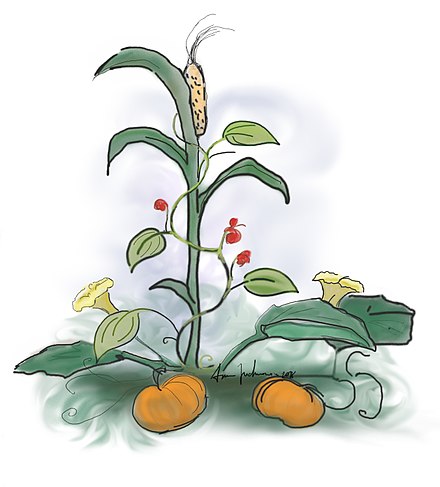
When I went online, I found the Three Sisters are the main agricultural crops of various indigenous peoples of Central and North America and include maize/corn (Zea mays), pole beans (Phaseolus vulgaris), and squash (genus, Cucurbita). Using a technique known as companion planting, the maize and beans were planted together in mounds formed by hilling soil around the base of the plants, and squash is planted between the mounds. This allows the cornstalk to serve as a trellis for climbing beans. The beans then fix nitrogen in their root nodules and stabilize the maize in high winds. The wide leaves of the squash plant shade the ground, keeping the soil moist and helping prevent weeds. The Farmer’s Almanac notes this was the practice favored by the Iroquois for centuries before the European settlers arrived in the 1600’s. The Almanac also says according to legend, “the plants were a gift from the gods, always to be grown together, eaten together, and celebrated together.”
Cornell University offers guidelines for raising the three sisters. Plant the corn when the ground has warmed and is no longer cold and wet (Iroquois tradition holds to plant when the dogwood leaves are the size of a squirrel’s ear). Soak corn seeds for several hours, but not more than eight hours, before planting and keep them well watered for the first weeks if the soil is not kept moist by rain. Prepare low hills that are 3 to 4 feet (0.9 to 1.2 m) apart within and between the rows and place five to seven corn seeds, evenly spaced to a depth of 1 to 1-1/2 inches (2.5 to 3.75 cm) and cover with soil. You can plant any of the corn varieties, but dent, flint, and flour corns are especially suited to this system (I am trying sweet corn). If you follow the Iroquois tradition, you should plant the seeds with kind thoughts three days before the full moon. When the corn plants are about six inches (15 cm) high, plant pole beans and pumpkins (the Iroquois used winter squash) or other summer squash around them. The “three sisters” seeds can be sowed during the spring or summer. I might try this in the front bed where I intended to plant black oil sunflower (Helianthus annuus) for the birds.
THOUGHTS: I first heard of the three sisters when I was studying archeology at the University of Utah. The Anasazi who lived in the four corners (the states of New Mexico, Colorado, Utah, and Arizona all meet) area of the southwest grew a popcorn variety of maize until more productive varieties of the three sisters were introduced from Mesoamerica and cultivated. Human’s have long used a combination of experimentation and borrowing to improve both food sources and technology, and this continues today. That means we rely on each other to survive, even if we sometimes fight. The trick is to have more cooperation than conflict. Act for all. Change is coming and it starts with you.
 A travelers odyssey