
February 08, 2024
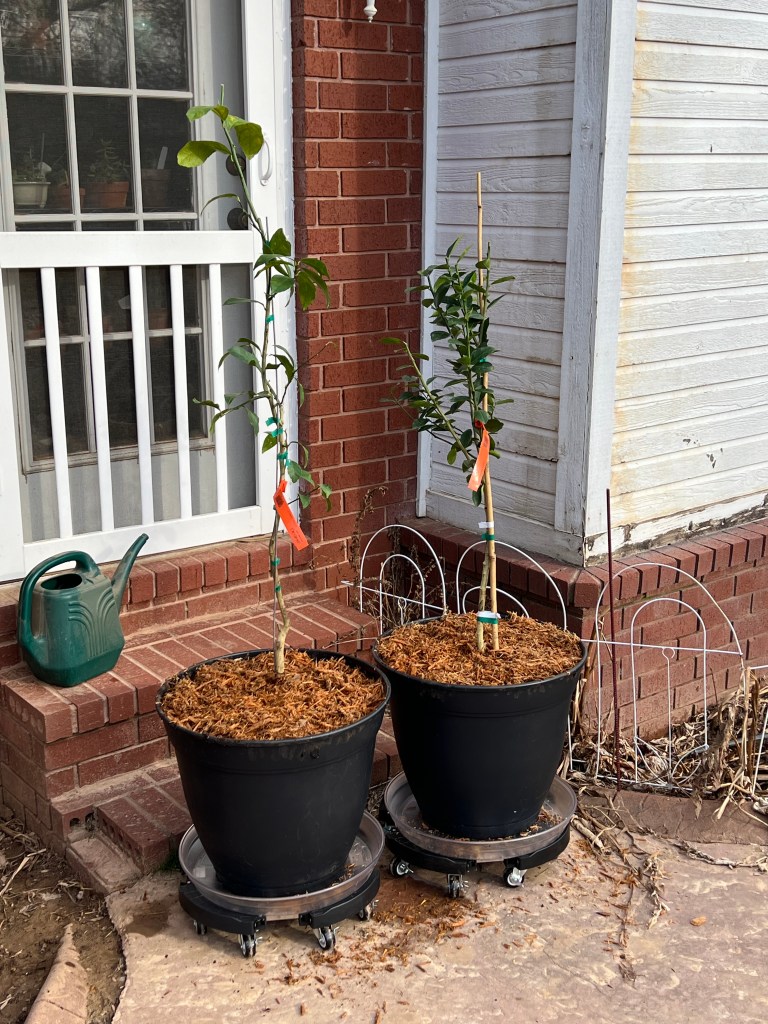
Getting my first seeds in the seed pots inspired me to plant several fruit trees as well. I first tried to find a nursery near me where I could purchase the trees and found it was too early in the year for them to be in stock. We are in growth zone 7 and our last frost is predicted for April 15. That means any local trees would still be dormant and may be problematic to plant and ensure they would survive. I am planting the trees in containers to allow me to bring them in at night when the temperatures drop much below freezing (28F/-2.2C) to protect the trees. That also means I needed to focus on dwarf trees that could be contained in pots set on heavy duty plant caddies. I ordered the plant caddies and got them put together over the weekend. I ordered the two trees from an online nursery. I had trouble ordering at first, as my virtual private network (VPN) is set to show trackers I live in an area which grows citrus, and the nursery would not ship the trees to that state. I got a work-around for that problem and ordered my two citrus trees. They arrived on Monday.
When I went online, I found citrus is a genus of flowering trees and shrubs in the rue family (Rutaceae). Plants in the genus produce citrus fruits, including important crops such as oranges, lemons, grapefruits, pomelos, and limes. The genus Citrus is native to South Asia, Southeast Asia, East Asia, Melanesia, and Australia and various species have been used and domesticated by the indigenous cultures since ancient times. Citrus cultivation spread into Micronesia and Polynesia from Taiwan by migration (the Austronesian expansion – c. 3000 to 1500 BCE). Citrus spread to the Middle East and Mediterranean (c. 1200 BCE) along the incense trade route, and from there to Europe and the Americas. While citrus trees can grow from seed, the most common method is grafting onto rootstocks. This is physically joining part of a shoot of a desired species onto the roots of a different but closely related species, so the two parts grow as one plant. Grafting is a preferred method because it propagates a new plant of the desired citrus but confers the extra advantages from the characteristics of the rootstocks, such as their vigor of growth, hardiness, and soil tolerance.
The citrus fruits I use most are lemons and limes, so these are the two trees I ordered. The nursery site had a single tree that had been grafted to produce both fruits from a single bush, but I decided to buy separate trees. I figured that if one died, I still might be able to save the other. I decided on a Meyer Lemon (Citrus meyeri) tree and a Key Lime (Citrus aurantiifolia) tree. I checked with the nursery’s Chat feature and was assured these were both dwarf varieties (6 to 8 feet/1.8 to 2.4 meters) and that I could keep them smaller by planting the trees in containers and pruning. I purchased the pots I needed locally after receiving the citrus trees and then researched how to plant the trees. A YouTube video suggested I put the root ball on compost, but I decided to use potting soil to avoid the possibility of burning the roots. I bought root starter and citrus kits (nutrients) from the nursery to augment growth. The nursery site suggests I might get “some fruit” in the first year. We will see.
THOUGHTS: Growing citrus trees is an iffy business where I live in Arkansas. Zone 7 is on the cusp of the growth range for outside trees as temperatures occasionally drop below 20F (-6.6C). We already have a ramp leading to the new windowed porch so the plant caddies should allow me to wheel the trees inside on bitter nights (if they do not get too big), or I could always get smudge pots to keep them warm. This is yet another experiment in sustainability. The more I try and provide for myself, the more it impresses me how most of the world does not get to “play” at sustainability. You grow or catch what you want (or can), or you do not eat. I still have the luxury of a supermarket. Act for all. Change is coming and it starts with you.
 A travelers odyssey