
February 20, 2024
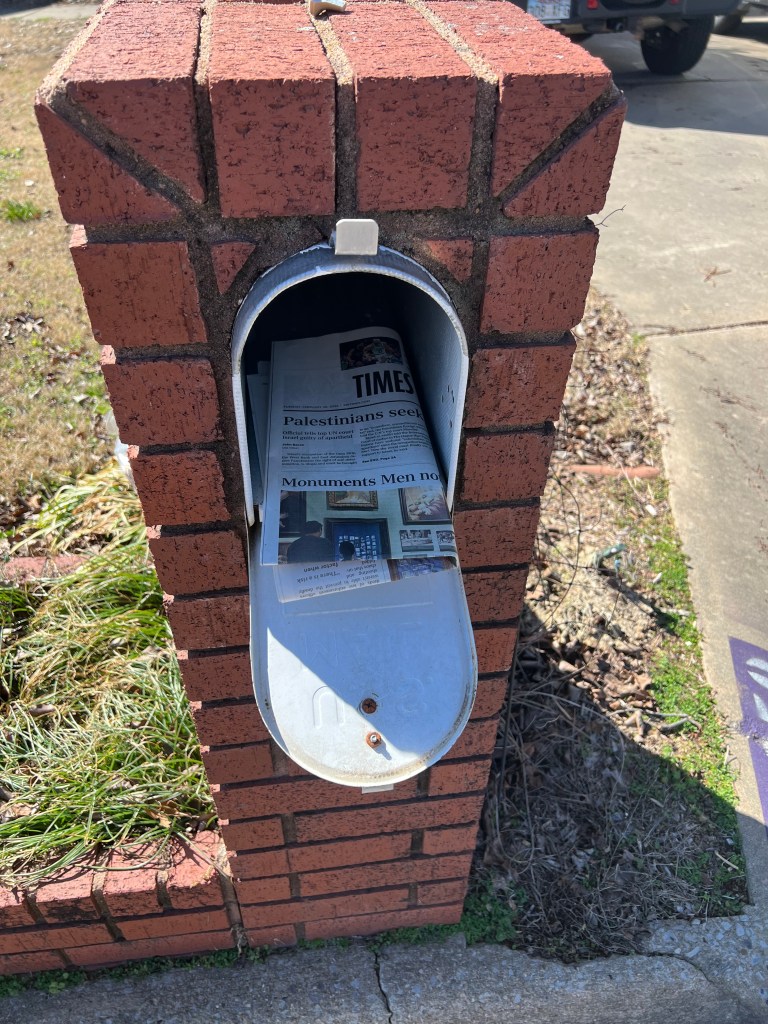
I have mentioned how my local newspaper has been cutting back on delivery. This began in earnest during the pandemic as the Saturday edition was stopped but the price was the same (shrinkflation). The next move came as Holiday editions were either not printed or came out the day before. This was disconcerting as I never knew if the paper was not printed, or my carrier had not delivered the paper. I eventually found the front page would carry a disclaimer (in small print at the bottom) explaining when the paper would not be delivered. Correspondence from the newspaper office suggested I could still receive the paper (including the Saturday edition) online and tried to convince me to switch to this reduced priced edition. When I finally switched to online only, the carrier continued to deliver the hard copy edition to my driveway. Last week the publishers decided to forego carriers and have the newspaper delivered by the US Postal Service.
When I went online, I found switching newspaper delivery from costly carriers to the US Postal Service is becoming the norm as the decline of print journalism has left publishers with fewer ways to cut costs. Newspapers have been delivered by mail in the US for centuries. The earliest second-class mail began in colonial times, and many weekly newspapers have relied on the postal service for their entire existence. Many small dailies in rural areas switched to mail delivery after the financial crisis of 2007-08. For major metro dailies it is not uncommon to provide postal delivery for readers outside primary circulation areas. Gannett, the nation’s largest newspaper publisher, makes all 400-plus of its titles available for postal delivery, primarily for readers who relocate but want to maintain connections to their previous communities. Some newspaper executives who have relied on postal delivery for decades wonder why the change is taking so long. “It’s high-quality delivery at predictable times,” said Tim Price, senior vice president at Boone Newsmedia Inc. “If our primary goal is to get the printed product in the hands of the readers, we can do that with the post office.”
One of the problems with receiving your printed copy of the newspaper by mail is it no longer covers breaking news. Tim Franklin, senior associate dean at the Medill School of Journalism, Media at Northwestern University, said he expects more local news organizations to at least explore a moving to postal delivery, “because the potential cost savings are huge, and it eliminates the headache of carrier turnover”. This also raises an existential question of what a printed newspaper should be in the digital era. “What’s breaking news at press time may be old news by the time it hits the mailbox. So, the printed newspaper needs to be relevant in other ways.” That means feature stories that are in-depth, contextual, and personal. I have read print newspapers are primarily read by Boomers like me who like the tactile feel of paper. Whether the publication is delivered via carrier, postal, or digital means in depth coverage of relevant local events is what keeps me a subscriber.
THOUGHTS: My two brothers and I cut our respective teeth in the business world becoming newspaper carriers when we were in Grade School. While our small town did not have a daily paper, the Big Town in our mostly rural area of Kansas distributed one. My older brother got the job of delivering 100+ newspapers to our community of 600 and subbed out smaller routes to my younger brother and me (I later learned these were the parts of town he did not like delivering to). In my lifetime the walking paperboy has shifted to adults in cars traversing wide areas. The shift to postal delivery eliminates the job of carrier which often supplied a secondary income. A technological shift is always accompanied by the loss of one job and the creation of many others. We cannot bemoan the past, but rather adapt for the future. Act for all. Change is coming and it starts with you.
 A travelers odyssey