
February 24, 2024
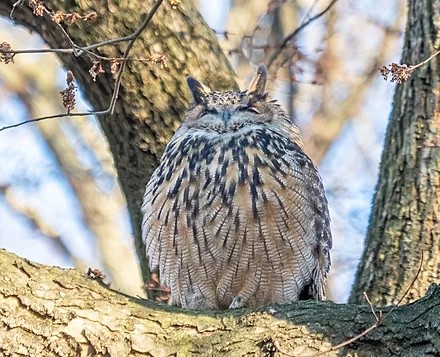
My NY Times feed shared the sad news that Falco, the Eurasian eagle-owl that I blogged about earlier this month died Friday night after apparently striking a building on the Upper West Side in New York City (NYC). The Wildlife Conservation Society, which operates the zoo that had housed Falco, said the owl had been found on the ground after apparently hitting a building on West 89th Street. Building residents contacted a rescue organization who retrieved him and declared him dead a short time later. Zoo employees took him to the Bronx Zoo, where a necropsy will be performed to determine the cause of death. Flaco had escaped when vandals shredded his mesh enclosure in February 2023 and spent his last year as a free bird. One sad aspect of the freedom Flaco obtained was as a nonnative species he was destined to never find a mate. Still, he could be heard hooting into the post-midnight darkness to establish his territory and declare his interest in breeding. Flaco’s last reported hoots were heard from a water tower on West 86th Street at 3 am last Sunday. On Friday, Flaco was found just a few blocks away.
When I looked online, I found Eurasian eagle-owls (Bubo bubo) like Flaco are strictly territorial and will defend their territories year around, but territorial calling appears to peak from October to early January. Territory size averages 5.8 to 30.9 miles2 (15 to 80 km2). Territories are established by the male who selects the highest points in the territory to sing, allowing their song to be heard at great distances. Nearly as important in territorial behavior as vocalization is the white throat patch. When stuffed specimens with flared white throats were placed near an owl’s territory, males reacted quite strongly and often attacked the stuffed owl, while reacting more mildly to a stuffed owl with a non-flared white throat. In January and February, the primary function for vocalization is courtship. Eagle-owls often pair for life but usually engage in courtship rituals annually, most likely to re-affirm pair bonds.
After his escape, Flaco settled in Central Park but around Halloween began to venture into the city and embarked on a tour of Manhattan where he would turn up on the terraces and air-conditioners that resembled the cliff ledges Eurasian eagle-owls are accustomed to. He would spend the day sleeping out of the wind and then fly out at dusk to hunt. Each day Flaco spent outside his zoo enclosure was risky. Striking a building, especially a window, could have (and finally did) proved lethal. Flaco also faced threats from the rodenticide in the rats that he ate, and a fatal collision with a vehicle. He was able to avoid vehicles by sticking mostly to rooftops, water towers, and other elevated elements of his new environment. The risk of being killed by a building strike was serious. The National Audubon Society says as many as 230,000 birds a year die in New York City from window strikes. This is especially hazardous at night when lights illuminate indoor vegetation and can confuse birds who navigate by starlight. While Flaco never found a mate, he may have been defending his territory against his own reflection in a window.
THOUGHTS: Flaco caused concern for a variety of reasons when he escaped. Flaco had hatched in North Carolina and had never lived outside of his small enclosure prior to his escape. Some worried he would not be able to feed himself or even know how to fly. Instinct quickly took over and he fed on the numerous rats which also call NYC home. Others feared the owl might feed on native bird populations. Attempts to recapture him proved futile and were finally abandoned. Flaco appeared to do well in his foreign environment, even if only for one year. It may have been the best year of his life. While we cannot gauge the thoughts of Flaco, living twice as long in captivity may have seemed more like an eternity. Act for all. Change is coming and it starts with you.
 A travelers odyssey