
March 1, 2024
From Astrobotic
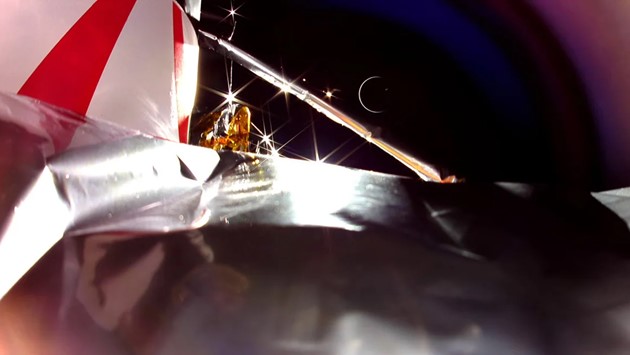
Inside the back section of today’s local newspaper was an article on questions raised by landing human remains on the moon. Peregrin I launched on January 8, 2024, and was set to be the first commercial lunar lander and the first US built lunar lander on the moon since Apollo 17 in 1972. Shortly after the lander separated from the Vulcan rocket a propellant leak developed that prevented completion of its mission. The spacecraft was redirected into Earth’s atmosphere after six days in orbit where it burned up over the Pacific Ocean on January 18th. Peregrin I was built by Astrobotic Technology and carried payloads for NASA’s Commercial Lunar Payload Services program. Other payloads included a library (microprint on nickel) with Wikipedia contents, Long Now Foundation’s Rosetta Project, and cremains space burial companies Elysium Space and Celestis paid Astrobotic to carry to the moon. The decision to include human remains was criticized by President Buu Nygren of the Navajo Nation, who said the Moon is sacred to the Navajo and other Indigenous peoples. The remains never made it to the moon, but they did spark controversy about appropriate burial.
When I looked online, I found burial (interment or inhumation) is a method of final disposition where a dead body is placed into the ground. This is usually accomplished by excavating a pit or trench, placing the deceased and objects, and covering it. Evidence suggests some archaic and early modern humans buried their dead, seen as a demonstration of respect. Burial has been used to prevent the odor of decay, to give family members closure, and to prevent witness of the decomposition of kin. Many cultures see burial as a necessary step for the dead to enter the afterlife or to give back to the cycle of life. Methods of burial may be heavily ritualized and include natural burial (“green burial”), embalming or mummification, and the use of containers (shrouds, coffins, grave liners, and burial vaults) to slow the decomposition of the body. Objects or grave goods may also be buried, and the body may be dressed in fancy or ceremonial garb. Depending on the culture, the way the body is positioned, and the associated grave goods may have great significance. There are alternatives to burial, like cremation, burial at sea, and cryopreservation (freezing).
Peregrin I’s attempt to use the lunar surface as a burial site is not the first. Eugene Shoemaker is still the only person whose remains have been sent to the Moon. Shoemaker enjoyed a celebrated career combining his discipline of geology with astronomical applications, helping to create the field of planetary science. Shoemaker studied craters on Earth, and founded the Astrogeology Research Program within the US Geological Survey in the early 1960’s. Shoemaker used his knowledge to train Apollo mission astronauts on what the terrain would be on the surface of the Moon. Shoemaker died on July 18, 1997, in a car crash while exploring a meteor crater in Australia. Carolyn Porco, a close colleague of Shoemaker’s, decided to try to get the ashes of the deceased scientist to the Moon. NASA liked the idea of honoring Shoemaker and called Celestis. On January 6, 1998, NASA’s Lunar Prospector blasted off for the south pole of the Moon, looking for ice and carrying an ounce of Shoemaker’s ashes. The mission ended when NASA deliberately crashed the craft on the surface of the moon on July 31, 1999, making him the first and only person to be buried on the moon.
THOUGHTS: Celestis has been helping people send their loved ones into space for over 20 years, with four different levels of burial. Earth Rise will launch into space and then return to earth starting at US$2,995. Earth Orbit launches into orbit around the earth starting at US$4,995. Luna launches to lunar orbit or the surface, and Voyager launches into deep space, both at US$12,995. Certificates and apparel are also available. As space exploration increases, burial customs will be one of the many traditions that will be challenged. Act for all. Change is coming and it starts with you.
 A travelers odyssey